
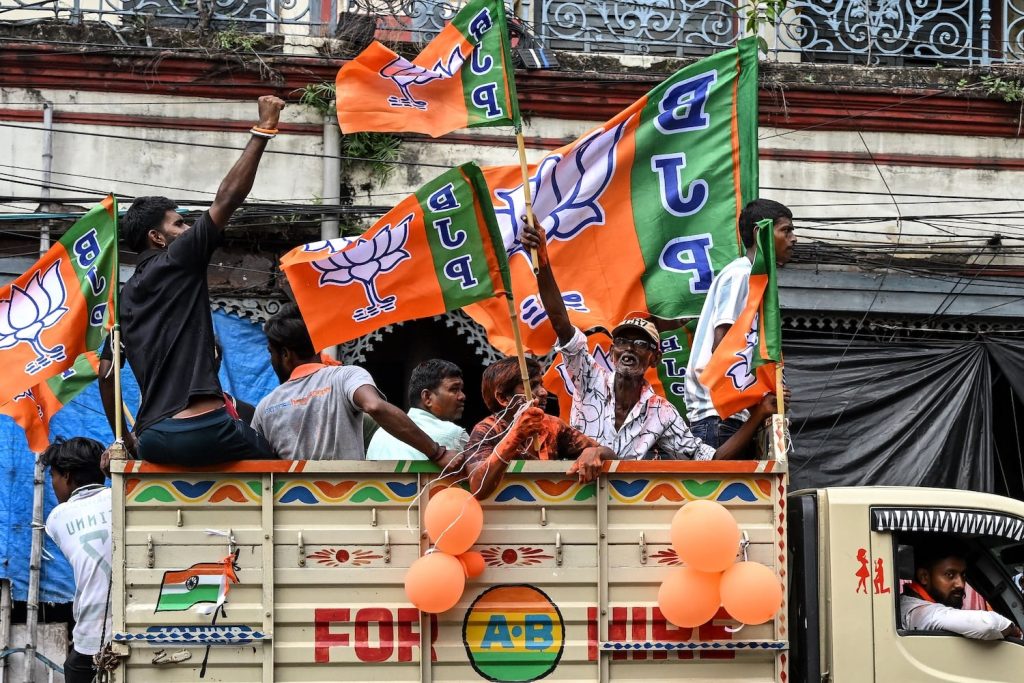
Last week, election results in the Indian state of West Bengal revealed the dramatic defeat of the All India Trinamool Congress (AITC) party, which ruled the state legislature for the past 15 years. The Hindu nationalist Bharatiya Janata Party, which leads India’s national government and controls 22 other states and union territories, finally breached this regional bastion.
Capturing nearly 46 percent of the vote to the AITC’s 41 percent, the BJP won 207 seats in the legislature while the AITC picked up 80. It also unseated longtime West Bengal Chief Minister Mamata Banerjee. So, what explains this stunning victory in the state, which prides itself on its subnational ethos?
Last week, election results in the Indian state of West Bengal revealed the dramatic defeat of the All India Trinamool Congress (AITC) party, which ruled the state legislature for the past 15 years. The Hindu nationalist Bharatiya Janata Party, which leads India’s national government and controls 22 other states and union territories, finally breached this regional bastion.
Capturing nearly 46 percent of the vote to the AITC’s 41 percent, the BJP won 207 seats in the legislature while the AITC picked up 80. It also unseated longtime West Bengal Chief Minister Mamata Banerjee. So, what explains this stunning victory in the state, which prides itself on its subnational ethos?
A combination of factors explains the BJP’s success. The AITC without a doubt faced anti-incumbency sentiment, in part owing to the fact that it failed to attract any significant economic investment in West Bengal during its years in power. Jobs in the state’s manufacturing sector paying decent wages stagnated in recent years. With few viable opportunities at home, many young people have moved from West Bengal to other parts of India seeking better prospects.
These factors certainly contributed to a disillusionment with Banerjee’s government—a disillusionment that had an electoral impact.
Among these other forces at work, the BJP played on fears about illegal immigration to West Bengal from neighboring Bangladesh and anxiety about that country’s recent political turmoil. After the ouster of former Bangladeshi Prime Minister Sheikh Hasina in 2024, there were a spate of attacks against the country’s Hindu population. The BJP highlighted these issues, helping the party to consolidate the Hindu vote. Though it is true that there is some illegal immigration from Bangladesh to West Bengal, its scope and impact are the subject of vigorous debate.
To put it bluntly, these scare tactics were relentless, which seemed to allow the BJP to overcome West Bengal’s long tradition of secularism. The party fastened onto another, related issue: the AITC’s reliance on Muslim voters to forge its electoral juggernaut in West Bengal. The state’s ruling party had pandered to some of the more dogmatic elements of the Muslim community. The BJP almost certainly won votes by focusing on this issue, framing the AITC as more anti-Hindu than pro-Muslim.
The BJP’s approach hinged on a historical legacy that lingered under the surface during the decade and a half of AITC leadership in West Bengal as well as the 34 years of Communist Party rule before that: the Hindu-Muslim divide that has haunted the state since the Partition of India. The BJP tugged at these underlying tensions in its campaign rhetoric.
Controversially, the BJP also deployed a novel tool during West Bengal’s state election: the Special Intensive Revision, a nationwide mechanism introduced in October and ostensibly designed to remove fraudulent voters from the electoral rolls.
In practice, enacting the Special Intensive Revision struck more than 9 million people from West Bengal’s electorate for lacking the requisite paperwork to prove their eligibility, most of them in constituencies that the BJP had never won. Experts say this disproportionately affected Muslim and minority voters; as many as 2.7 million people challenged their removals. Regardless, the sheer number of people taken off the voter list on the eve of the election raises profound questions about its fairness—even conceding that some names were rightfully removed.
Muslims comprise 27 percent of West Bengal’s population, and most of them are poor—making them an easy target. Many of India’s poor do not have birth certificates and lack other viable means of identification, such as passports. Opposition leaders and many political analysts have contended that the Election Commission of India (ECI), traditionally a neutral body, played a pernicious role in striking these voters from the rolls. In this view, the ECI used the Special Intensive Revision to deliberately remove swaths of voters on flimsy grounds.
Admittedly, the ECI has the authority to scrutinize the electoral rolls to ensure their accuracy, and it is of course possible that the BJP would have won West Bengal without the Special Intensive Revision. The AITC has challenged the BJP on the issue, and Banerjee—who lost her seat to a former aide who had joined the national ruling party in 2020—refused to officially resign. Nonetheless, Suvendu Adhikari was sworn in as West Bengal’s new chief minister on May 9.
Under Banerjee’s long-running leadership, the West Bengal government had its shortcomings, which seem to have added up for voters. Despite her initial promises of poriborton, or transformation, after Communist Party rule, Banerjee failed to adequately attract investment, promote economic growth, or generate employment. These lapses drove growing public frustration and ultimately increased backlash against the AITC.
At least two other issues likely played a role in shaping the outcome of this month’s election. First, the AITC relied on an army of party cadres who became known for running extortion rackets across the state. Citizens alleged that party workers used their clout to intimidate people and coerce them to pay for routine government services. This everyday criminality, analysts argue, alienated the state’s voters. Other accusations of corruption under the ATIC notably include a scandal involving bribery in the hiring process for government school teachers.
Second, the AITC lost ground among an important constituency that it had carefully cultivated over the years: women. Urban women especially were aggrieved after the horrific rape and killing of a postgraduate resident doctor at a government hospital in Kolkata in 2024. After another rape case in Durgapur, Banerjee suggested that residential colleges should not allow young students to go out at night—infuriating women voters in cities across the state. Rural women, meanwhile, also bailed on Banerjee; the reasons are complex but also in part turned on issues of personal safety.
West Bengal’s election was not the only one that boosted the BJP this month. The party comfortably held onto the western state of Gujarat and even made gains in Kerala, where it has long struggled to establish a foothold. Taken together, these results suggest that the BJP may have achieved widespread ideological appeal by consolidating the Hindu vote and promising welfare provisions alongside political stability. The BJP’s success elsewhere underscores the role of dissatisfaction with the AITC in West Bengal, even amid the doubt sown by the voter list removals.
Still, the BJP’s tactics to oust the AITC from West Bengal—and its strong showing in other state elections—raise questions about the future of India’s constitutional democracy. From the demonization of Muslims to the role of the Election Commission in shaping the voter lists on the eve of an election, what happened in West Bengal may be a disturbing portent for the future of electoral process in India at the state and national levels.