
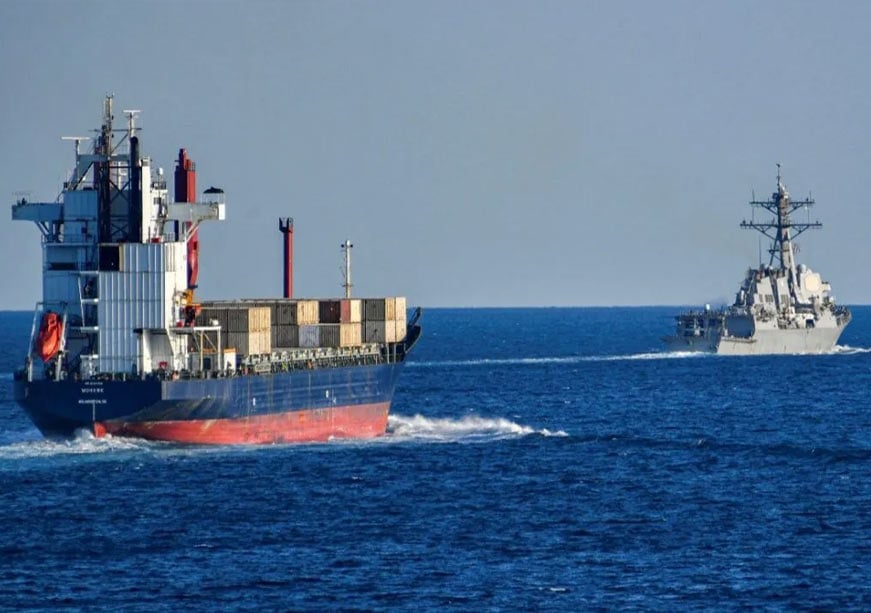

Iran’s closure of the Strait of Hormuz reduced daily oil tanker traffic to less than 10 percent of its pre-war levels. This unprecedented drop in the passage of tankers was driven not just by the increase in attacks, but by the collapse of affordable insurance cover. By March 2026, all 12 members of the International Group (IG) of Protection and Indemnity (P&I) clubs had issued 72-hour cancellation notices on parts of their war-risk cover in the Gulf. Consequently, hull premiums surged from 0.15-0.25 percent to 5-10 percent per voyage. At an additional US$10-14 million per trip, voyages became commercially unviable. The Strait was, in effect, priced shut. Recent US blockade measures have further disrupted maritime flows, highlighting how geopolitical tensions are impacting both critical sea routes and insurance costs.
The episode exposes how, without adequate cover, financing is withdrawn, and charterers refuse to load cargo. Elevated premiums alone can create trade chokepoints, even in the absence of a physical or military blockade. For emerging maritime economies such as India, these shocks translate into immediate and compounding vulnerabilities.
With over 95 percent of India’s trade by volume and around 70 percent by value transiting sea lanes, the stakes are considerable. The impact extends to Indian seafarers, who constitute one of the world’s largest maritime labour forces, exposing them to operational risks, stranding, wage delays, and uncertainty when insurance cover and voyages are disrupted. The country has recently approved a US$1.38 billion (INR 12,980 crore) sovereign-backed Bharat Maritime Insurance Pool to provide domestic coverage across hull, cargo, P&I, and war-risk segments, particularly for high-risk routes. However, as maritime routes become increasingly volatile, the need to further strengthen India’s maritime insurance capacity has become urgent.
Maritime Insurance Architecture
Maritime insurance operates across several layers: Hull and Machinery cover for physical vessel damage; P&I for third-party liabilities, such as pollution, cargo loss/damage and crew injury (the IG of P&I clubs, which insures approximately 87 percent of global tonnage, is near-universal); and war-risk insurance, a separately priced add-on.
Two features of this system are particularly notable. First, premium pricing is anticipatory: it adjusts ahead of military escalation, not after. Second, a ratchet effect persists: premiums rise quickly but fall slowly, even as conditions stabilise. Brief conflicts can translate into months of elevated shipping costs.
At the core of war-risk premium pricing sits the Joint War Committee (JWC) of Lloyd’s of London. Its high-risk designations can trigger premium escalations and coverage withdrawal within periods as quick as 72 hours. Two features of this system are particularly notable. First, premium pricing is anticipatory: it adjusts ahead of military escalation, not after. Second, a ratchet effect persists: premiums rise quickly but fall slowly, even as conditions stabilise. Brief conflicts can translate into months of elevated shipping costs.
Thus, as maritime insurance architecture evolved into a market-driven system centred on international underwriting clubs rather than a policy instrument, states largely treat maritime insurance and war-risk pricing as a commercial cost of shipping rather than a strategic variable in trade or economic resilience planning. The Hormuz crisis has brought into focus the systemic role of maritime insurance in determining trade continuity, particularly for developing economies.
India’s Exposure
Systemic Gaps and Structural Dependence
Historically, India has had limited strategic engagement with this London-centred architecture for underwriting global war-risk. With less than 1 percent of global shipping tonnage, India lacks the heft to influence freight markets, risk pooling, and insurance availability during periods of stress. Consequently, India’s maritime sector remains dependent on external markets, without robust domestic mechanisms to respond when global insurers withdraw or reprice.
Despite these constraints, India has augmented its strategic petroleum reserves, introduced schemes such as RELIEF, and increased domestic risk retention by expanding the state-owned General Insurance Corporation of India’s (GIC Re) reinsurance capacity over the past decade. In 2022, GIC Re set up a marine cargo pool to cover shipments from high-risk zones such as Ukraine, Russia, and Belarus, demonstrating that India can assemble coverage. However, such cover largely remains reactionary to global pressures.
India’s policy attention has also broadened. While the Insurance Regulatory and Development Authority of India (IRDAI) oversees the domestic market, the International Financial Services Centres Authority (IFSCA) at GIFT City has sought to position it as a hub for foreign reinsurers. However, uptake has remained limited. The government declined IFSCA’s proposed domestic P&I club in December 2022, but asked for its revival within weeks of the Hormuz crisis.
India has thus yet to establish a sovereign backstop capable of stabilising premiums or guaranteeing cover during market stress, or a domestic P&I club of meaningful scale. Without measures such as these, India’s insurance resilience continues to rely on the very external markets it seeks to insulate itself from, further compounded by global reinsurance structures.
Even with the Bharat Maritime Insurance Pool, these initiatives remain fragmented and reactive, serving as post-facto risk-mitigation measures rather than instruments that build structural insurance capacity or resist market dislocation. India has thus yet to establish a sovereign backstop capable of stabilising premiums or guaranteeing cover during market stress, or a domestic P&I club of meaningful scale. Without measures such as these, India’s insurance resilience continues to rely on the very external markets it seeks to insulate itself from, further compounded by global reinsurance structures. Domestic insurers, including GIC Re, operate within exposure limits and cede excess risk to international reinsurers, who rely on retrocession. This constraint was evident during the Hormuz disruption when GIC Re had to scale back cover in the absence of viable risk-sharing mechanisms.
Energy, Workforce, and Institutional Vulnerabilities
Around 30 percent of India’s crude oil imports and 54 percent of its LPG supply transits the Strait of Hormuz. When insurance costs spiked in March 2026, freight costs rose, threatening domestic inflation. India’s strategic petroleum reserves are designed for physical supply disruptions, not for prolonged economic strain from elevated premiums.
For a country seeking to raise its share of the global maritime workforce to over 20 percent, the absence of a domestic P&I ecosystem also represents a labour welfare concern.
This dependence extends to India’s maritime workforce. Approximately 80 percent of Indian seafarers serve on foreign-flagged ships covered by foreign P&I clubs. When these clubs reduce coverage in high-risk zones, crews face stranding, wage delays, and uncertainty about repatriation. The Hormuz crisis impacted 23,000 Indian seafarers, leaving 768 of them stranded on 28 Indian ships in the Gulf. For a country seeking to raise its share of the global maritime workforce to over 20 percent, the absence of a domestic P&I ecosystem also represents a labour welfare concern.
Institutional fragmentation across the Ministry of Finance (MoF), the Ministry of Ports, Shipping and Waterways (MoPSW), and the Ministry of Petroleum and Natural Gas (MoPNG), with no single body empowered to monitor market signals or coordinate responses in real time, further compounds these vulnerabilities. India’s response in March 2026 appeared to rely on ad hoc inter-ministerial coordination rather than a dedicated, pre-established institutional system, revealing a significant limitation given the speed and scale at which such shocks unfold.
Policy Recommendations
- Create a single nodal authority for maritime risk: Maritime insurance intersects insurance regulation, shipping policy, and energy security, split among the IRDAI under the MoF, the MoPSW, and the MoPNG. No standing mechanism exists to bring them together with the authority to act in a crisis. Coordination takes time the market does not provide; cover could lapse before a government position is confirmed. The March 2026 inter-ministerial group was a reasonable improvisation, but a permanent, pre-established institutional framework is necessary.
- Establish a Sovereign Maritime Risk Pool: A sovereign risk pool anchored by GIC Re needs to be capitalised in advance and automatically triggered by JWC designations, not assembled mid-crisis. The US, for instance, deployed a US$20 billion reinsurance facility within days, and kept voyages moving. India’s RELIEF scheme, by contrast, absorbs costs after a disruption but was not designed to prevent them. Given the ratchet effect in premiums, any sovereign instrument must be built for duration, not individual episodes. The Bharat Maritime Insurance Pool is an important step in this direction, marking a move towards institutionalising sovereign capacity to manage maritime insurance shocks.
- Fast-track a domestic P&I club: The 1950 Japan P&I Club, established under comparable conditions of high external dependence and a limited fleet, offers a useful precedent: it scaled incrementally and reached IG associate status within a decade. Similarly, India must build a P&I club in parallel with its existing fleet-building initiatives to allow both to strengthen each other.
- Build sovereign reinsurance depth: A domestic P&I club that continues to cede war-risk exposure to international reinsurers solves less than it appears to. GIC Re withdrew war-risk cover in the Gulf precisely because its reinsurance partners pulled back, leaving Indian refiners exposed when they need protection the most. To expand its risk-bearing capacity, India needs stronger sovereign reinsurance buffers, including dedicated war-risk reserves. Without this, all institutional improvements will remain contingent on external markets.
- Build international pricing influence: India should seek more structured engagement with global risk-pricing forums. JWC designations move markets quickly, yet India has limited visibility into these processes. Formal participation may not be feasible, given the market-based nature of these bodies. However, informal engagement or observer-level access would be a material improvement. Early visibility will create room for diplomatic engagement and market coordination before decisions take effect.
India’s response in March 2026 appeared to rely on ad hoc inter-ministerial coordination rather than a dedicated, pre-established institutional system, revealing a significant limitation given the speed and scale at which such shocks unfold.
Conclusion
Maritime insurance is critical to trade flows. The Hormuz crisis demonstrates that trade disruptions can arise as much from financial and insurance systems as military action. While diplomacy, naval escorts, and fiscal measures address immediate shocks, the deeper challenge is to build institutional capacity to manage such risks at scale and protect India’s trade. Maritime insurance lies at the heart of economic resilience, and India’s priority must be a forward-looking framework that can withstand volatility and disruptions.
Priya Noronha is a Research Intern at the Observer Research Foundation.
The views expressed above belong to the author(s). ORF research and analyses now available on Telegram! Click here to access our curated content — blogs, longforms and interviews.