
By Jeremy Ray Jewell
Every bookshelf becomes a latent crime scene: China’s all-too-familiar totalitarian playbook to encourage self-censorship.
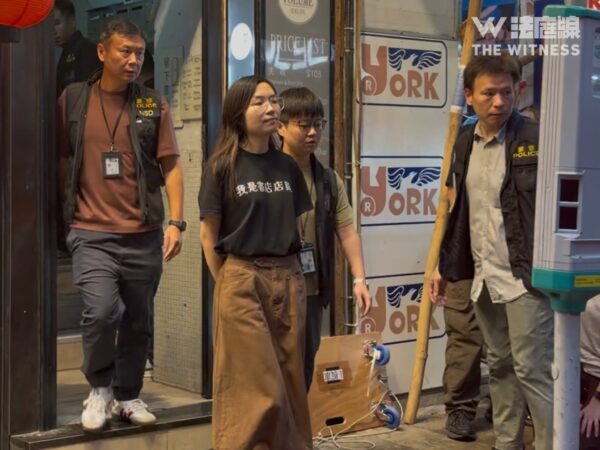
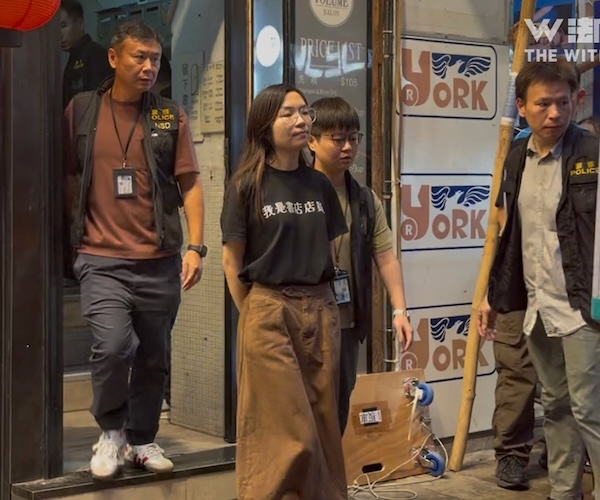
Mandy Lau, an employee of Have A Nice Stay, is escorted from the bookstore during the July 15 police operation. Photo: Screenshot/ Reporters Without Borders Asia-Pacific Bureau
When Hong Kong police arrested Mandy Lau on July 15, she was wearing a black T-shirt printed with six Chinese characters: 我是書店店員—“I am a bookstore clerk.” What should have been a mundane occupational description became an emblem of defiance across the Sinosphere. Lau was among five people arrested after national-security police searched two independent bookstores, Have A Nice Stay and Greenfield Book Store, accusing them of selling publications intended to incite hatred against Hong Kong’s government. Police declined to identify the volumes, releasing the booksellers on bail while keeping the investigation open.
What could the books have had in common?
The raid was no abrupt departure. Since Hong Kong’s 1997 return to Chinese sovereignty, a steady erosion of independent media has accelerated: the 2015 disappearance of the Causeway Bay booksellers, the 2020 National Security Law, and the 2024 Article 23 ordinance. As newspapers closed and opposition politicians were imprisoned, small bookstores became the last spaces where Hong Kong’s suppressed history could be encountered. July’s arrests marked the third such operation targeting independent booksellers in only four months.
While the specific titles connected to the latest raid must rely on journalistic reports rather than an official police inventory, the pattern is clear. The prohibited subject is not conventional sedition, but memory itself: memories of a plural China, a democratic Hong Kong, and the individuals imprisoned for defending both.
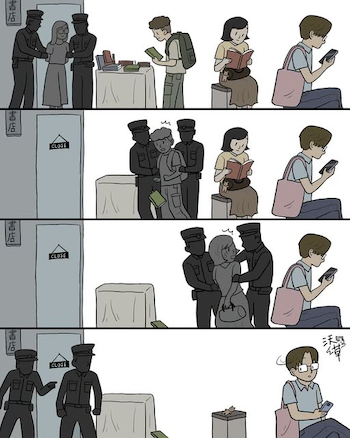
A variation on Martin Niemöller’s poem “First they came”: police first seize readers and then come to arrest a bookseller. Illustration: Watchout (沃草), a Taiwanese civic-media organization
The book most clearly associated with the intercepted shipment is the Taiwanese edition of Emily Feng’s Let Only Red Flowers Bloom. Feng documents people whose identities defy the Party’s demand for a homogeneous, Han-dominated nation—from detained Uyghurs to human-rights lawyers. The book’s offense: it records ways of being Chinese that cannot be reduced to a single authorized account of history. It even discusses the earlier persecution of Hong Kong booksellers; a volume preserving the memory of one crackdown has now become evidence in another.
This conflict between lived diversity and compulsory unity acquired a new weapon with China’s Ethnic Unity and Progress Promotion Law, which entered into force on July 1. Article 63 extends legal accountability to organizations and individuals outside China judged to be undermining ethnic solidarity. While officials reject the “long-arm jurisdiction” label, the implication is unmistakable: speech conducted beyond China’s borders is now subject to Beijing’s definitions of division.
Nor is this extraterritorial ambition theoretical. Over the years, Chinese public-security authorities have supported undeclared global “overseas police service stations” which have been credibly accused of monitoring and coercing dissidents abroad. One day after the law took effect, a Tibetan man identified as Lobga Rangzen fatally set himself on fire near United Nations headquarters in New York—an act Tibetan advocates situated within the struggle against the erasure of their identity and historical memory. Article 63 supplies new legal language to this documented system of overseas monitoring. In May, a U.S. jury convicted Lu Jianwang of acting as an illegal Chinese agent in connection with an undeclared Ministry of Public Security station in Manhattan, where he was tasked with locating a pro-democracy advocate.
The other books reportedly connected to the raid preserve different fragments of the past. Emily Lau’s memoir Stay recalls a Hong Kong where opposition legislators challenged the government openly and democratic reform was an imaginable future. Shiu Ka-chun’s Prisoners Outside the Walls prevents political detainees from being erased by the state by documenting the communities of solidarity actively supporting them. A similar principle explained the earlier targeting of The Troublemaker, Mark Clifford’s biography of imprisoned Apple Daily founder Jimmy Lai. Biography resists authoritarian language because it dramatizes the value of those that the state would toss into the category of national-security offender.
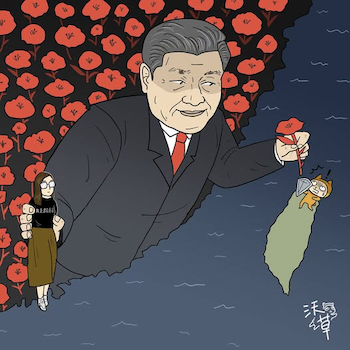
The illustration links the Hong Kong bookstore arrests to Xi Jinping’s campaign for ideological conformity. The picture references journalist Emily Feng’s Let Only Red Flowers Bloom. Illustration by Watchout (沃草)
Hong Kong’s government refuses to issue a definitive banned-books list. Instead, Security Secretary Chris Tang asserted that booksellers must ensure for themselves that their stock is not “poisonous,” arguing that an explicit blacklist would hinder enforcement. This nebulousness is strategic: by declining to identify what offends, while retaining the power to punish those who are accused of breaking ranks, authorities force booksellers to play it safe. The threat of censorship pressures sellers to preemptively abandon entire categories—Taiwanese political analysis, protest accounts, prison writing, and independent journalism.
For Taiwan, Hong Kong serves as both a market and a warning. A major center of traditional-Chinese publishing, Taiwan produces the political works that cannot circulate in mainland China. President Lai Ching-te responded to the raids by issuing a warning: books were being used by China as incriminating evidence of social rebellion. Taiwanese officials noted that some publishers are already curtailing what they distribute to Hong Kong. The spread of fear demonstrates how security laws force publishers, readers, and booksellers to internalize Beijing’s censorious political boundaries.
This impulse is not uniquely Chinese. On June 23, a federal court in Texas sentenced artist Daniel “Des” Sanchez Estrada to thirty years in prison. Sanchez Estrada was not present at the anti-ICE protest where a police officer was shot; he was convicted of corruptly concealing records after moving a box containing left-wing zines and other materials that prosecutors insisted might implicate his wife in the crime. The Justice Department characterized the materials as anti-government propaganda. That prompted the Freedom of the Press Foundation to argue that constitutionally protected literature has been transformed into evidence of terrorist sympathies.
There is a difference between here and China: Sanchez Estrada received a jury trial under a fundamentally different legal system. Yet the underlying prosecutorial method is disturbingly familiar. The state does not need to outlaw a publication if it can make possession, movement, or concealment of the material evidence of criminal intent or ideological affiliation. This is the indirect advance of modern censorship: books become evidence, biography becomes subversion. In this way, authorities preserve the appearance of lawful procedure — while steadily forcing citizens to recoil from protected speech.
The Estrada case exists within a wider confrontation between the second Trump administration and the free press. A campaign for censorship is escalating, via journalist subpoenas, device seizures, and threats to revoke broadcast licenses.
Constitutional protections do not sustain themselves; they survive only so long as the governed insist upon them. That truism is what gives Mandy Lau’s shirt its charge. In Hong Kong, “I am a bookstore clerk” became a political declaration because booksellers traffic in memories that the state cannot fully control. Ambiguity, in such conditions, is not incidental—it is a method of authoritarian rule. When no one knows which title will trigger arrest, when a pamphlet can help consign an artist to decades in prison, every bookshelf becomes a latent crime scene. The campaign to criminalize reading, reporting, and remembering is no longer local; it is metastasizing across borders.
Jeremy Ray Jewell is an American writer and creative technologist who applies systems thinking to culture, politics, and digital media. He holds an MA in History of Ideas from Birkbeck, University of London, and lives in Taiwan.