
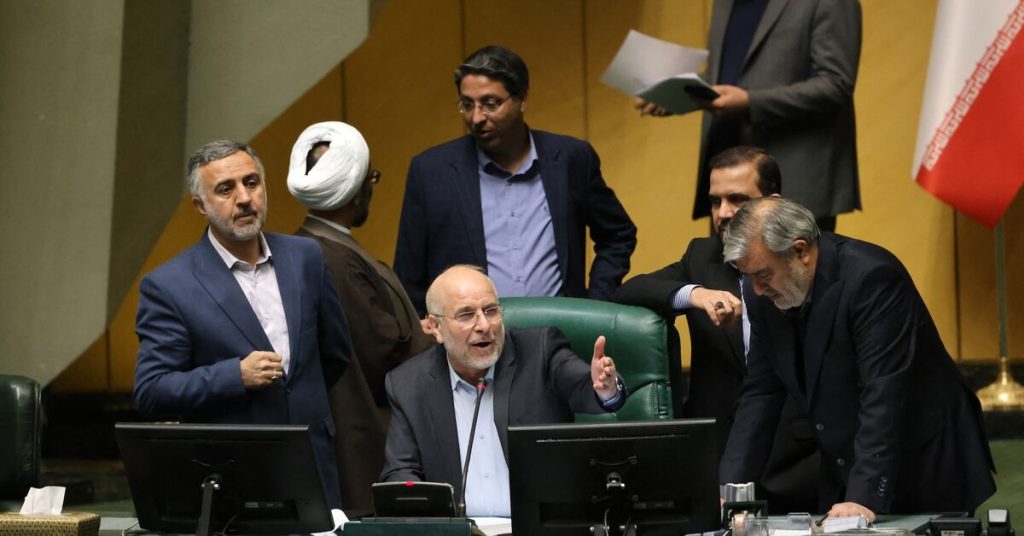
The United Arab Emirates’ deputy prime minister, Sheikh Mansour bin Zayed, held a phone conversation with Iran’s parliament speaker, Mohammad Bagher Ghalibaf, on Wednesday in the first high-level contact between the two sides since the Iran war erupted.
Ghalibaf is leading Iran’s negotiations with the United States.
The two officials discussed the latest regional developments and ways to de-escalate tensions in the region, the state-run Emirati news agency said in a brief statement. Iran has not yet commented on the call.
UAE-Iran tensions
Tensions have escalated between Abu Dhabi and Tehran over the latter’s repeated attacks on Gulf countries in response to the joint US-Israeli strikes that started on Feb. 28.
The UAE has been one of the hardest-hit Gulf states by Iran. Its air defenses have intercepted at least 537 ballistic missiles, 26 cruise missiles and 2,256 drones fired from Iran since the start of the war through April 8, according to the Emirati Ministry of Defense. They include 17 missiles and 35 drones launched by Iran toward the UAE on April 8 alone, just hours after US President Donald Trump announced a 45-day ceasefire with Iran. Since then, the ministry has not reported any new attacks.
One day after the Iranian attacks began on March 1, the Emirati Foreign Ministry closed the UAE Embassy in Tehran and recalled its ambassador in response to the “blatant Iranian missile attacks” and “acts of aggression against civilian sites, including residential areas, airports, ports and service facilities.”
The UAE has also been affected by Iran’s de facto closure of the Strait of Hormuz, though its impact on the Emirati oil export volumes is minimal thanks to its Habshan‑Fujairah pipeline, which bypasses the strait.
According to a Reuters analysis published last week, the UAE’s estimated oil export value dropped by more than $174 million year-on-year in March. In comparison, Iraqi revenues saw the largest drop, falling by 76% to $1.73 billion. Kuwait was next with a 73% decline to $864 million.
Last Tuesday, the UAE Foreign Ministry expressed its disappointment at the UN Security Council’s failure to take what it described as “decisive action to address the serious global repercussions of Iran’s illegal closure of the Strait of Hormuz.”
The UN Security Council failed to adopt a draft resolution submitted by Bahrain aimed at reopening the Strait of Hormuz. China and Russia blocked a watered-down version of the resolution, which had initially authorized the use of force.
Diplomatic efforts to extend ceasefire
The call comes amid efforts to extend the current US-Iran ceasefire due to expire on April 22. Reports suggest Pakistan is working to secure a second American-Iranian meeting that could come as soon as this week. On Wednesday, Pakistan’s army chief, Field Marshal Asim Munir, was received in Iran by Foreign Minister Abbas Araghchi.
Earlier on Wednesday, Iranian Foreign Ministry spokesperson Esmaeil Baghaei told reporters that the Pakistani delegation’s visit to Iran marks “a continuation of the discussions in Islamabad.” He added that since Iran’s delegation returned from Islamabad, “several messages have been exchanged through Pakistan.”
A senior White House official told Al-Monitor, “The United States has not formally agreed to an extension of the ceasefire.”
The official added, however, “There is continued engagement between the US and Iran to reach a deal.”
A US blockade of Iran’s ports and a partial blockade of the Strait of Hormuz took effect Monday, following an announcement of the blockade by Trump a day earlier.
US Central Command posted on X that no ships made it past the US blockade in the first 24 hours. However, data from Kpler and LSEG show that at least three tankers entered the Gulf via the strait on Tuesday, and a US-sanctioned tanker known for carrying Iranian oil was seen entering on Wednesday. The US-sanctioned, Chinese-owned tanker Rich Starry appeared to turn back toward the strait after exiting a day earlier.
On Wednesday, senior Iranian military commander Maj. Gen. Ali Abdollahi warned that if the blockade continues, the “Iranian armed forces will not allow any exports or imports to continue in the Persian Gulf, the Gulf of Oman and the Red Sea.”