
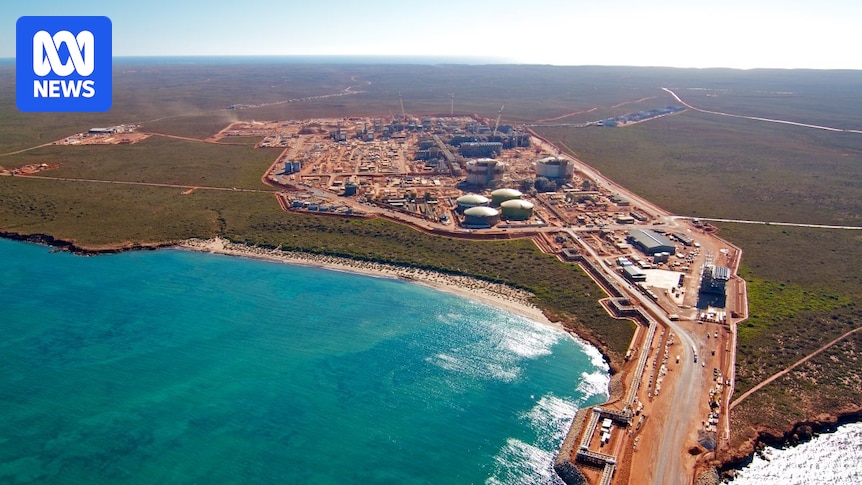
Natural gas taxes are back in the fray after the expansion of Australia’s largest project received environmental approval ahead of Senate inquiry hearings this week which will probe how resources are taxed.
Australia’s offshore petroleum regulator NOPSEMA has approved an environment plan for further development of US-based multinational Chevron’s Gorgon project, off Western Australia’s north-west coast.
Chevron is planning to install new wells and pipelines to maintain the Gorgon project’s gas production rates of about 15.6 million tonnes of liquefied natural gas (LNG) a year.
Over 30 years this would equate to about 468 million tonnes of LNG.
Greens Senator Steph Hodgins-May is chairing the gas tax inquiry. (ABC NEWS: Matt Roberts)
Greens Senator Steph Hodgins-May, who is spearheading the gas tax inquiry, said the sheer volume of Australian gas being used in the Gorgon project alone was a clear indicator of why tax reform was needed.
“What we’re seeing is the government essentially handing $300 billion worth of Australian gas to an American owned multinational … ripping up our oceans and paying absolutely nothing in royalties,” Ms Hodgins-May said.
“We are absolutely appalled that this has been allowed to happen with barely any public consultation.”
Chevron did not directly respond to questions about the Gorgon project, but confirmed to the ABC it would appear at the gas tax inquiry this week.
Chevron processes gas from its Gorgon Project onshore at Barrow Island. (Supplied: Chevron)
Chevron Australia president Balaji Krishnamurthy said increasing tax on gas companies would ultimately result in less returns for Australians.
“Short-term measures to boost the tax take from gas companies can look attractive on paper, but they carry longer-term consequences in the form of reduced investment and lower production,” he said.
“We understand community expectations that companies pay their fair share of tax, and we have made a significant contribution over recent years.”
Giving away gas ‘for free’, for now
Chevron does not pay state royalties for the gas from its Gorgon LNG project, as the gas reserve is located offshore in Commonwealth waters.
Instead, the project is taxed federally via the Petroleum Resource Rent Tax (PRRT). But only when it makes a profit.
Under the PRRT, expenses from previous years can be deducted from a company’s revenue. Those expenses can be carried forward indefinitely, and their value compounds each year with interest.
This allows companies to recoup their investment costs before paying the tax, which forms the basis of Ms Hodgins-May’s claim that Australia is “giving away our gas for free”.
For example, Chevron only made its first PRRT payment in August last year after the federal government amended the system, forcing companies to pay at least 10 per cent of a project’s income each year.
Chevron has operated in Australia for more than 70 years. (
ABC News: Keane Bourke
)
“Based on current assumptions, with the enacted changes, we expect to pay around $800 million in PRRT by the end of 2027,” Mr Krishnamurthy said.
“Since 2009, Chevron has paid more than $20 billion in corporate taxes and royalties in Australia, alongside more than $80 billion invested with our joint venture partners to develop the Gorgon and Wheatstone gas projects in Western Australia.”
Last year’s budget projected $1.95 billion would be raised this financial year through the amended PRRT.
The Greens and independent senator David Pocock have been pushing to impose a 25 per cent flat tax on all gas exports.
“It’s not up to Chevron to decide whether they’re paying their fair share,” Ms Hodgins-May said.
“We hope this inquiry will get the answers we need and give the government the confidence it needs to act, and to finally tax them what they owe.”
Gas tax reform unclear
Australian Energy Producers (AEP) chief executive Samantha McCulloch accused the Greens of misrepresenting the industry’s tax contributions.
“The Australian oil and gas industry contributed $21.9 billion in taxes and royalties last year while supporting jobs, regional communities and economic growth,” Ms McCulloch said.
Looking at exports alone, earnings in 2024-25 from Australian oil and gas reached $77.5 billion.
Ms McCulloch said a 25 per cent tax on gas exports would put Australia’s energy security at risk, citing analysis from consultancy firm Wood Mackenzie.
“Wood Mackenzie’s analysis of the Greens’ proposal for a 25 per cent tax on gas exports found it would result in an effective tax rate of more than 80 per cent for some companies, which would make Australia ‘uninvestable’,” Ms McCulloch said.
The ABC revealed last month the prime minister’s department had requested modelling for potential options to tax gas giants.
At the time, Energy Minister Chris Bowen would not confirm or deny if changes were on the horizon.
A spokesperson for Resources Minister Madeleine King said there had been “no change” to the federal government’s policy on how resources are taxed.
“The Australian Government supports developments that stack up environmentally and economically,” the spokesperson said.