

Global cues driving local prices
Internationally, bullion rose close to $4,770 an ounce, recovering ground lost over the previous two sessions. The move came even as the US tightened its stance in the Strait of Hormuz, while at the same time signalling openness to negotiations.
President Donald Trump said Iranian officials had approached his administration with the intent “to work a deal.” Iranian President Masoud Pezeshkian also indicated that Tehran remained open to continuing talks within international legal frameworks.
Oil prices dropped below $100 a barrel, easing pressure on inflation expectations. Equity markets moved higher and the dollar weakened slightly, creating a supportive backdrop for gold, which is priced in the US currency.
Lower energy prices have reduced some of the inflation-driven demand that had supported bullion earlier in the conflict. That shift has also influenced expectations around interest rates, with markets still factoring in a limited chance of rate cuts by the US Federal Reserve this year.
What it means for buyers
Despite the latest uptick, gold remains under pressure compared to peak levels seen during the early stages of the conflict. Prices are still roughly 10% lower than where they stood at the height of market stress, when investors rushed into safe-haven assets.
Recent trading suggests that buyers are stepping in during dips, but conviction remains limited. The market continues to balance easing inflation fears against the risk of renewed disruption, particularly with the Strait of Hormuz still under strain.
– With inputs from Bloomberg.
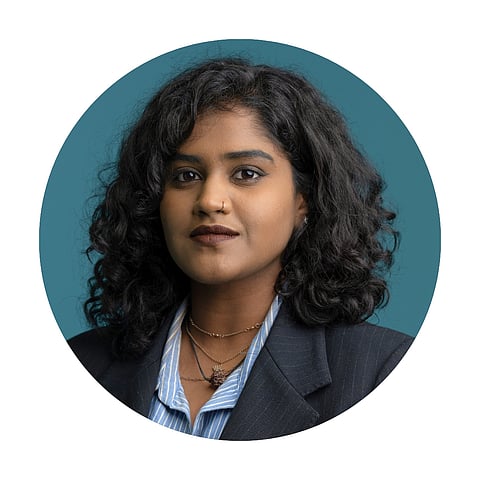
Nivetha Dayanand is Assistant Business Editor at Gulf News, where she spends her days unpacking money, markets, aviation, and the big shifts shaping life in the Gulf. Before returning to Gulf News, she launched Finance Middle East, complete with a podcast and video series.
Her reporting has taken her from breaking spot news to long-form features and high-profile interviews. Nivetha has interviewed Prince Khaled bin Alwaleed Al Saud, Indian ministers Hardeep Singh Puri and N. Chandrababu Naidu, IMF’s Jihad Azour, and a long list of CEOs, regulators, and founders who are reshaping the region’s economy.
An Erasmus Mundus journalism alum, Nivetha has shared classrooms and newsrooms with journalists from more than 40 countries, which probably explains her weakness for data, context, and a good follow-up question.
When she is away from her keyboard (AFK), you are most likely to find her at the gym with an Eminem playlist, bingeing One Piece, or exploring games on her PS5.