
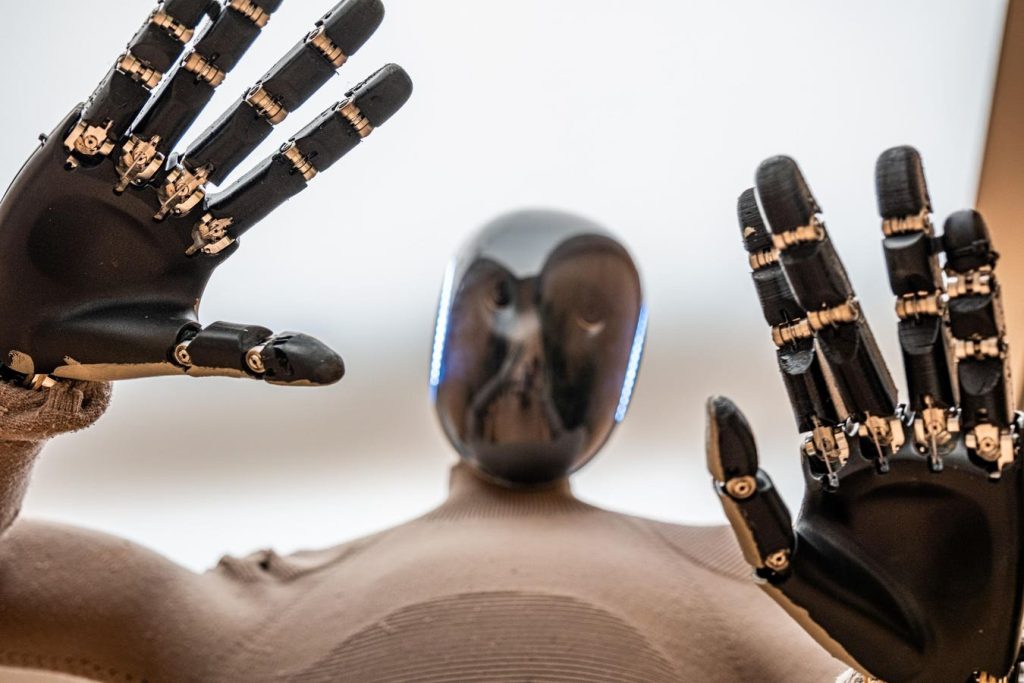

1X, which makes the Neo humanoid robot, is probably the most vertical-integrated robot manufacturer on the planet.
The Washington Post via Getty Images
The New York Times says it’s “nearly impossible” to build a humanoid robot without China. “Building on the country’s electric vehicle industry, Chinese companies are making robot parts at a scale and price point others can’t match,” says a June 11 story by Meaghan Tobin, reporting from Tokyo, and Keith Bradsher, reporting from Shenzhen, China.
A visit to Hayward, California, might show something different. Hayward is where 1X, maker of the Neo humanoid robot that will ship this year for $20,000, or $500/month on a subscription plan, is made.
And by “made,” I don’t mean “assembled.”
“We design and manufacture NEO’s critical components in-house — including motors, batteries, structures, transmission systems, soft goods, sensors and more,” the company said on April 30 this year. “From cutting metal parts to fully automated motor manufacturing lines that form copper coils, we maintain maximum control of our supply chain.”
I recently asked 1X’s head of design and product, Dar Sleeper, about competing with China on cost.
“We’ve been able to drive the BOM [bill of materials] cost super low,” he told me in on a podcast that I also reported in Forbes. “Because we’re so vertically integrated, we make so many things in-house and we do all of our manufacturing here in the US, we’re able to control our supply chain,” he added.
That includes copper coiling in the motors. Tendons that move Neo’s limbs and digits. Clothing that Neo wears. Components that make up Neo’s fingers. Batteries that power the robot, and more.
What 1X outsources versus what 1X makes in-house.
John Koetsier
And 1X is not the only one.
Figure AI, which makes the Figure 03 humanoid robot, chose to vertically integrate to a significant degree as well. “We made the decision to focus heavily on the assembly of our core technology in-house (actuators, hands, batteries, final assembly) and when needed, leverage outside vendors for piece part manufacturing.” the company said in a blog post in March of last year. For batteries, a key robot components in an area where China has global domination, Figure is building them in-house.
Standard Bots, which just raised $200 million, plans to make everything in America.
1X is building capacity to expand to 100,000-plus annual production capacity by the end of 2027, with a second California facility already in the pipeline, and Figure’s planning to hit similar numbers. Phantom, a Silicon Valley humanoid robot startup, is already manufacturing its own proprietary cycloid actuators. Apptronik is building in Texas. Agility Robotics’ massive RofoFab factory is in Salem, Oregon.
None of these things are necessarily easy, but neither are they impossible.
It’s true, robot manufacturing may require some raw materials or components from other countries. A recent McKinsey report highlighted that China has a significant share of robotic components supply. But the same report shows that China is only massively dominant in a single category: magnets for motors. In other categories like driver boards or bearings or sensors, there are a number of suppliers in multiple nations like South Korea, Japan, Germany, the United States itself and elsewhere.
Sources of key components for humanoid robots. China is significant, but overwhelmingly dominant in only one category.
McKinsey
Right now, there’s two main approaches to building humanoid robots, McKinsey says. And both have challenges.
“In this premodular phase, most OEMs are forced into one of two paths to obtain components: vertical integration or close codevelopment with a limited number of partners in which they piece together adjacent industrial components and redesign them for humanoid requirements,” the report states. “Both paths accelerate development, but neither automatically translates into cost-efficient scale. Vertical integration concentrates all manufacturing overhead on a single OEM, while ad hoc codevelopment requires costly redesign that must be repeated for each platform.”
Obviously, China has massive advantages in many areas. There’s huge and consistent governmental support for robotics in general and humanoid robots specifically: the Chinese government sees supremacy in robots as critical to China’s continuing domination of global production. There’s also a massive and well-defined supply chain that is generally physically close to robot manufacturers that makes innovation and production in robotics relatively quick and easy. There are obvious cost advantages in many areas as well.
Of course, it’s also true – as you see in the McKinsey report referenced above – if your actuators require rare earth magnets, China has most of the global supply. And, clearly, it is getting increasingly selective in how it exports those to the rest of the world. Here too, however, there are developing alternatives. MP Materials is building domestic magnet capacity with Department of Defense backing, Niron Magnetics is commercializing rare-earth-free magnet materials and Evolution Metals & Technologies is installing magnet-making machines targeting 10,000 metric tons of annual capacity largely from “urban mining,” AKA recycling.
The reality is that Figure, 1X, Apptronik, Tesla and other American humanoid robot manufacturers aren’t trying to out-source China component by component. They’re playing a different game: vertically integrating, owning their own actuator design, building their own battery production, taking assembly in-house and building their own physical AI.
One of the reasons for that is vertical integration – right through the intelligence and data levels – is critical for success at this stage in humanoid robotics development, as a recent Bessemer Venture Partners report suggested. The side effect, however, is that fewer suppliers, foreign or domestic, sit in the critical production path.
(Which, ironically, is kind of the same playbook that built China’s EV industry, running in reverse.)
There are also things that western companies potentially have better access to: Nvidia chips, other high-end AI chips, plus their own proprietary physical AI foundation models. By the Times’ own reporting, UBTech imports chips that control its robots’ movements. And Unitree relies on Nvidia simulation software to train its robots and just announced a partnership to build robots around Nvidia chips and software for reasoning and decision-making.
The reality is that it’s really hard for anyone to make good robots that do worthwhile work at reasonable speed and accuracy, don’t break down, and have scalable physical intelligence to do more and more work over time. Component sourcing is hard, but it’s just one piece of the puzzle. Vertical integration is one of the ways to solve it, though it can be expensive and risky.
Those challenges exist in China and in America, and everywhere else on the planet where companies are racing to build robots that are both reasonably priced and good workers.
But it’s not nearly impossible to build a robot without China. Multiple companies are doing it today.