
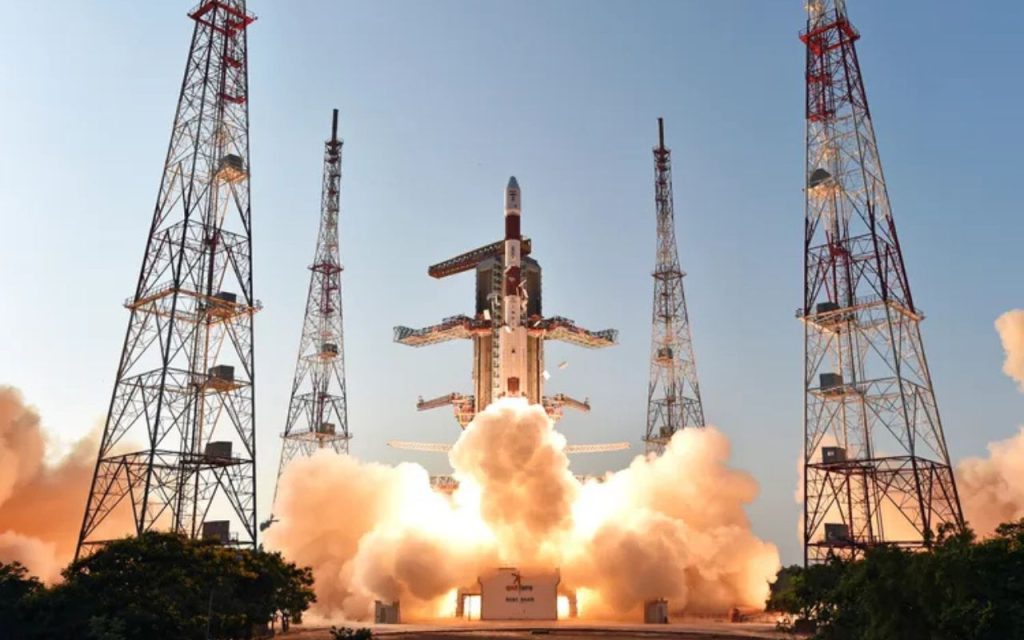
Long perceived as a “frugal” space programme focused on a few flagship low-cost missions, India’s space sector has clearly entered a new phase. New Delhi is no longer simply seeking to demonstrate technological capability. The objective is now to build an integrated, sovereign and export-oriented space power.
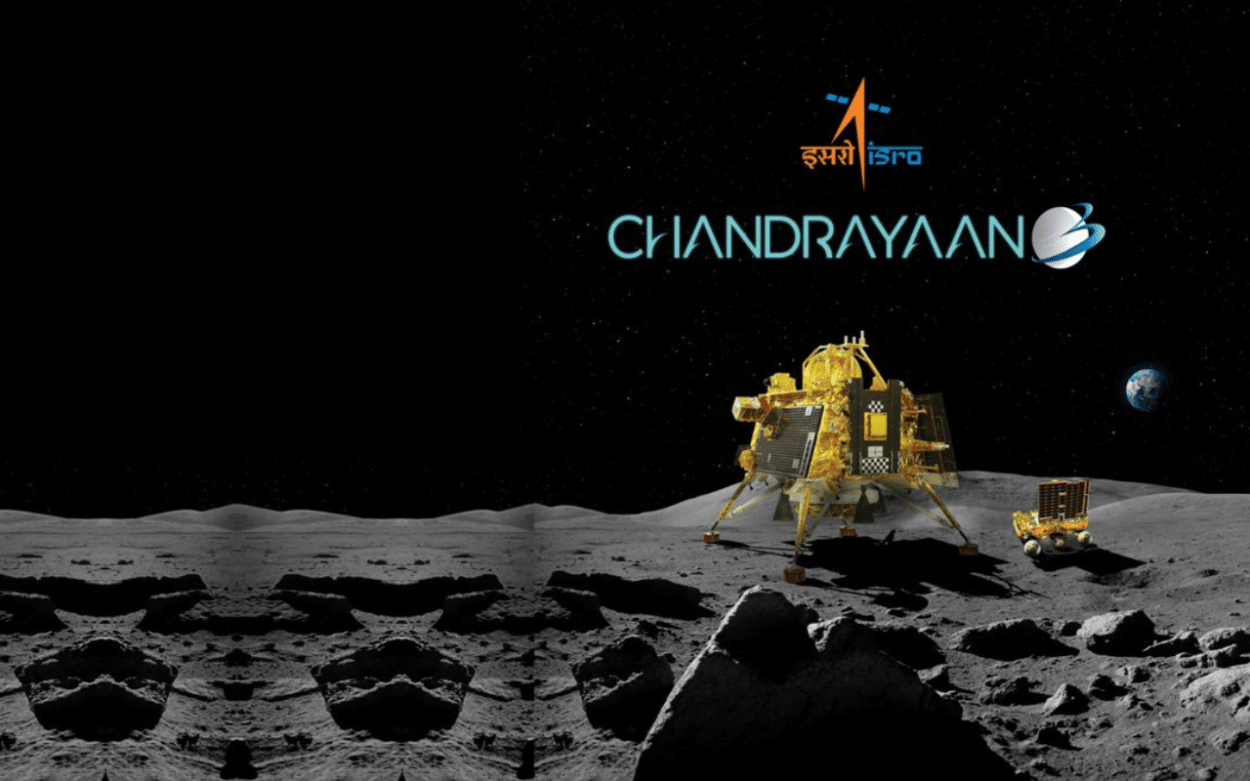
In 2023, India achieved a historic first with the landing of Chandrayaan-3 on the Moon’s south pole. This region was still unexplored by other space powers that had previously reached the lunar surface. A few weeks later, ISRO (the Indian Space Research Organisation) launched Aditya-L1, India’s first mission dedicated to studying the Sun. Since then, the country has accelerated constellation projects, opened its space sector further to private players, prepared its first human spaceflight missions under the Gaganyaan programme, and is actively pushing its industrial base to localize production at scale.
Behind these symbolic missions, another battle is unfolding: the industrialization of India’s space sector.
Make in India
“Make in India”, promoted by Narendra Modi, no longer concerns only automotive, defence or electronics. It now extends across the entire space value chain. And this shift is already visible on the ground, on Earth. In Bangalore, Chennai and Hyderabad, a new generation of industrial players and start-ups is progressively transforming the Indian space ecosystem into a full industrial platform, spanning launchers, satellites, ground infrastructure and future orbital services.
During a dedicated India roundtable organized in Paris by Business France and GIFAS, the French Aerospace Industries Association, a few weeks ago, several French executives established in India reached a common conclusion: India’s space sector is no longer an emerging market, but a market undergoing rapid structural consolidation, driven simultaneously by geopolitics, strategic autonomy and large-scale industrialisation.
A National Strategy Designed as a Complete System
One of the most striking features of the Indian model is its vertical coherence. While some countries focus on satellites, others on launchers or downstream services, New Delhi is building a full value chain anchored in technological sovereignty. As highlighted by Jean-Luc Maria, CEO of Exotrail, a French company providing in-orbit mobility services:
“India is one of the rare countries with a space strategy ranging from scientific exploration through to commercial exploitation, covering satellites, launchers and soon human spaceflight. We can notably mention the Gaganyaan programme, which aims to send Indian astronauts into space.”
This ambition is not new and began nearly 50 years ago through Franco-Indian cooperation, recalls Jean-Luc Maria:
“Since the 1970s, there has been extensive cooperation on engine preparation and development, particularly engines that are now used on certain stages of Indian rockets.”
At one point, Indian launchers even served as backup solutions for European missions.
A Rapidly Accelerating Ecosystem
A real turning point has taken place in recent years with the accelerated opening of India’s space sector to private players, leading to the emergence of a completely new ecosystem of Indian companies, explains Jean-Luc Maria:
“The space sector has accelerated significantly in India. The Indian space agency has relied on NSIL, NewSpace India Limited, whose role is to foster and support new economic actors, particularly start-ups.”
Clémentine Gallet, CEO of Coriolis Composites, a supplier of carbon-fibre and composite materials for the aerospace sector, highlights the remarkable industrial upgrading and technological maturity of Indian players. Her company supplies composite materials to an Indian start-up developing MALE drones:
“Capabilities are emerging in all factories and design offices, meaning there is now engineering expertise and local R&D development. These Indian industrial players are directly adopting advanced robotic manufacturing processes, bypassing the artisanal phases experienced by Western industries. They are using tools like Dassault Systèmes’ CATIA. And they have experienced a tremendous acceleration, with a first machine installed last year and massive orders expected in the coming years.”
This dynamic is reinforced by the structuring role of IN-SPACe (Indian National Space Promotion and Authorization Centre), a kind of commercial arm of the Indian space state. According to Noël Ballot, Chief Commercial and Marketing Officer at Safran Space, it has become a key instrument for technology transfer and industrial acceleration:
“[It is] a powerful organization capable of rapidly transferring technologies to private companies in order to design space vehicles more quickly.”
The comparison with the United States is obvious. Just as NASA enabled the emergence of SpaceX or Rocket Lab through progressive outsourcing, ISRO is now catalysing a domestic private ecosystem. However, there is one major difference. The Indian government intends to maintain strong strategic control.
This public-private orchestration is now driving an openly global ambition. According to projections associated with IN-SPACe’s strategy and reported by the World Economic Forum, India aims for a space economy of around $44 billion by 2033, representing approximately 8% of the global market.

Defence, China and Pakistan: Geopolitics as an Accelerator
It is impossible to understand India’s space strategy without considering its security dimension. Regional geopolitical pressure, particularly border tensions with China and Pakistan, acts as a powerful catalyst, explains Clémentine Gallet of Coriolis Composites:
“The war is at their border. Since targeted attacks involving Pakistan, they have intensified efforts to build their own defence capability, and this is creating a fast-growing industry.”
This geopolitical pressure is directly reflected in space programmes. India plans to significantly strengthen its defence satellite capabilities. According to ISRO, 150 surveillance satellites are expected to be deployed over the next three years, with strong participation from private industry.
Small Satellites
This strategy is largely based on new small satellite constellations capable of providing continuous observation missions, for both civilian and defence applications, relying on distributed architectures of miniaturized satellites.
In this context, Exotrail supplies Indian players with miniaturized propulsion systems adapted to these new constellations, as well as an orbital vehicle, the “SpaceVan”, designed for in-orbit logistics, refuelling and inspection missions, explains Jean-Luc Maria:
“In the current geopolitical context, space is an increasingly important battlefield. There is therefore a very strong defence concern among Indian players to master in-orbit mobility. Because mastering mobility in space means mastering action in space.”
An Indian company had previously attempted to launch a satellite designed to refuel other satellites in orbit:
“Unfortunately, the launch in January was not successful. But there remains very strong interest in India in mastering this technology.”
Critical infrastructures
Beyond observation, New Delhi is also seeking to secure critical navigation and communications infrastructure. India is accelerating development of NavIC, its sovereign navigation system designed to reduce dependence on the US GPS. This topic has become highly sensitive in the Indo-Pacific region. As Noël Ballot from Safran Space explains, concerns are increasing among Indian authorities:
“They are very keen to deploy additional satellites for the NavIC system, which operates at 22,000 kilometers altitude and offers better resistance to jamming. On their territory, they are realizing that they are being jammed by both Chinese and Pakistani systems.”
The challenges extend beyond satellites themselves to ground infrastructure and secure communications. With more than 150 satellites expected in the coming years, managing data flows, links and cybersecurity is becoming critical, warns Noël Ballot:
“The Indian state wants to deploy more than 150 satellites within the next two years. Proper management of access and satellite-to-ground communication is key, including all cyber and security aspects related to satellite security.”
In this context, the ground segment is also evolving towards an industrialized platform model. Noël Ballot emphasises a deep transformation:
“Ground segment as a service means maintaining contact with satellites and launchers, whose trajectories are highly complex. Continuous connectivity is required both to command satellites and to collect data, particularly for Earth observation missions.”
This increasing complexity takes place in a market already structured globally by a few major players such as SSC (formerly Swedish Space Corporation). However, India is seeking to develop its own capabilities in this strategic segment. New players are emerging, although, as Noël Ballot notes:
“The regulatory framework still limits their development at present.”
One example, however, is Geminus Space. Based in Pune, the company has developed an AI-based antenna network management system enabling optimization of global ground station operations, explains Noël Ballot:
“When managing a fleet of antennas distributed worldwide, it is difficult to know whether they are operational or whether a satellite will pass over one station or another. Geminus Space has developed an AI system that manages this fleet and enables switching between operators to ensure service continuity.”
The company works in synergy with its sister company Antaris, which develops a complementary approach on the satellite side with a so-called “digital twin satellite” model, providing a full virtual representation of onboard systems (computing, navigation, communications):
“They enable modelling both the service provided by the satellite constellation and how that service can be operated.”
In a context of proliferating constellations and growing dependence on orbital infrastructure, the ground/satellite segment is becoming a true nervous system of the space economy. This software and industrial layer is now as critical as launchers or satellites themselves.
You could also be interested in India’s AI strategy
Reducing Dependencies
This drive for strategic autonomy is also reflected in a strong desire to reduce technological dependence on the United States, China and other foreign critical components. In this context, component origin has become a major industrial and political issue.
Pierre de Bausset, chairman of Indian company Dynamatics, explains that his group has developed a fully Indian military drone line:
“The main advantage, compared to most of our Indian competitors, is that there are no Chinese components. And for India, this is extremely important.”
The company has also signed a partnership with Germany’s Aerodata to develop ISR platforms that are “fully ITAR-free and free from Chinese constraints.”
Noël Ballot notes that in the future, equipment used to control ISRO missions and satellites supplied by Safran may no longer be exportable unless manufactured locally. The French group has already anticipated this shift by acquiring a test bench company in Bangalore in 2022 to secure its regional industrial presence:
“This allowed us to guarantee the continuity of supply of our equipment developed and manufactured in India and to serve the Indo-Pacific region.”
Safran has also tripled its turnover and workforce in the country and now employs more than 3,000 people in India.
For New Delhi, space is therefore no longer just a technological or economic lever. It is becoming a pillar of national sovereignty and a tool of strategic resilience in an increasingly unstable regional environment.
The New Strategic Frontier: Access to Space
One remaining challenge, though, is autonomous and large-scale access to orbit. The main bottleneck for both India and Europe remains launcher availability. Europe is still struggling to stabilize industrial production around Ariane 6. The United States dominates through SpaceX, while China is rapidly scaling up.
For Jean-Luc Maria of Exotrail, the situation is not expected to improve quickly. In this context, India and Europe have a strong interest in closer cooperation:
“There is a very strong need today to reduce our dependence, particularly on the United States and China. India is a country that masters launch vehicles, so there is an opportunity for Europe and India to accelerate together on launch cadence and availability in order to access space. There is a real risk over the next 5 to 10 years of becoming even more dependent than we are today on non Indo-European launch systems.”
The center of gravity of the global space economy is therefore shifting towards Asia. And India clearly intends to occupy a central role within it. Europe, for its part, has every interest in strengthening industrial and space cooperation, notably through the recent FTA framework.