
China and the European Union’s decision to launch formal trade consultations is a positive signal that, despite the trade tensions that have risen between the two sides in recent months, a trade war is still preventable.
Both China and the EU position themselves as supporters of economic globalization at a time when this spirit encounters unprecedented challenges.
That stance could be significantly weakened if they fight a trade war. The reality is that the two sides are each other’s key trading partners, with deep economic interdependence too painful to disrupt.
Immediately after U.S. President Donald Trump began his second term in office, he openly complained about the U.S. trade deficit with the EU and threatened to slap tariffs on the bloc.
In response, the European Commission clarified that, in terms of two-way trade, the EU had a surplus in trade for goods while the U.S. had a surplus in trade for services, adding that the two sides had complementary strengths.
Brussels’s logic at the time also rings true for EU-China trade. When EU officials highlight the bloc’s trade deficit in goods with China to support a narrative that the status quo is unsustainable, they usually fail to mention the other side of the coin.
China is the EU’s fourth-largest services trading partner, with the bloc recording a services trade surplus of €21.3 billion ($24.37 billion) with China in 2025.
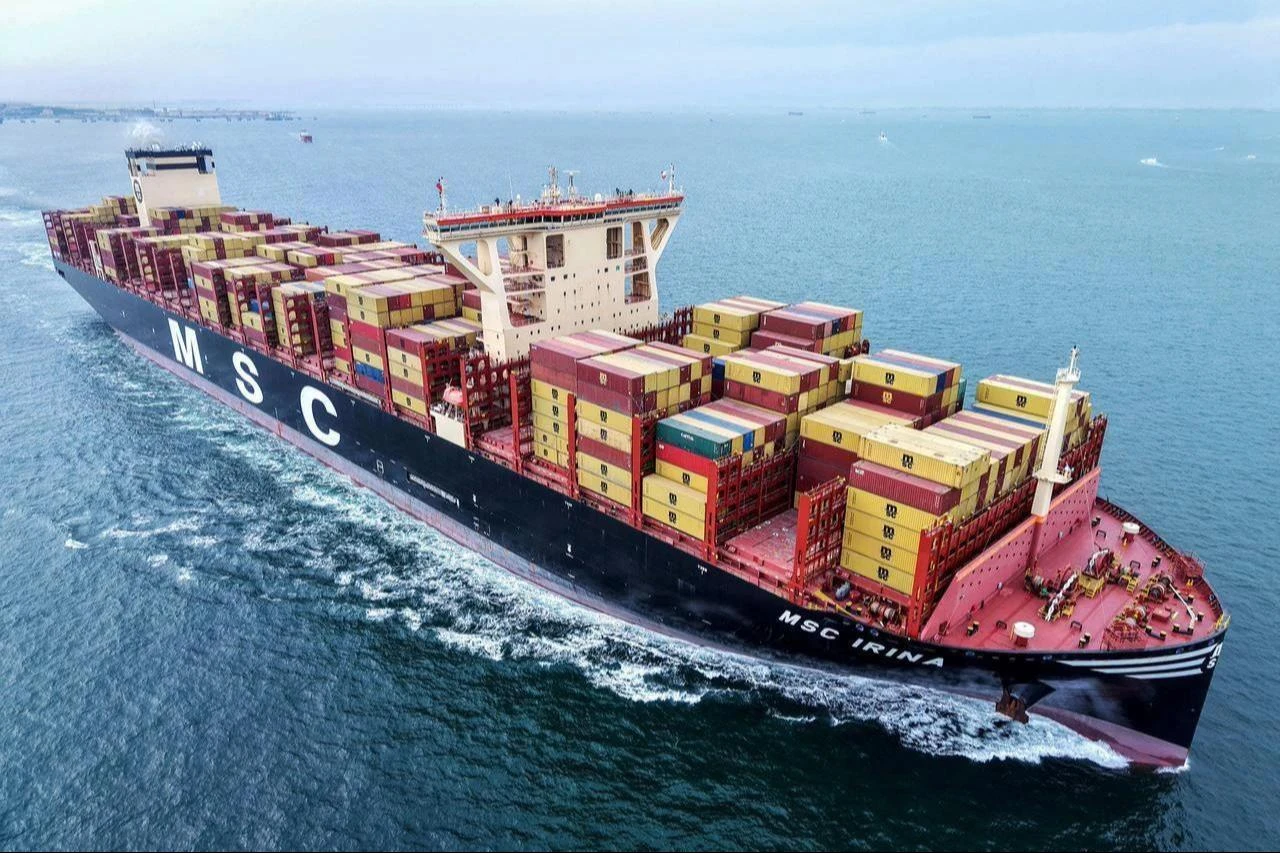

A cargo ship loaded with containers leaves the port in Qingdao, in eastern Chinas Shandong province on May 7, 2025. (AFP photo)
Real roots of Europe’s economic decline
The EU’s declining weight in global trade is real. Its share of world exports dropped from around 19% in 2002 to less than 15% in the early 2020s.
In 1990, manufacturing accounted for 20% of the EU’s gross domestic product (GDP). Currently, it is around 15%. However, it is dubious to describe China as the main problem behind the EU’s woes.
The high energy cost in Europe, a notable factor curtailing the EU’s manufacturing capability, is certainly not caused by China.
It stems from the EU’s own structural mistakes such as over-reliance on natural gas imports and flawed pricing mechanisms. Bureaucracy is another major drag.
According to a 2024 paper by the Columbia Business School and New York University Shanghai, the economic cost of red tape in France is as high as 3.9%. Austrian manufacturer RHI Magnesita says it spends about €1 million a year ensuring it complies with EU rules on corporate sustainability.
Red tape is an internal issue for which the EU and European national governments need to find effective solutions.
In contrast, China’s endeavor to develop itself has never ceased. After decades of hard work and international economic engagement, China has leveraged its own advantages such as long-term planning, infrastructure construction, and economies of scale to build a complete industrial system.
In the present day, the country is profoundly shifting to innovation-driven development. In 2025, its R&D spending intensity surpassed the average of OECD economies for the first time.
In other words, trade imbalance is an outcome of China’s increased competitiveness relative to that of the EU, but it is not China’s intention to undermine European industries.
If China’s success story becomes a scapegoat for an economic powerhouse’s own problems, it will raise a legitimate concern for many middle powers in the Global South about whether they will also be targeted by scapegoating if they pursue greater development in the future.
Blaming China is politically easier, but it also runs a risk of blurring Brussels’s vision in terms of prescribing what really goes wrong.
One way for the EU to address trade imbalance is to attract more Chinese businesses to invest and produce in Europe, but there are signs that the momentum in this regard is shrinking.
According to a report published by Rhodium Group in May, just €5.2 billion in new Chinese greenfield investments in Europe were announced in 2025, a steep drop from €16.9 billion in 2023.
Brussels’s move to intensify scrutiny of Chinese investments will of course make the EU a less attractive destination for Chinese businesses, which is a point made in the study.
More to Read
Unseen benefits of Chinese imports
China-EU trading relationship is complex and multi-sided. It is unfair to just frame it as “China exporting subsidy-fueled industrial overcapacity to Europe” or “China Shock 2.0.”
While it’s necessary to keep an eye on Chinese goods’ possible negative impact on European industries, a responsible policymaker is also supposed to recognize the benefits they bring to Europe.
According to a recent piece of research published by the European Central Bank (ECB), cheap imports from China have helped keep inflation down in the eurozone since the second half of 2025.
Last month, inflationary pressures rising from the US-Iran war prompted the ECB to raise its key interest rate for the first time since 2023, which is no good news for the eurozone’s growth.
In other words, the eurozone would face higher inflation without cheap Chinese imports.
For Europe, another underappreciated effect of Chinese imports is its gains in innovation and productivity.
In a study published in 2022 by Stanford University’s Center on China’s Economy and Institutions, researchers estimated that import competition from China accounted for 14% of European technological upgrading during a period of about seven years after China’s entry into the World Trade Organization in 2001.
If cheap labor-based Chinese goods could drive European technological advancement two decades ago, there is no reason why Chinese products featuring more elements of innovation can’t do the same today.
For that to happen, the EU needs to stay motivated and embrace products, technologies, and capital from China in a strategic way, rather than resorting to a “small yard, high fence” approach.
When Chinese officials tell their European counterparts that China supports the EU in pursuing strategic autonomy, it should not be viewed as a merely show of goodwill.
Managed smartly, sound cooperation with China will certainly help strengthen the EU’s economic competitiveness and, thereby, strategic autonomy.
If Brussels copies Trump’s playbook and launches a trade war against China, Beijing will have to respond reciprocally to safeguard China’s national interests.
Having fought two trade wars with Trump’s America, China will be fully at ease to deal with pressure from the EU. Frankly, Brussels holds less leverage than Washington does regarding how to pressure China on trade and economic matters.
From China’s perspective, dialogue remains the only viable way for the two sides to better understand each other’s concerns and seek solutions to their trade disputes.

July 04, 2026 11:19 AM GMT+03:00