
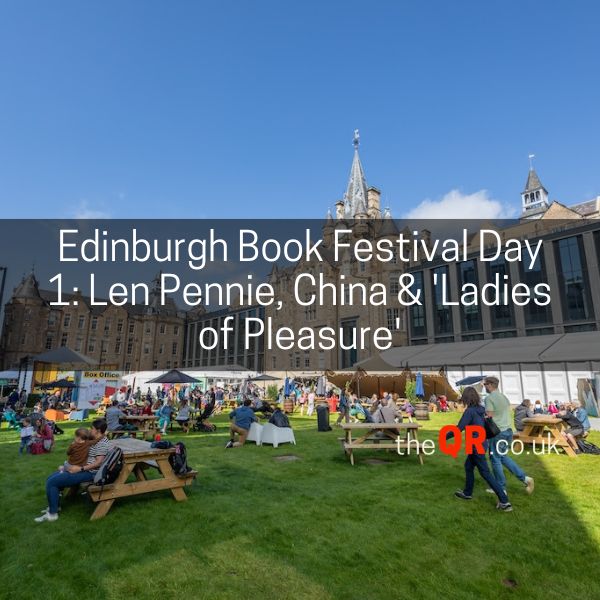
With so many book events to choose from each day, the Edinburgh International Book Festival offers a huge variety of subjects and authors to delve into. Today I listened to women talking about ‘How Not to Lose Endangered Languages’, ‘China’s Internet’, and ‘Ladies of Pleasure’. Quite the eclectic mix.
The Futures Institute is a great venue, and whilst I loved going to Charlotte Square in the past, I have got very used to this compact area with various theatre spaces. It’s well-organised and seems to run smoothly. That said, if we get rain, it might not feel quite so much like the picnic/festival atmosphere that prevailed today.
Preserving Endangered Languages and Navigating Digital Censorship
So, back to the women. First up was Scots poet and defender of the Scots language, Len Pennie and author/journalist Sophia Smith Galer discussing how languages can just disappear, particularly if the diaspora fails to nurture them and what we can do to preserve and encourage the use of ‘non-standard’ languages in particular. Pennie was brought up in a household that included her grandparents, and the Scots tongue was what she heard and spoke first and foremost.
Smith Galer was brought up in a household where her mother and nonna spoke what she accepted as Italian. She didn’t learn it and, despite reading Arabic and Spanish at university, still couldn’t speak Italian. When she finally decided to teach herself, not only did she discover she had a facility for Italian, she also discovered that her mother and nonna weren’t speaking Italian after all. What they spoke was a very specific language derived, like Italian, from Latin, but subtly—and sometimes not so subtly—different. And it transpired there are many other variants too, spoken by quite a lot of other Italians, but potentially not enough to keep them going for much longer.
“Pennie was brought up in a household that included her grandparents, and the Scots tongue was what she heard and spoke first and foremost.”
There are no straightforward answers as to how to preserve a language, but Pennie’s impassioned plea that it’s not about the language, per se; it’s about the people, resonated, and she suggests that you encourage older people to keep using the vernacular they were brought up on but teach youngsters too. Learning that using your ‘common tongue’ is not something to be ashamed of is key and, wonderfully, those suffering from some signs of dementia often respond to songs in the language of their childhood, which Pennie actively encourages. ‘Use it or lose it’ indeed.
Yi-Ling Liu discussed the issues explored in her non-fiction book The Wall Dancers with Festival Director Jennie Niven. The title is reflective of being held captive (the wall) and learning how to skirt around restrictions on your freedom (dancing), and she spoke with authority about examples of how this can be seen in practice in China. She is Hong Kong Chinese, and has also been educated in America and mainland China. At fifteen, she interned at a Beijing newspaper and had her first taste of censorship. With her degree in English and creative writing, she returned to Beijing to pursue a career in journalism, and she described how the internet has changed the lives of the majority of Chinese people—over 90% have access to the internet, mainly on mobile phones.


She gave examples of the new opportunities this access brought with it, but then the clampdowns that ensued. She made no moral judgement, merely observed. Audience questions raised issues of the posturing that the reach of the internet allows China, but also a perhaps more worrying trend of citizens self-regulating, by not broaching subjects perceived to be banned. A phenomenon also being witnessed in the West. A sobering thought.
Female Sexuality and Pleasure Throughout History
‘Ladies of Pleasure’ was a discussion by three academics with an interest in women’s sexuality as depicted—or not—throughout history. It was engaging, funny and passionate. Sex historian, author, broadcaster and podcaster Kate Lister was candid and gave good stats on all sorts of female pleasure-related topics. She’s not shy and revealed some quite astonishing facts and figures.
“Yi-Ling Liu discussed the issues explored in her non-fiction book The Wall Dancers with Festival Director Jennie Niven. The title is reflective of being held captive (the wall) and learning how to skirt around restrictions on your freedom…”
Ancient historian, author and presenter Jean Menzies is fascinated by the classical world and has been delving into the evidence about women, sex and pleasure way back when. Have things changed much between then and now? Hard to tell, when even the little evidence that has been unearthed—literally—is misconstrued. Both Lister and Menzies agreed that no one is likely to want to either set up or donate to a ‘sex toy’ archive—and who tells women’s stories anyway? It’s a dilemma.
Ashley Douglas spoke passionately about the sixteenth-century ‘Sappho’ Marie Maitland, whose love for other women she uncovered through rigorous research using primary sources. She does not doubt the importance of her findings, despite some academic dissent about the authorship—or meaning—of the erotic lesbian poetry she has uncovered. In her case it’s personal, and her passion is electrifying. I for one learnt things, laughed and gasped at some other things and was entertained, whilst being educated too. What a fine way to end my first day at the Festival.
Featured Image: Edinburgh Futures Institute – Edinburgh International Book Festival – provided by Festival PR.