
The term space superiority is in vogue these days. According to the United States Space Force (USSF):
Space superiority allows military forces in all domains to operate at a time and place of their choosing without prohibitive interference from space or counterspace threats, while also denying the same to an adversary. Space superiority extends beyond protecting friendly space capabilities from attack; it also encompasses protection of friendly forces in all domains from space-enabled attack.
To me, space superiority involves the ability to achieve “command of a particular point in space” for the time required to achieve a specific end goal. By extension, space superiority means developing the logistics to maintain a strategic edge for yourself and denying your competitor/adversary that same advantage in space. This would also mean achieving the strategic high ground in space, as nations have done throughout history on land, in the air, and at sea, especially in times of crisis and/or conflict.
China defines space superiority as achieving space logistics and infrastructure, and then using them for the kind of war it might fight. This aspect was proven during my research trip to China to study their space program. The question we should ask when we consider the use of space superiority is what kind of war will it support: a limited war, a protracted war, a gray zone conflict, or a major war in space?
If you notice, the focus on what constitutes space superiority is different for China. Consequently, the United States is watching the wrong indicators of Chinese space power. Most analyses seem to concentrate on the number of satellites launched and China’s counterspace weapons, but these reveal only part of the story. While we learn about Chinese satellites’ maneuvers in space, such as those undertaken in July 2025 by the Shijian 21 and Shijian 25, they tell us little about their purpose and strategic effects.
Positions in space are the newest strategic high ground, offering persistent surveillance, precision navigation, global communications, missile warning, and rapid targeting data. To me, the state that sustains these functions while denying them to an adversary shapes the terms of conflict; the same logic extends to building presence on the Moon or Mars. In maneuver warfare, the side that observes, orients, decides, and acts most quickly – as John Boyd recognized – seizes the initiative, but in space, maneuver is bound by orbital mechanics, communications latency, fuel, and geometry.
Therefore, possessing and launching satellites is not enough; a capable force must know its delta-v budget, how it sustains itself, and how its trajectory choices trade vulnerability for opportunity. These aspects are revealed in China’s focus on space logistics as a key component of its space superiority concept.
The Moon as Strategic Geography
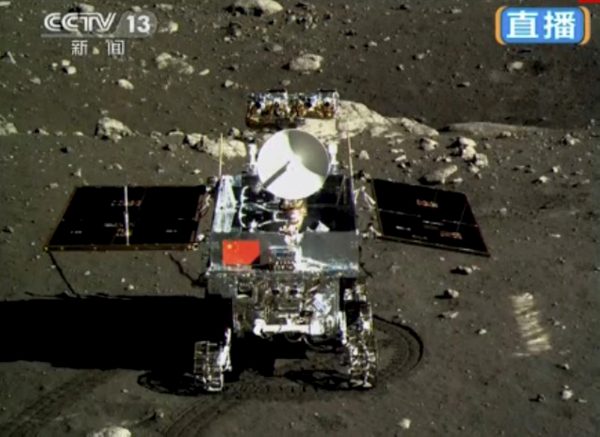
The most consequential development is that China is beginning to solve the logistics problem of warfare in space. For instance, the upcoming Chang’e 7 lunar mission, to be launched later this year, is surveying the Lunar South Pole and searching for resources, including water ice in permanently shadowed regions. If Chang’e 7 is successful, the mission will contribute to the knowledge China needs for sustained operations on and around the Moon.
The immediate gain for China is information about strategically useful geography. Where is lunar water located? How concentrated is it? Can robotic autonomous systems reach it? Where are the most useful landing areas? Which locations combine access to resources with favorable sunlight and communications? These are key questions because transporting everything from Earth is expensive, as I have argued elsewhere.
If lunar water can eventually be extracted at a useful scale, it could support life-support systems and potentially be separated into hydrogen and oxygen. That raises the long-term possibility of producing propellant on the Moon. This becomes more significant when Chang’e 7 is connected to Chang’e 8 and the proposed International Lunar Research Station to be built by China in 2036. As per an article by Chi Wang et. al, “Taking into account the future location of the lunar research station, the CE-7 [Chang’e 7] mission will select the lunar south pole region as its preferred landing area.”
China is accumulating the scientific knowledge, surface experience, communications architecture, and robotic capabilities required for a more persistent lunar presence: think space logistics that result in space superiority.
Planetary Defense
China’s planetary defense program presents an even clearer example of why U.S. assessments must move beyond the binary distinction between civilian and military space when understanding China’s conception of space superiority.
China is developing technologies to track, approach, and strike objects at enormous distances. According to an article by Nikola Schmidt et al, “China’s planetary defense program has evolved from scattered scientific initiatives into a strategically integrated component of its space policy with the aim of contributing to the Chinese dream of becoming a recognized global power.”
Wu Weiren, the chief designer of China’s Lunar program, and director and chief scientist of the Deep Space Exploration laboratory, stated that “we have planned to launch this effort [planetary defense] focusing on a kinetic impact test against an asteroid next year [meaning 2026].” The dual-use capability is pretty obvious.
In accordance with Wu’s statement, China has announced plans for an asteroid-deflection demonstration involving observation of a target followed by a high-velocity kinetic impact. Reporting on Chinese research has discussed an impactor striking at approximately 9 kilometers per second, roughly Mach 26.
The proposed Chinese mission has identified asteroid 2015 XF261, estimated at around 30 meters in diameter, as a potential target. Simulation studies within China have shown that a 580-kilogram impactor traveling at about 9.3 km/s could produce measurable orbital changes.
Li Mingtao, chief scientist at the asteroid monitoring and early warning research center under the China National Space Administration (CNSA), announced on June 30 that China will establish a coordinated ground- and space-based monitoring system for near-Earth asteroids to provide early warning and support for planetary defense against potential asteroid impacts. As Li put it, “Early warning time, a key factor in asteroid monitoring, varies dramatically depending on the asteroid’s size and when it is discovered.”
Smaller asteroids are hard to spot, so China is building a comprehensive monitoring system to detect them. This includes both ground-based and space-based monitoring constellations that are not limited by atmospheric and day-night constraints, especially from the sun’s glare on ground-based monitoring systems.
To hit a relatively small asteroid, China must find the object, characterize it, calculate its trajectory, navigate across deep space, conduct autonomous terminal guidance, and physically interact with the target at extreme velocity. Those competencies will play a critical role in a future operating environment extending beyond geosynchronous orbit and towards building a cislunar space domain awareness capability. The ability to deflect an asteroid that small and that fast can be used to strike enemy targets in times of conflict. Moreover, China’s growing ability to track small asteroids means they are building a very efficient space tracking and monitoring system.
Shijian 25 and Maneuver Without Regret
China’s work on orbital refueling could have even more immediate military implications. Shijian 25 was launched in January 2025 specifically to test technologies for satellite fuel replenishment and mission extension. This means that a satellite can maneuver without regret, as it moves beyond the fuel constraints imposed by satellite designs.
Today’s satellites carry finite propellant. For instance, a People’s Liberation Army Aerospace commander knows that moving a satellite could improve survivability but also understands that repeated maneuvers shorten its operational life due to fuel constraints. Consequently, fuel scarcity shapes operational behavior and how you may fight. Refueling begins to change the equation.
Say there is a crisis over Taiwan. If Chinese spacecraft believed to support targeting, communications, or space-domain awareness could maneuver repeatedly, replenish propellant, and return to useful orbital positions, U.S. planners would confront a considerably more dynamic problem than today’s relatively predictable orbital architectures.
China, for a long time, has treated space assets as critical infrastructure, and this does not include just satellites and satellite internet. The goal is for China’s spacecraft, including satellites, to be able to reposition when demanded by operational circumstances, without having to view each such maneuver as a deduction from mission life. These goals are supported by China’s 15th Five-Year Plan (2026-2030).
China treats in-space refueling and on-orbit logistics as critical infrastructure. This means it is thinking of space in terms of logistics: rendezvous of space vehicles, autonomous docking, standardized interfaces, fuel transfer, servicing of spacecraft, and eventually orbital depots. Last year, Tsinghua University’s Shenzhen International Graduate School demonstrated the operation of a flexible robotic arm in orbit, advancing orbital refueling technology to extend spacecraft lifespans.
Military Thought and Space Capabilities
Institutionally, China’s 2024 dissolution of the PLA Strategic Support Force (PLASSF) and establishment of separate Aerospace, Cyberspace, Joint Logistic and Information Support Forces should be understood as a significant adaptation. The PLASSF integrated multiple information-related capabilities. The new structure allows for greater organizational specialization while preserving its connection to China’s broader concept of systems confrontation. This aligns with China’s military doctrine, which places space within a broader framework of integrated joint operations rather than treating it as an isolated platform or service.
The PLA Aerospace Force is designed to consolidate China’s space and counter-space capabilities under a unified command structure with direct reporting to the Central Military Commission (CMC). This enhances central control, reduces bureaucratic friction, and enables more rapid decision-making in crisis scenarios. It also allows for clearer delineation of roles among the other newly established forces, including the Cyberspace Force and the Information Support Force, each of which addresses distinct but interrelated aspects of information warfare. Doctrinally, the establishment of the Aerospace Force reflects a maturation of China’s approach to space power.
Chinese military thought argues that understanding of the military balance is fundamentally shaped by “systems warfare concepts,” according to which modern warfare is a confrontation between opposing operational systems. This view is tied to an era of informatization and intelligentization in which battlefield dominance increasingly depends on information acquisition, transmission, and exploitation.
To degrade an adversary’s system of systems, one must be able to see, track, disrupt, and, if necessary, disable the space-based elements that hold that system together. The end goal of such a space strategy is not the satellites themselves but what strategic effects they offer, in terms of the kind of war China aims to fight.
Therefore, China’s conception of space superiority is deeply interconnected with its ability to develop space logistics, economic power, an adaptable military, and a strategic understanding that space capabilities such as maneuver and refueling are essential to the development of a mature military doctrine. Ultimately, the future of space power will depend on combining information superiority with sustained maneuver grounded in a sound political understanding of why achieving space superiority matters.
The views expressed are those of the author and do not reflect the official guidance or position of the United States Government, the Department of Defense, the United States Air Force, or the United States Space Force.