
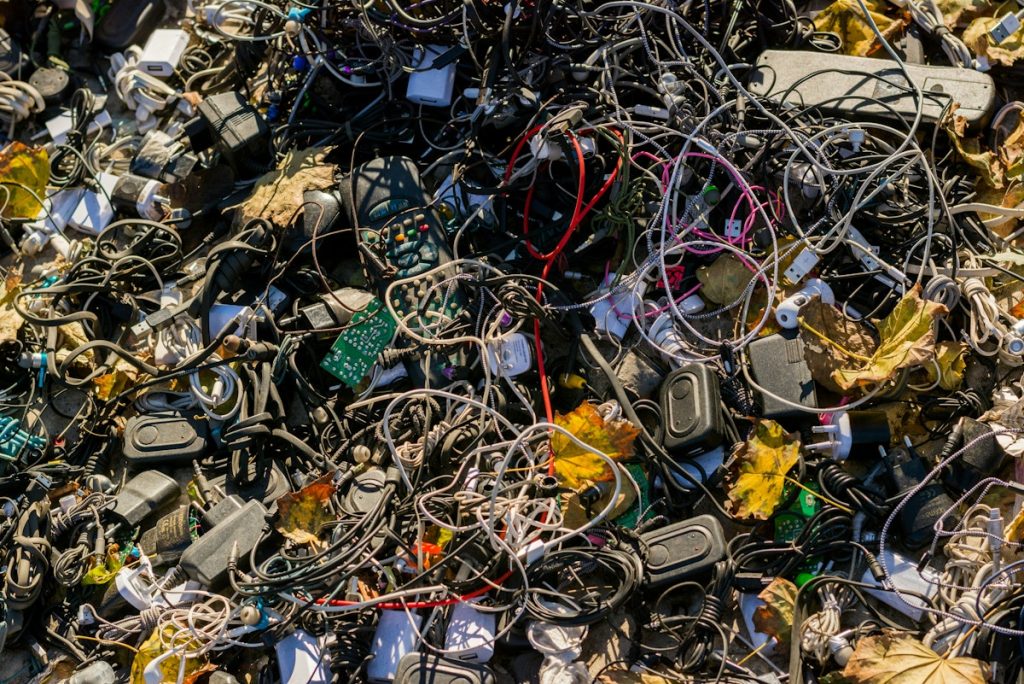
On the morning of July 7, 2026, a shipping container declared to contain tin ore caught fire shortly after offloading at Port Klang, Malaysia. After firefighters doused the flames, they pried open the steel doors and found no industrial metals — only a cargo packed full of scorched electrical and electronic waste, or e-waste.
Investigators and NGOs have long raised concerns about containers with falsely declared documents regularly slipping into Malaysia’s illegal recycling yards. To slip past customs, smugglers often falsify paperwork, declaring hazardous waste as legitimate raw materials.
However, this particular shipment met with a strict new rule: an absolute ban on e-waste imports that took full effect on April 1, 2026, under Malaysia’s new Customs Order.
But enforcing this rule means combing through millions of containers a year, playing a game of whack-a-mole against a black market that disguises itself as honest green businesses.
Nik Ezanee Mohd Faisal, the chief of the Malaysian Border Control and Protection Agency (AKPS), has told reporters that the sheer volume of containers passing through national ports daily makes manual detection challenging.
Between Jan. 26 and July 7, a specialised e-waste joint task force called Op Green Shield has inspected 685 containers, an AKPS spokesperson told Mongabay. Among these containers, 143 containers packed with 3,370 short tons (3,057 metric tons) of e-waste have already been sent back to their countries of origin since operations began. Another 531 containers, including backlog from previous operations, are earmarked for the next phased repatriation process that began on July 8.
“
I’m worried for my own health, as well as my aging parents. They would live here for the rest of their lives and having constant exposure to these chemicals in the air would be horrible for their breathing. Sometimes I feel like I can’t breathe.
Tan Yu Jinh, resident, Telok Panglima Garang
By contrast, between January and May 2026, Port Klang alone processed almost 6.4 million twenty-foot-equivalent units of cargo, or about 3.2 million standard 40-foot (12.3 meter) shipping containers.
Evolving transport routes
Driven by rapid consumer tech trends, electronic devices are replaced by newer gadgets faster than ever. In 2022 alone, the world created 68.3 million short tons (62 million metric tons) of e-waste. Of that, less than a quarter was documented as properly collected and recycled, with little data on where the rest went.
An investigation by the Basel Action Network (BAN) found that US e-waste brokers alone sent an estimated 1,949 containers out of the country’s ports every single month, with Malaysia repeatedly coming up as a primary destination.
To avoid paying more for proper hazardous waste disposal at home, businesses and consumers in wealthier nations like the US, Japan and parts of Europe export their e-waste to Southeast Asia. This trade continues despite the Basel Convention, an international treaty established to regulate the transport and trade of hazardous waste.
Here in Malaysia, local scrapyards and informal dumps process the materials, in many cases with little to no environmental oversight.
“The big problem in this case is that most of the e-waste sent to Malaysia is coming from the US, which is not Party to the Basel Convention,” Jim Puckett, the executive director of BAN, told Mongabay in an email. “The US is therefore, shamefully, under no obligation to do anything about the e-waste trafficking from the US to Malaysia. This places the Malaysian government in a very unfortunate situation.”
Despite this legal loophole, Puckett said some Western exporters have reportedly agreed to take back their illicit e-waste shipments. While he called this cooperation a positive development, he said waste must be sent back to the country of origin instead of being diverted and dumped into another vulnerable country.
Puckett said both the Malaysian and US governments should be transparent about the returned shipments, so that “no third country is laden with these e-wastes and the ensuing pollution that it will bring,” he said.
Historically, China had taken in nearly half of the world’s plastic waste since 1992, but its 2018 import ban fractured the market, forcing brokers to seek out friendlier and less regulated shores. Now, with countries like Malaysia slamming their doors shut on e-waste, Puckett said the trade is migrating to the United Arab Emirates, India, Pakistan, Indonesia, and the Philippines.
He added that smugglers are also becoming more creative in covering their tracks. “We suspect the brokers are trying new tricks to avoid BAN’s detection and alerts to the Malaysian authorities,” he said. “For example, they are distorting the transportation routes of the shipments — sending them first to South Korea, Singapore or other destinations before re-shipping them from those destinations to Malaysia.”
Breathing room for domestic e-waste
While the new regulation pushes global brokers to reroute their illicit waste, it’s creating much-needed room for Malaysia’s domestic recycling ecosystem to grow.
Mohamed Tarek El-Fatatry, who runs the local e-waste collection and recycling facility ERTH (Electronic Recycling Through Heroes), welcomed the ban, noting that it forces the industry to process e-waste collected locally instead of managing the mountains of foreign waste.
“There’s so much waste in the country, so this ban is a good thing because it means we get to focus on domestic recycling efforts instead of importing the other stuff,” Mohamed Tarek said. He added that before the import ban, local recyclers who complied with environmental regulations were at a disadvantage when competing against rivals working with imports.
Imported e-waste is often pre-sorted by syndicates overseas, Mohamed Tarek said, allowing operators to select only high-value components — such as motherboards containing precious metals like gold — that can yield millions of ringgit per container when processed.
For domestic e-waste, there are more labour-intensive steps involved. “You don’t just collect the motherboard, you collect the whole computer,” he said. “Then you have to process the lower-value metals and nonprecious materials, which have a lower value per kilogram. But if you focus on motherboard only, then you’re printing money. Run the motherboard container through the furnace and tomorrow you have metals ready to sell.
“If recovery facilities have the option between buying imported stock and local stock, they will always buy the imported stock because they can cherry-pick the materials and much of the undesired materials and plastics would already be filtered out,” Mohamed Tarek added. “Whereas local stock would be a mixed bag and needs extra effort to sort and dismantle.”
He said it’s this economic reality that fuels the environmental hazards found in illegal scrapyards. Because unlicensed operators lack legal access to municipal landfills to dump large amounts of plastic leftovers after retrieving the valuable materials, they use various ecologically destructive methods to handle the waste.
Some operators torch the entire component to melt away the outer plastic casings and isolate the precious metals inside. Others manually strip out the valuable materials first, then either incinerate the remaining plastic residue or crush it into pieces small enough to blend into soil and be dumped into the surrounding environment.
“Illegals will put a whole router into the furnace with the plastic because otherwise they will just end up with tons of plastic, and they don’t have the means to go put it in a landfill because they’re illegal,” Mohamed Tarek said.
A health hazard
Communities living close to these illegal operations frequently report chemical smoke settling over their homes when illegal operators turn on the furnaces at night.
Tan Yu Jinh, who lives in a residential area in Telok Panglima Garang, located 30 kilometres (19 miles) east of Port Klang, said although he can’t pinpoint the location of the burning, the odours force him to keep his doors and windows sealed. Frustrated by air pollution during nights when burning takes place, Tan has already filed two complaints with the relevant authorities.
He noted that the burning has become less frequent since April.
“It doesn’t smell like regular open burning. It almost smells like burnt plastic,” he told Mongabay in an interview, describing a biting stench that clings to the back of the throat. “I run to the bin outside when I want to throw the rubbish and back indoors, not because I don’t want to spend time outside, but I would find it difficult to breathe because of the air outside.”
Older electrical devices are commonly treated with chemicals designed to prevent fire hazards. When these devices are burned, they release toxins into the air, alongside heavy metals like mercury and cadmium. Without industrial filtering systems, this airborne fallout can settle directly into local neighbourhoods, posing long-term health and environmental risks.
“I know the smell is coming from something that shouldn’t be burned,” Tan said. “I’m worried for my own health, as well as my ageing parents. They would live here for the rest of their lives and having constant exposure to these chemicals in the air would be horrible for their breathing. Sometimes I feel like I can’t breathe.”
This story was published with permission from Mongabay.com.