
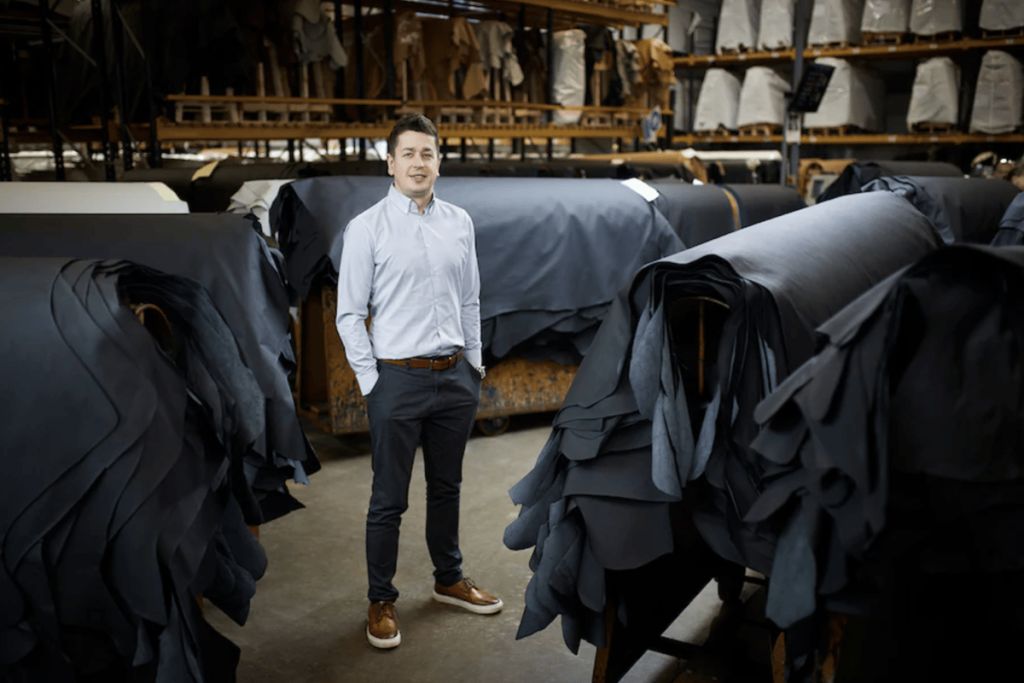
Nicholas Muirhead, chief executive of eighth-generation family firm Scottish Leather Group, tells Stephen Emerson how his company continues to evolve through expansion abroad and innovation at home
Nicholas Muirhead can trace his family’s involvement in the leather trade back eight generations, but the business he now runs as chief executive looks nothing like the one his ancestors would recognise.


Scottish Leather Group’s client list runs from Rolls-Royce, Bentley, Aston Martin and McLaren to Emirates, British Airways and Singapore Airlines, and its newest product line didn’t even exist four years ago.
Nicholas joined the family firm straight from the University of Edinburgh, where he studied chemical engineering, followed by a postgraduate marketing qualification at Strathclyde.
After joining the family firm in 2007, he moved through production and commercial roles before running subsidiary companies as managing director, then stepped up to chief commercial officer and, in September 2023, chief executive.
The unusual engineering-to-marketing route, Nicholas says, gave him a pragmatic, problem-first approach to operations alongside a fuller understanding of routes to market, positioning and brand equity – a broader foundation than most single-discipline executives get.
The group’s footprint is genuinely global despite its Renfrewshire roots. Alongside its headquarters at Bridge of Weir and a cutting facility in Paisley, the company operates a wholly-owned factory in Guangzhou, China, under its Muirhead aviation brand, cutting and sewing full seat covers for airline customers.
A separate Chinese joint venture finishes leather bound for Polestar, while a partnership on the Mexican border with Texas cuts automotive leather destined for Ford and Lincoln.
North America is currently the group’s strongest export market, which Nicholas attributes directly to US tariff policy pushing manufacturers toward domestic sourcing, which is good news for Ford and Lincoln supply.
Aviation demand from China and Southeast Asia – the fastest-growing airline markets globally – is the firm’s other main pillar of growth.
UK automotive remains core, but has faced a tougher run amid a geopolitical landscape Nicholas reports “seems to move almost on a daily basis”.
Client expectations have shifted hard in five years, he adds. Sustainability criteria now sit alongside price and technical spec as genuine deciding factors for customers, and development timelines have compressed sharply as Chinese firms bring new models to market faster than traditional Western makers.
“There’s less understanding that something takes time to do,” Nicholas says. “You get two options – you can complain about it, or you say, right, this is our new reality.”
Competing against lower-cost global producers, he argues, comes down to more than price.
The group’s premium positioning rests on full farm-to-finish traceability, decades of craftsmanship, and a shift from simply supplying hides 15 years ago to now delivering complete sewn covers integrated with its own protein padding material, BioPRO Foam.
“It’s got to have substance,” Nicholas says of the firm’s premium tag.
That has meant turning down business that gets too cheap or too competitive to protect the group’s workforce of more than 600 people in Scotland.
And that substance increasingly includes environmentally friendly credentials. The group published its first sustainability report in 2003 and has just confirmed it has hit net-zero on scope one and two emissions, achieved without any carbon offsetting, through on-site waste recovery, water recycling, a solar PV array commissioned this year, and a deliberate switch to buying renewable energy at a premium over conventional supply.
Where technical specification and price are equal between competitors, Nicholas says, sustainability becomes the differentiator, and some customers now actively promote the group’s carbon impact data to their own end users.
The firm’s standout new venture is its BioPRO Foam, a collagen-based foam developed over four years from the group’s position as the UK’s largest raw collagen producer, itself a byproduct of leather manufacturing.
The foam is naturally fire retardant and eliminates chemicals such as melamine found in conventional foams.
Having secured a global patent, the group has reinvested in a site on Dunn Street in Dalmarnock, Glasgow, a facility it had divested in 2021 during post-Covid restructuring, with aviation customers already signed up across first, business and economy class seating, although Nicholas says he is not yet in a position to name them.
That premium path, he believes, is not just Scottish Leather Group’s strategy, it is one the whole sector has to go down.
Energy costs in Scotland run well above the group’s competitors in Europe and China, and the labour it employs, while skilled, is expensive relative to mass-production rivals.
Increasingly, Nicholas says, that labour needs to shift toward higher-skill roles suited to automation, robotics and AI adoption rather than volume manufacturing.
“I think mass production is going to be difficult to do in Scotland and the UK to compete globally, given our current climate,” he says. “Not saying it’s impossible, but it’s difficult.”
Nicholas adds that premiumisation isn’t a niche choice for a heritage brand, it’s the only realistic route left for Scottish manufacturers trying to compete on a global scale.
How a byproduct became the group’s latest patent
Scottish Leather Group’s BioPRO Foam began with the question of what else could be done with collagen, the raw material the firm already produces more of than any other UK manufacturer.
Collagen is a byproduct of the tanning process, traditionally sold into food and cosmetics markets, used for sausage casings and as a makeup ingredient.
Under innovation lead Dr Warren Bowden, the group’s team identified foaming properties in the material and, over four years, developed it into a viable seating foam.
The resulting product is naturally fire retardant and strips out chemicals such as melamine and PFAS commonly found in conventional foams.
After early conversations under NDA generated strong customer interest, the group secured a global patent and committed capital to reopening its Dunn Street site in Glasgow’s East End, previously mothballed in 2021 during post-pandemic restructuring.
Aviation clients are already signed up to use the foam, adding a third product line – alongside leather hides and sewn covers – to a customer relationship that, in some cases, now spans all three.
For a business chasing diversification beyond automotive and aviation leather alone, it is the clearest evidence yet that the group’s strategy is working out well.
Scottish Leather Group keypoints
1 – Eighth-generation ownership
Nicholas Muirhead joined the family firm in 2007 and became chief executive in 2023, following roles in production, commercial and subsidiary management.
2 – Three-site Scottish footprint
HQ at Bridge of Weir, cutting at Paisley, and a reopened foam facility on Dunn Street in Glasgow.
3 – Global manufacturing partnerships
A wholly-owned factory in Guangzhou, a Chinese joint venture finishing leather for Polestar, and a Mexican border facility cutting leather for US auto makers Ford, Lincoln and Lucid.
4 – Net-zero on scope one and two
Achieved without carbon offsetting, via waste recovery, water recycling, solar PV and renewable gas procurement.
5 – UK’s largest raw collagen producer
The byproduct underpins BioPro, a patented, fire-retardant foam now supplied to the group’s aviation clients across all cabin classes.