
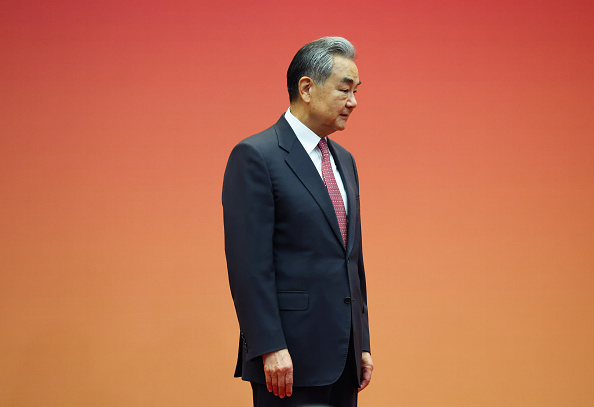
Chinese Foreign Minister Wang Yi toured the Nordic countries this week, breaking diplomatic bread in capitals where a Chinese foreign minister had not visited, in some cases, for almost a quarter of a century.
It was an attempt, experts say, to improve relations with one of Europe’s most China-sceptic regions, despite ongoing bilateral tensions around strategic investments, spy scandals, Chinese ships damaging Baltic Sea infrastructure, and Beijing’s staunch support for Moscow. It was also an opportunity to remind the Nordic countries – and Denmark in particular – that China is always waiting in the wings as America becomes increasingly fickle.
“The Nordics realise that the US is no longer a reliable partner, while China has become an increasingly indispensable actor because of the scale of the Chinese market, the centrality of Chinese supply chains, and the superiority of China’s green technologies,” said Andreas Forsby, a China expert at the Danish Institute for International Studies in Copenhagen.
Back in the early 2000s, when many in the West were trying to cultivate closer ties with Beijing, the Nordic countries competed to see which had the closest partnership with China. But from 2018 onwards, as the US-China rivalry intensified, they became embroiled in a series of bilateral disputes with Beijing, Forsby noted. China’s support for Russia’s war in Ukraine made relations even more fractious.
Regional meetings
As he toured the Nordic countries this week, Wang knew that, beyond the red carpet and polite handshakes, there would still be frustrations. Each capital had its own grievances and priorities.
Denmark’s Foreign Minister Lars Løkke Rasmussen told journalists he wanted an “open and free conversation with a high degree of robustness” with the Chinese, and that there should be “respect for the fact that we have different points of view.”
Norwegian Prime Minister Jonas Gahr Støre, meanwhile, said he wanted China to use its Kremlin connections to help bring about a negotiated settlement to the war in Ukraine, which he said would ultimately improve China-Europe relations.
“China is probably the country with the best and most direct access to the Russian leadership. We expect, hope, and strongly urge China to use that channel,” Gahr Støre said.
Meanwhile, Finland welcomed recent Chinese statements against escalation in Ukraine, while acknowledging an undercurrent of unresolved tensions between Beijing and Helsinki.
In June, Finland’s security police, Supo, unveiled a plot involving Chinese attempts to buy 10 properties near sites of strategic importance to national defence. Just a few weeks later, Chinese officials harshly criticised the Finnish embassy in Beijing for organising a so-called ‘rainbow run’ to show support for LGBTQ communities.
Despite these issues, the Nordic nations seem to be adopting a fresh, realpolitik approach to relations with China. Still, tensions continue to simmer beneath the displays of diplomacy.
“Regardless of this newfound pragmatism, the Nordics remain deeply mistrustful of China given its support for Russia’s war in Ukraine, its authoritarian regime under Xi Jinping, and its increasingly unbalanced trade practices that threaten Europe’s economic sustainability,” Forsby said.
Shared Arctic ambitions
One key area where Nordic and Chinese interests overlap is the Arctic.
In the past, Beijing’s ambitions for the region ranged from research stations to deep-water ports and runways for Arctic expeditions.
However, the Nordic countries blocked many of these proposals because they didn’t see Beijing as a trustworthy partner. Washington also made it clear that China should not be allowed to gain a strategic foothold in the region.
With US President Donald Trump’s aggressive stance on Greenland, however, China now sees a crack in the Nordics’ resistance.
“Strategically, for Beijing, the Nordics are becoming important, especially the Arctic, where Russia is active, and China wants to be,” explained Dr Julie Chen from the University of Helsinki’s Asia Studies Department. “So they use the Nordics as a sounding board.”
Still, even though Wang held talks and a working dinner with his Danish counterpart and had an audience with King Frederik X, he did not meet with Prime Minister Mette Frederiksen, who is known for her hawkish stance towards China. In her two terms in office, Frederiksen has yet to visit Beijing.
“China is powerful in many ways, and the Nordics are small. But it doesn’t mean the weaker countries have to lose. You just have to play the game,” said Chen, noting that all five Nordic nations are now NATO members and have “beefed up” their capacity to protect themselves.
“They understand there are risks in dealing with China in every area.”
INTERVIEW: EU prepares Arctic ‘decade’ amid Greenland tensions
NUUK, Greenland – It is the “decade of the Arctic” and the EU is moving…
3 minutes
(cm, aw)