
The Moon’s surface has been sampled, scanned, and photographed for decades, yet one of the most basic questions about it remains unsettled: what, exactly, is the whole thing made of from place to place?
That gap matters because the Moon’s chemistry is one of the clearest records of how it formed, cooled, and changed over time. It also matters for a more immediate reason. The lunar south pole, now a major focus for exploration planning, cannot be understood fully without a better picture of its elemental makeup.
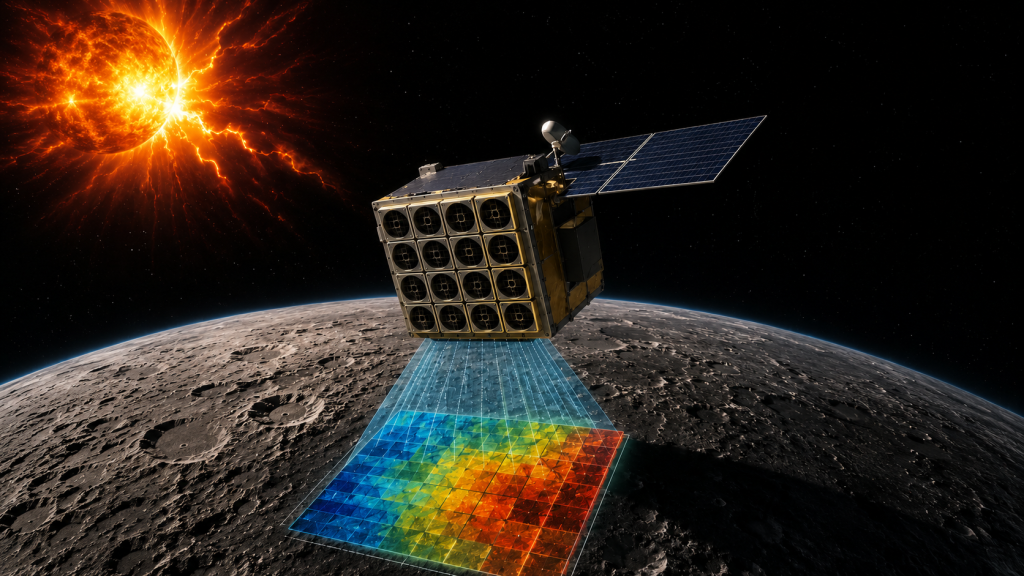
A team from Tokyo Metropolitan University says a compact X-ray telescope may finally make that possible. Using numerical simulations, the researchers found that a lightweight instrument orbiting the Moon could produce the first complete map of elemental abundance across the entire lunar surface, something past missions have not been able to achieve.
Their results suggest that one telescope could map five key elements across the Moon in about two years. A larger system using 25 telescopes could do the job faster and at finer detail.
A long-standing blind spot in lunar science
Scientists do not need lunar chemistry simply to fill out a catalog. The balance of elements such as oxygen, iron, magnesium, aluminum, and silicon helps constrain models of the Moon’s origin and its later geological history, including ideas about a lunar magma ocean early in its past.
Returned samples from Apollo and other missions offer precise data, but only from limited places. Orbital methods help widen the view, though each comes with tradeoffs. Ultraviolet, visible, and near-infrared spectroscopy can map some minerals and some elements, but the results can depend heavily on modeling, especially for lighter elements. Gamma-ray spectroscopy has measured several elements successfully, yet it has struggled to pin down light elements such as magnesium, aluminum, and silicon with low uncertainty.
X-ray fluorescence offers a different path. When solar X-rays strike the lunar surface, atoms in the soil emit element-specific X-rays in response. Instruments in orbit can detect those emissions and infer which elements are present.
That method is especially valuable for lighter elements, but it has been difficult to use on a global scale.
Past missions made progress without finishing the job. Apollo 15 and 16 mapped magnesium-to-silicon and aluminum-to-silicon ratios over only part of the Moon. SMART-1 detected titanium and iron in some regions, but low solar flare activity and radiation damage limited results. Chandrayaan-1 and Chandrayaan-2 produced valuable elemental maps, yet coverage remained incomplete. Chang’E-2 surveyed about 65% of the surface for several elements, still short of a full map.
Why full lunar maps have been so hard to get
The central problem is that X-ray fluorescence depends on the Sun, and the Sun does not cooperate on a neat schedule.
Solar flares provide the strong X-ray illumination needed for clean measurements, but they are transient. Mission lifetimes are finite. At the poles, where incoming solar X-rays are weaker, the problem gets worse. Instruments also degrade in radiation over time, reducing performance before a mission can finish a full survey.
The Tokyo Metropolitan University team, led by Airi Toida and Professor Yuichiro Ezoe, tackled those constraints by modeling a compact telescope system based on technology developed for GEO-X, a Japanese small satellite mission designed to observe Earth’s magnetosphere in soft X-rays.
The proposed lunar instrument uses a MEMS-based lobster-eye X-ray telescope, a CMOS detector, and an optical blocking filter. The design is compact, about 3U in size, and weighs less than 10 kilograms. That small mass is a major departure from conventional X-ray telescopes, which are generally too large and heavy for this kind of lunar mapping mission.
The lobster-eye design is important because it gives the system a wide field of view. Instead of observing only a narrow patch at a time, it can cover a broad area during a powerful flare. The team modeled a telescope with a 10-degree by 10-degree field of view, a 300-millimeter focal length, and sensitivity in the 0.3 to 2 kiloelectronvolt range.
The detector has also been tested in radiation conditions harsher than those expected in lunar orbit. According to the study, the loss in energy resolution remained within an acceptable range for the mission goals.
What the simulations say is possible
To test whether the concept could work in practice, the researchers built a numerical model of lunar X-ray emission and detector response. They assumed an observation altitude of 4,000 kilometers above the surface, roughly in line with the typical periapsis used for Artemis Gateway planning, and a mission encountering 300 solar flares per year when flare classes were averaged into M-class equivalents.
Under those assumptions, a single telescope could map oxygen, iron, magnesium, aluminum, and silicon across the entire Moon with a grid size of about 70 by 70 kilometers in two years.
That would already mark a major advance, especially because the model suggests the instrument could also work in polar regions that have been difficult to cover in past surveys.
The numbers varied by element. In the simulated mare region, observed fluorescent X-ray count rates were 0.8 counts per second for oxygen, 0.2 for iron, 0.01 for magnesium, 0.003 for aluminum, 0.008 for silicon, and 0.004 for sodium. In the highlands, oxygen reached 0.9 counts per second, iron 0.09, magnesium 0.007, aluminum 0.007, silicon 0.007, and sodium 0.003.
The study found that global observations of heavier elements beyond that set would be much harder. Calcium, titanium, and iron K-shell lines could in principle be resolved, but global mapping of several heavier elements would take far too long under the modeled conditions, in some cases more than a century. Those elements may still be accessible in localized regions during especially strong solar flares.
A 25-telescope array changes the picture
Because each telescope unit is so compact, the team also modeled a satellite carrying a five-by-five array, 25 telescopes total.
That configuration expands the field of view by a factor of 25 and allows the spacecraft to operate at a lower altitude, about 1,700 kilometers, while improving spatial resolution to about 30 by 30 kilometers. With that setup, the team estimated global observations of oxygen, magnesium, aluminum, silicon, and iron could be completed within about a year, while sodium could be added within two years.
The tradeoff is power. The study notes that each GEO-X payload uses less than 10 watts, most of it in the readout electronics, and that even if several sensors shared circuitry, a 25-detector system would still demand more power than a single unit.
The authors also noted limits in the model. It does not account for surface roughness, which earlier work suggests could cut actual counts by as much as half. In permanently shadowed regions, the model records non-zero signals because each observation cell is larger than individual shadowed patches and includes illuminated terrain nearby.
Practical implications of the research
A complete elemental map of the Moon would do more than settle a long-running scientific problem. It would give researchers a global chemical framework for interpreting returned samples, testing models of lunar formation, and comparing mare, highland, and polar terrains on equal footing.
It could also help guide mission planning. The south pole is drawing intense attention for future landings, and better chemical maps could help evaluate candidate sites and support in situ measurements or later sample-return efforts. Just as important, the study points to a lower-cost route for lunar science.
If a lightweight X-ray telescope can deliver global mapping from a small satellite, it could widen what future missions are able to do without relying on much larger spacecraft.