
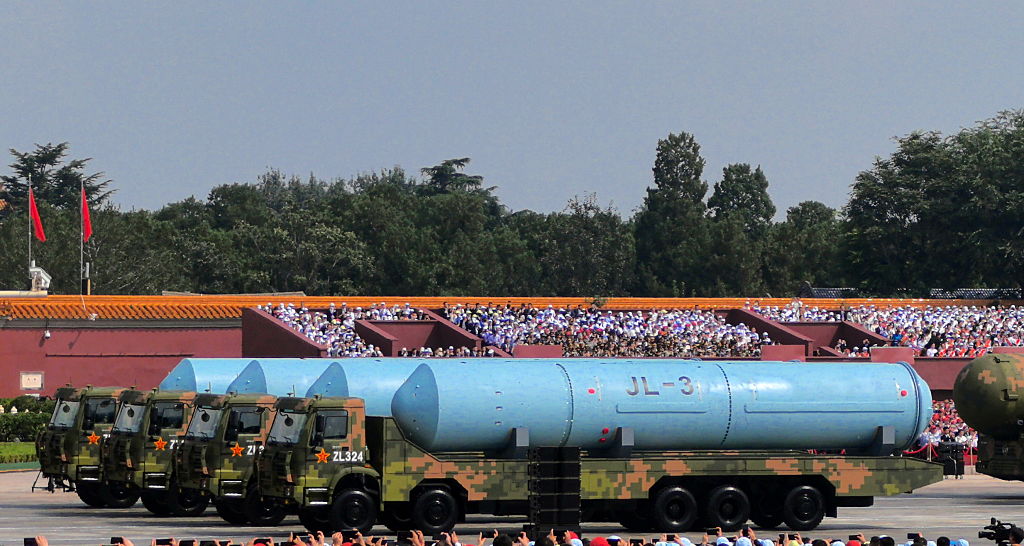

China said on 6 July that one of its submarines had test-launched a ballistic missile into the Pacific Ocean. This followed the signing of an alliance between Australia and Fiji by only hours.
ASPI analysts provide their views on this:
Malcolm Davis, senior analyst
The ink was barely dry on the historic 6 July alliance between Australia and Fiji when the response came from Beijing: a test into the South Pacific of a submarine-launched ballistic missile (SLBM), a weapon designed for nuclear war. This was hardly a subtle riposte to Australia and Fiji achieving a mutual defence agreement, called the Ocean of Peace Alliance (or Veitacini Treaty).
With the signing of the agreement, Fiji became Australia’s fourth full ally, after the United States, New Zealand, and Papua New Guinea.
The test should be seen as a clear warning by Beijing of its intent to challenge any effort by Australia to strengthen regional ties, particularly any that counter Chinese efforts for forward influence or even military presence. Although preparing for such a test usually takes months, the final timing can hardly be seen as coincidental.
The test also reinforces Chinese confidence in its military capabilities, including its nuclear weapons capabilities. This has been the fourth such test by China. The most recent had occurred in September 2024, when an intercontinental ballistic missile of the DF-31 type flew from Hainan to seas near French Polynesia. So, it’ll be interesting to see how close this test’s warhead came to Fiji.
Australia should take this Chinese response seriously and see it in a similar light to last year’s naval deployments – the first of which, in March, circumnavigated Australia, conducting unannounced missile drills in the Tasman Sea along the way. Beijing is sending a clear message to Canberra, Wellington and Southwest Pacific states that it will coerce through implied military force to achieve its strategic objectives. In this case, China’s goal is a Southwest Pacific that is compliant and accepting of Chinese presence and influence. An SLBM test in Australia’s region is about as strong a signal of intent as it can get.
Mike Hughes, Defence Strategy Program director
It is unlikely the test is directly linked to the Australia–Fiji deal. And Beijing would be happy if that’s all the region takes from the test. The key story here is that China’s military and nuclear modernisation continues apace – the very thing that causes anxiety across the entire region and likely a core driver for states such as Fiji and Papua New Guinea to form alliances with Australia. There should be no remaining doubt about China’s intent for dominance in the region, across every field of the economy, technology and the military and across every domain from the sea to the sky, cyberspace and space itself.
Justin Bassi, executive director
China’s 6 July test represents an escalation in its ongoing military expansion and sends a deeply concerning strategic signal to Australia and the wider Indo-Pacific.
This development demonstrates an increasing willingness by Beijing to project power far beyond its own shores. China is not a Pacific nation, yet it is seeking to establish power in the region through increasingly assertive military activities. While Beijing has pursued global influence through a more gradual and surreptitious strategic approach, its engagement throughout the Pacific has been far more overt, increasingly relying on demonstrations of military capability and strategic coercion.
The timing of this provocation is no coincidence. It comes as Australia continues to strengthen its position as a leading Pacific nation, including through the signing of a new alliance with one of its closest friends and neighbours, Fiji. Countries across the Pacific should judge Beijing not by its rhetoric about peace and stability but by its actions. This latest demonstration of military power reinforces concerns that the Chinese Communist Party is seeking to reshape the regional order through intimidation, coercion and the projection of military strength, rather than through genuine partnership and mutual respect.
Linus Cohen, researcher
Wander on down to the port of Suva about now and you may notice an odd-looking ship bedecked with just about every kind of antenna, radome, and satellite dish you can point a camera at. Yuan Wang 5 is a satellite-tracking and telemetry vessel operated by the People’s Liberation Army Aerospace Force – China’s space force. One of its jobs is to help determine how well ballistic missile tests go.
For a Chinese test of a strategic missile – that is, one designed for full nuclear war – Monday’s was unusual in flying the weapon over a realistically long distance. The missile didn’t fly steeply to ensure it would fall close to its launch site. Instead, it flew at a shallower, more normal angle. And Yuan Wang 5 was on hand for the occasion.
Raji Rajagopalan, resident senior fellow
China’s test is another example of its aggressive behaviour towards smaller countries. Coming on the heels of Australia’s agreement with Fiji, this is also a demonstration of China’s displeasure at Canberra trying to secure its backyard.
On the positive side, it demonstrates to the region the need for mutual cooperation in the face of such behaviour. We have already seen the Chinese navy circumnavigate Australia, adding to its aggressive behaviour in the South China Sea and against Taiwan. The same Chinese behaviour is now being extended to the South Pacific.
The test also draws attention to China’s unprecedented and unexplained expansion of its nuclear forces. This is also likely to have a deleterious effect on the global non-proliferation order, which is already crumbling with many more countries pursuing nuclear ambitions.
Madi Jones, analyst
The effectiveness of China’s nuclear missile test might best be measured in the subsequent reactions of Pacific island nations. China would like them to see security cooperation with each other as provocative. So the political success of the test, quite apart from its technical objectives, could be measured by any shift towards seeing security alliances with Australia as destabilising for the region.
China has been clear in its pushback on the 29 June Nakamal agreement with Vanuatu, framing it as targeting China’s interests in the region and arguing that it was not conducive to regional stability. The past week has seen a swell of activity in the Pacific, with prime minister of Solomon Islands calling for regional cooperation on collective security and now the Ocean of Peace treaty signed with Fiji and open to all Pacific island countries. Taken together, this suggests that China sees the mounting agreements as a threat to its own interests in the region.
A show of military power over the Pacific may aim to deter further security cooperation there. However, it may instead have the opposite effect, encouraging Pacific island nations to seek collective security. In response to China’s 2024 missile testing, Pacific nation responses, including from Fiji and Palau, urged respect for the region and condemned the show of force.
Eric Frecon, visiting fellow
A test such as this one could be counter-productive for China in the long term, two months before the next Pacific Islands Forum Leaders Meeting. Militarisation is a key concern in the region, and Beijing’s influence in Solomon Islands has waned since the appointment of Prime Minister Matthew Wale in May.
This test seems to contradict China’s usual and very effective narrative in the Pacific, one in which it portrays itself as an advocate for ordinary islanders.
Some of its new partners, like Kiribati (which has hosted a Chinese space tracking station), had vehemently complained about its 2024 test. The question is now whether the US will reply with a test, as it did in 2024 – also over the heads of the Pacific islanders.
Richard Gray, resident senior fellow
The launch is a show of nuclear force to a region in which the nations have no nuclear weapons and do not, individually or collectively, present a military threat to China. It was not a routine test, as China described it. It will be seen as a naked threat. It will be interpreted in the region as a response to the latest signing of a regional security agreement that does not involve China, the Australia–Fiji alliance signed hours before.
This is likely to be counter-productive for China in the longer term, another example of its misreading of the context and consequences of its actions. Regional countries including Australia should see this blunt threat for what it is and respond accordingly – with a firm determination to keep seeking security with each other and by rejecting the regionally disruptive influence of an overbearing China.
The clear escalation in threatening behaviour also raises questions for Australia about the benefits of a policy prioritising stability in our bilateral relationship with China.
This article has been updated with comments from another analyst.