
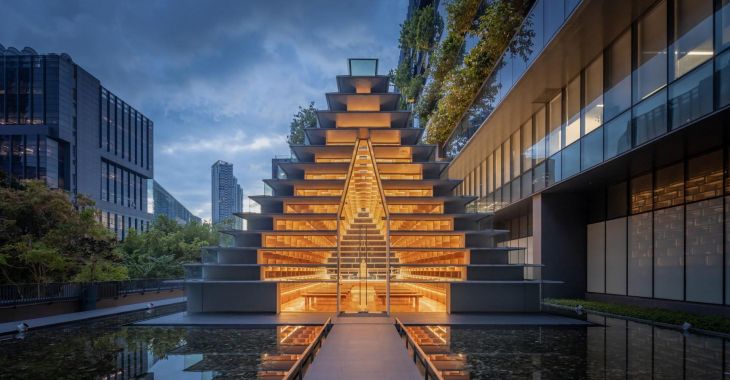
Glass Pavilion,
design: M Space
The Glass Pavilion in Bangkok was created as a contemporary meditation space where glass, steel, teak wood, and natural light come together to form an architecture of tranquility. Designed by M space, the pavilion is located on the rooftop garden along Sukhumvit Road, and its axis is oriented toward the Great Stupa of Wat Dhammamongkol Thawonbun Nantawihan. It is a small structure that does not replicate traditional Thai architecture but translates its forms into a simple, contemporary language.

Glass Pavilion, Bangkok — © M Space
meditation on the city
Bangkok is rarely associated with silence. It is a dense, bustling city full of stimuli, where a space for contemplation must not so much cut itself off from its surroundings as gently temper their intensity. The Glass Pavilion was created precisely in this context—not as a closed enclave, but as a place suspended above the city’s daily hustle and bustle. The pavilion is situated on a rooftop garden at 101 Sukhumvit Road. Its location is significant not only for practical reasons but also symbolically. The architects positioned the building so that its main axis directs the gaze toward the nearby Great Stupa. Thanks to this, the meditation hall does not close itself off entirely, but remains connected to the spiritual landscape of Bangkok.

Glass Pavilion, Bangkok — © M Space
A Form Rooted in Thai Tradition
The M Space studio designed the pavilion as a single, clear space, reduced to the basic elements of architecture: structure, roof, light, and material. The form references traditional Thai architecture, but does so without literal quotations. Instead of decoration, there is a rhythm of steel planes, and instead of historical reconstruction—a synthetic form built from the proportions of ancient structures. The exterior form was inspired by traditional Thai religious buildings: the multi-pitched roofs of temple halls and the stepped silhouettes of stupas. The architects do not quote them literally, but rather utilize their proportions and characteristic angles, translating them into a contemporary steel-and-glass structure.

Glass Pavilion, Bangkok — © Ketsiree Wongwan
Light streaming through the Glass Pavilion
Light is the most important element in the interior. It filters through the glass facades and skylight, reflects off the light-gray steel surfaces, and then gently blends with the warm hue of teak wood. The interior changes with the weather and the time of day —in full sunlight, it becomes brighter and more luminous, while under a cloudy sky, it takes on a soft, diffused character. The meditation hall was conceived as a calm, unified space. The steel surfaces of the structure merge here with a form resembling a lotus bud—one of the most important symbols of spirituality in Southeast Asia. However, this is not merely a decorative motif added to the building, but a hidden spatial order that enhances the atmosphere of concentration.

Glass Pavilion, Bangkok — © Ketsiree Wongwan
glass, steel, and teak wood
The materials were selected to emphasize the pavilion’s lightness while also adding warmth to its atmosphere. The glass opens the space to the garden and natural light; the steel organizes the interior with a clear, geometric pattern; and the teak wood introduces softness and a more intimate character. This combination is not merely aesthetic. In Bangkok’s tropical climate, glass architecture must respond to the sun, temperature, and air movement. Therefore, the glazing limits the interior from overheating, and the lower sections of the walls can be opened to ensure free airflow. The pavilion also benefits from the shade cast by neighboring buildings and a shallow body of water, which moderates the temperature around the structure. As a result , the Glass Pavilion remains bright and transparent while retaining a calm, intimate character.

Glass Pavilion, Bangkok — © SkyGround
pavilion over a body of water
The entire structure is set above a shallow body of water. This is not merely a landscape feature. During the day, it helps moderate the heat in the surrounding area while enhancing the experience of light. The reflections around the building make the pavilion appear lighter and more detached from the ground. The Glass Pavilion thus functions on several levels simultaneously. It is a meditation hall, a contemporary interpretation of Thai tradition, a response to the tropical climate, and a small-scale architectural space for contemplation set within an urban landscape. Its power does not stem from its scale, but from its consistency: from simple means that create a bright, ever-changing, and serene space.