
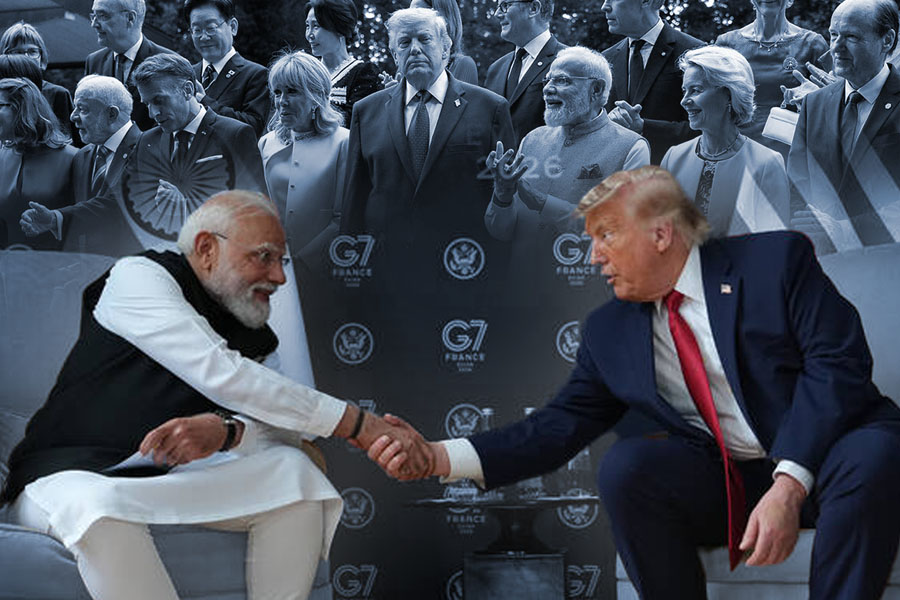
Donald Trump’s comments about Narendra Modi, the Prime Minister of India, and Xi Jinping, the President of China, made on the sidelines of the G7 summit, quickly became a focal point for international media and analysts. At first glance, his remarks appeared to be a simple comparison between two Asian leaders, but many observers believe the statements carried a message that went beyond evaluating the personalities or leadership styles of the two politicians. In a climate where the rivalry between the United States and China has become the central axis of global politics, Trump’s praise of Modi and his contrasting portrayal of Xi Jinping can be interpreted as part of Washington’s effort to elevate India’s role as a counterweight to China.
In his remarks, Trump described Modi as a strong, energetic, and influential leader who has succeeded in raising India’s standing in the international order. He praised the Indian government’s economic and development policies and emphasized that New Delhi has managed to establish itself as one of the world’s rising powers in recent years. These comments came as India has spent the past decade working to move beyond its status as a regional power and position itself as a major actor on the global stage.
Since Modi came to power in 2014, India has pursued a broad set of economic and administrative reforms. His government simplified the country’s tax system through the introduction of the Goods and Services Tax (GST) and implemented sweeping reforms to improve the business environment. A new insolvency law, investment facilitation measures, and the reduction of certain bureaucratic barriers were among the steps taken to boost economic growth.
Alongside these reforms, the “Make in India” initiative was launched with the aim of strengthening the domestic industry and attracting foreign investment. The Indian government hoped the program would transform the country into one of the world’s key manufacturing hubs. Although the initiative has faced challenges, it has succeeded in drawing the attention of many international companies to the Indian market.
Another area Trump highlighted was India’s development of digital and financial services. The Pradhan Mantri Jan Dhan Yojana program brought millions of citizens into the formal banking system, while the Digital India project expanded public access to online services and the internet. As a result of these policies, India today ranks among the world’s largest digital payments markets, and its startup ecosystem has experienced remarkable growth.
However, the significance of Trump’s remarks extends beyond their references to India’s economic achievements. The more substantial dimension of his statements lay in an indirect comparison between India and China. He spoke of Modi as the leader of an emerging power while describing Xi Jinping as a purely transactional leader, someone whose primary focus is on expanding China’s global influence through economic power, technology, and military strength.
In this context, Trump referenced the Belt and Road Initiative (BRI), the vast project that Beijing presents as a framework for infrastructure development and the strengthening of economic connectivity between nations. This initiative, which encompasses dozens of countries across Asia, Africa, Europe, and Latin America, is regarded as one of China’s most important tools of global influence. Western critics of the BRI, however, argue that Beijing uses it to deepen economic dependency and extend its political influence over partner countries.
In essence, Trump’s remarks reflect a rivalry that has been unfolding between Washington and Beijing for years. Trade disputes, competition in the technology sector, geopolitical tensions, and security concerns in the Indo-Pacific region have pushed the relationship between the two powers into a phase of comprehensive strategic competition. In this context, India has acquired particular importance for the United States.
Washington does not view India merely as an economic partner; it regards the country as one of the principal pillars of the balance of power in Asia. Security and defense cooperation between the two nations has grown significantly in recent years, and India’s participation in frameworks such as the Quadrilateral Security Dialogue (Quad), alongside the United States, Japan, and Australia, reflects its expanding role in the West’s regional strategy.
Trump also emphasized Modi’s ability to preserve India’s “strategic autonomy.” New Delhi has expanded its relationship with Washington while simultaneously working to maintain ties with Russia, the Gulf states, and even China. This multi-alignment policy has allowed India, in many instances, to pursue its own interests without fully committing to either of the world’s competing power blocs.
Many analysts argue that the comparison between Modi and Xi Jinping is not merely a comparison of two leaders but rather a comparison of two distinct models of governance and development. India is defined by its democratic system, pluralistic society, and market-based economy, while China relies on a centralized political structure and a dominant state role in the economy. These two models have, in recent years, become one of the central subjects of global debate about the future of development.
In India, Trump’s remarks were met with a warm reception from political officials and the media alike. Many interpreted them as a sign of India’s growing international credibility and an endorsement of the country’s rising position in the global order. For New Delhi, such expressions of support can be advantageous in its pursuit of a larger role in international institutions and greater global influence.
That said, some experts caution against interpreting all developments across Asia through the lens of India-China competition alone. Both countries carry substantial weight in the global economy, and many of the defining challenges of the twenty-first century, ranging from climate change to energy security, sustainable development, and public health, cannot be addressed without cooperation between these two powers.
Despite these considerations, one point remains clear: Trump’s remarks at the G7 summit were not simply a tribute to a foreign leader. They formed part of a broader geopolitical message, one that signals Washington views India as a key player in the emerging global order. Seen in this light, the primary audience for Trump’s words was not only Narendra Modi; Beijing, too, was very much a backdrop to that message.
For this reason, Trump’s praise of Modi should be understood less as admiration for an individual and more as a reflection of the rivalry that will shape the future balance of power across Asia and the world.
You can read the Persian version of this analysis here: