
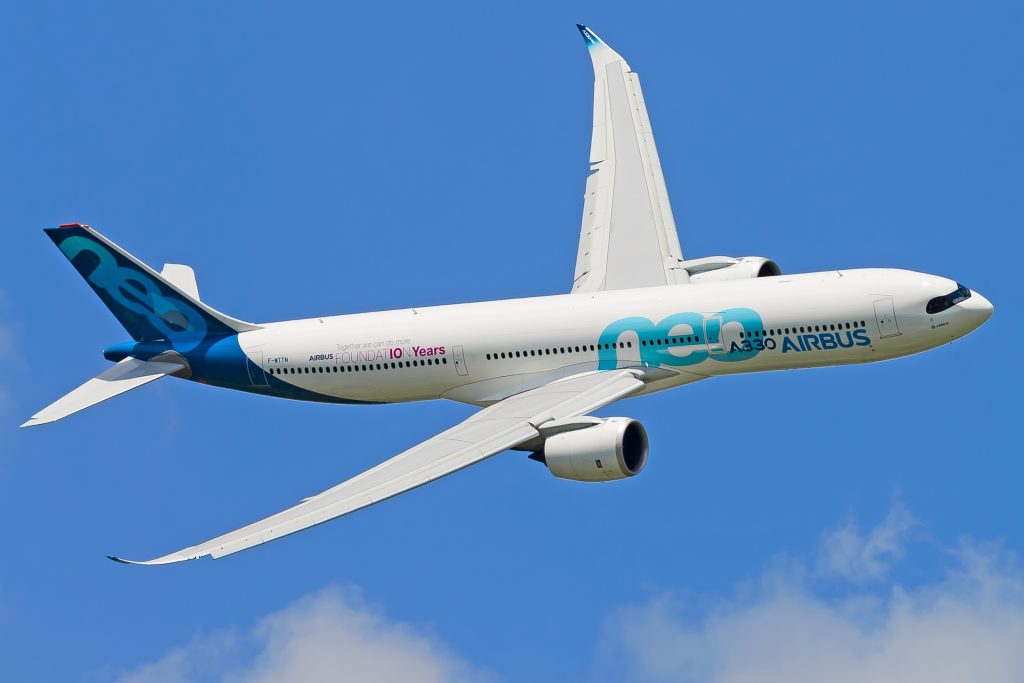
SHANGHAI — China Eastern Airlines (MU) will acquire 25 Airbus A330-900 widebodies in a deal valued at US$9.35 billion at catalogue prices, adding long-haul capacity and replacing older A330 aircraft as it further develops Shanghai Pudong (PVG) as an intercontinental hub.
The Shanghai-based carrier signed the purchase agreement with Airbus on June 26. While the published catalogue value is based on Airbus’s January 2025 pricing, China Eastern said the actual consideration will be significantly lower following negotiated discounts and has not been disclosed.
Deliveries are scheduled to begin in 2029 and continue through 2033, giving China Eastern a long-term replacement and expansion platform for its international network.
Deliveries begin in 2029
China Eastern plans to receive four A330-900s in 2029, followed by five aircraft in 2030, six in 2031, seven in 2032, and the remaining three in 2033.
The airline said it may adjust the timing or aircraft mix depending on market conditions and its wider capacity planning. The transaction will be funded through a combination of internal cash, commercial-bank loans, bond issuance, and other financing instruments, with payments made in U.S. dollars over the delivery period.
China Eastern expects at least 10 of its older A330ceo aircraft to retire on age grounds between 2029 and 2033. That means the order is not purely a one-for-one replacement programme. It gives the carrier room to modernize a familiar widebody fleet while also supporting measured long-haul growth.
A330neo to support Shanghai hub expansion
China Eastern said the incoming A330-900s will primarily be deployed from Shanghai Pudong, where the airline intends to add intercontinental destinations and increase frequencies on existing long-haul markets.
The carrier is positioning PVG not simply as an origin-and-destination gateway, but as a more structured transfer hub for international traffic. China Eastern said the aircraft will help support additional arrival and departure banks, reinforcing Pudong’s role as an intercontinental connecting center.
That makes the order strategically more significant than a conventional fleet renewal. China Eastern is committing to additional widebody capacity at a point when international flying from China is becoming a central part of its future network strategy.
The A330-900 offers a maximum range of up to 7,350 nautical miles and is typically configured for around 287 to 303 passengers in a three-class layout, although China Eastern has not yet announced its cabin configuration or planned routes for the type.
A familiar platform, with better economics
For China Eastern, the A330neo is a logical successor to the A330ceo aircraft already in its fleet. The airline said the newer variant offers high commonality with its existing A330 operation while bringing improved aerodynamics, new-generation Rolls-Royce Trent 7000 engines, and a more efficient cabin layout.
Airbus markets the A330-900 as a versatile widebody capable of serving short-, medium-, and long-haul missions. The manufacturer says the aircraft combines new engines, redesigned wings, and other aerodynamic improvements to reduce operating costs and emissions compared with older widebody types.
China Eastern said the A330neo will help optimize its fleet structure, lower unit operating costs, and improve both operational and service quality.
Part of a larger Airbus fleet strategy
The A330neo agreement follows China Eastern’s March commitment to purchase 101 Airbus A320neo-family aircraft, valued at around US$15.8 billion at list prices and scheduled for delivery between 2028 and 2032.
Taken together, the two transactions cover 126 Airbus aircraft and point to a fleet strategy divided between narrowbody growth and widebody international expansion. The A320neo-family order is designed to support replacement and growth across domestic and regional markets, while the A330-900 commitment gives China Eastern a clearer platform for longer international sectors from Shanghai.
No routes have been announced, and the first A330neo deliveries remain more than two years away. Still, the order gives a strong indication of where China Eastern sees its next phase of growth: not only in more efficient aircraft, but in a larger role for Shanghai Pudong as a connecting hub between China and the rest of the world.