
June 17, 2026
JAKARTA – From fuel price hikes to multibillion-dollar government programs, a growing list of grievances has fueled recurring protests during President Prabowo Subianto’s first year and a half in office, highlighting widening public dissatisfaction with the administration’s policy direction.
Over the past week, a fresh wave of student-led demonstrations have swept Jakarta and several other cities as public frustration over rising living costs, a weakening rupiah and broader economic pressures intensified following the government’s decision to raise non-subsidised fuel prices by more than 30 percent last week.
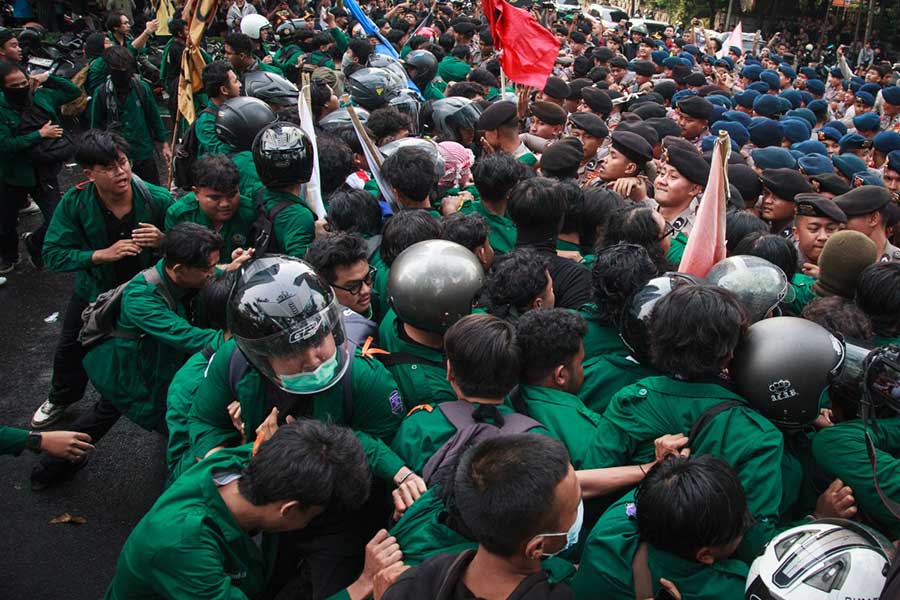
Thousands of students from universities across Greater Jakarta rallied on Friday at the Hotel Indonesia traffic circle, one of the capital’s most prominent landmarks, in a protest dubbed #MenujuIndonesiaBangkrut (Heading to Bankrupt Indonesia). Protesters accused the government of neglecting the economic struggles of ordinary Indonesians while continuing to fund costly flagship programs.
Among their demands were cuts to what they described as “wasteful state spending”, lower fuel and staple food prices, measures to stabilize the rupiah and a halt to major government initiatives, including Prabowo’s flagship free nutritious meal program, which has been allocated Rp 268 trillion (US$15.1 billion) this year.
The protests continued through Monday and spread to other cities, including Semarang in Central Java, Surabaya in East Java, Medan in North Sumatra, Lampung province and Bandung in West Java, where clashes between demonstrators and police were reported.
Tensions also surfaced on Monday during a public discussion at Yogyakarta-based Gadjah Mada University (UGM), which featured Deputy Agriculture Minister Sudaryono of Prabowo’s Gerindra Party, after a group of students disrupted the event and demanded it be halted. Sudaryono later claimed he was struck during the commotion before being escorted from the venue by security personnel.
Political analyst Lili Romli from the National Research and Innovation Agency (BRIN) said the latest protests reflected concerns that extend far beyond fuel prices, pointing instead to deeper frustrations over policymaking and the government’s handling of criticism.
“These repeated demonstrations by students and civil society groups may reflect growing disappointment with government policies, which many view as failing to adequately reflect the aspirations and concerns of the public,” Lili told The Jakarta Post on Tuesday.
He added that the House of Representatives, which is now dominated by pro-government parties, has also failed to exercise its oversight role, leaving many citizens politically unrepresented.
“Rather than channeling and fighting for public aspirations, some lawmakers have instead acted as government defenders, almost serving as the government’s spokesperson,” he said, adding that this has encouraged people to “seek extraparliamentary avenues through mass mobilization and street protests”.
The latest demonstrations are part of a broader pattern of unrest since Prabowo took office in October 2024. Previous protests included rallies against a planned value-added tax increase in late 2024 and the Indonesia Gelap (Dark Indonesia) movement in early 2025, which opposed budget cuts, including in education, to help finance the President’s flagship programs.
Read also: Students return to streets over wasteful spending
The current wave also comes less than a year after the August 2025 protests, when the killing of an online motorcycle taxi driver during the protest sparked nationwide outrage and transformed what began as protests over lawmakers’ lavish allowances into one of the nation’s largest episodes of civil unrest in decades.
Political analyst Aditya Perdana from the University of Indonesia warned that such recurring street protests should be viewed as a “serious political warning” by Prabowo’s administration, noting that public dissatisfaction is being fueled by unresolved economic problems and concerns over government management.
“If warnings like these continue to be ignored, there is a risk that public pressure will intensify and dissatisfaction will become more deeply entrenched,” he said. “The government needs to respond constructively by listening to criticism and addressing the issues being raised rather than dismissing them.”
President Prabowo has yet to comment on the protest. Vice President Gibran Rakabuming Raka, however, met with 15 student protesters at the Vice Presidential Palace on Monday evening and thanked them for their input.
Responding to the public criticism, Muhammad Qodari, head of the Government’s Communications Agency, described Prabowo as a “leader of a second wave of reform”, arguing that the President was now pushing through major economic reforms aimed at dismantling systems that had long benefited a narrow elite.
Qodari also reiterated the government’s commitment to continue the widely-criticized free nutritious meal program. “Challenges and problems are inevitable, but they are not a reason to stop. They are a reason to evaluate and improve.”