
Children press forward in their seats, clutching glow-in-the-dark sticks, bunny-ear headbands already on. A few of them climb onto the empty stage lit in orange and green, while their parents take pictures against a colourful board.
The much-awaited show at NCUI Auditorium in Delhi’s Hauz Khas on Friday has been delayed by about 10 minutes because of the rain. Outside, people hurry in. Since the venue has no parking during the week, the organisers have arranged autorickshaws to ferry visitors from a lot about 100-200 metres away.
Inside, no one seems to mind the wait. The air is rich with the smell of buttered popcorn. Ranjit Sada, a clown, is already working the crowd, selling trinkets and posing for photos with children.
 Clown Biju Pushkaran and Princess Julipi entertaining the kids with bubbles. (Express photo by Reva Thakkar)
Soon, the 500-seater auditorium is almost full, and the countdown begins. The lights dim, and a performer walks on stage in oversized white-and-black shoes, red-striped dungarees, polka-dot tie, and a small hat tilted on the right side of his head. His face is painted red, with a wide smile that travels ear to ear.
This is the Rambo Circus, India’s only internationally recognised circus founded in 1991, and this week it’s in Delhi, doing three shows a day, till June 28.
And the clown on stage is Biju Pushkaran. “It’s all designed by me,” he told The Indian Express after the performance.
He introduces the first act, and three Assamese women in bedazzling light green-grey pants and crop-top blouses come out holding candle stands. Christina, the lead, performs acrobatic feats — balancing six candle holders on her body while she contorts herself on the circular table.
Story continues below this ad
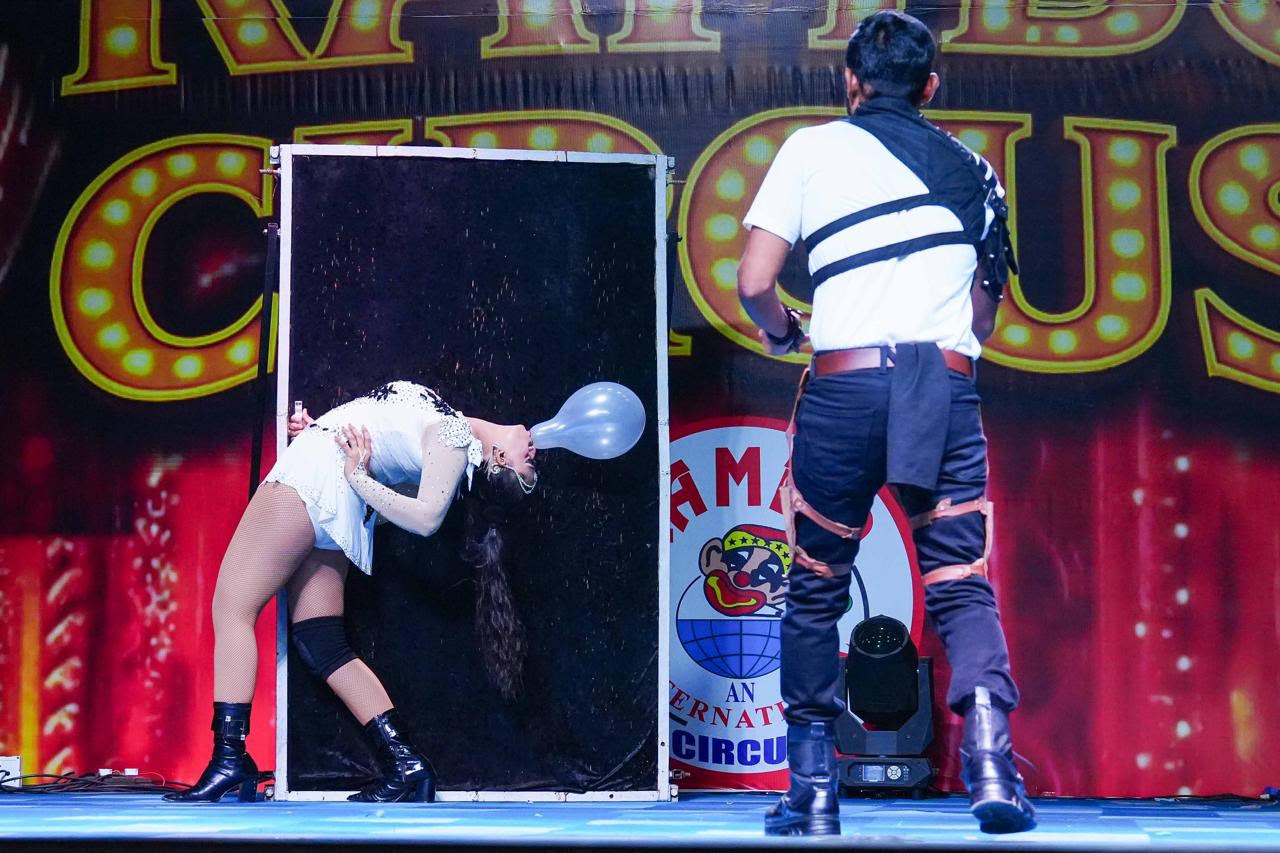 Mukesh and Priti performing the knife act. (Specially arranged)
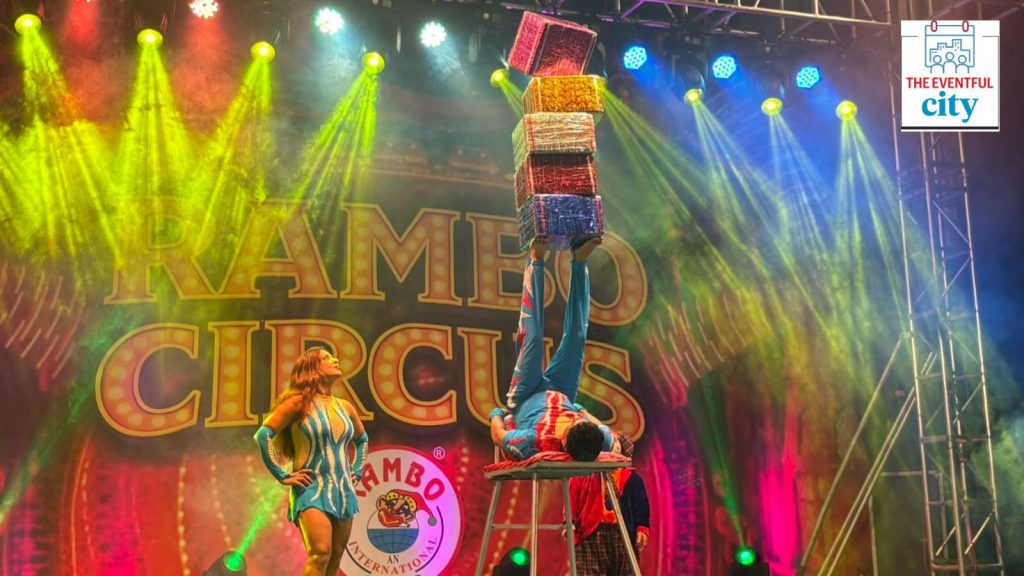
What follows is 90 minutes and 22 acts that don’t let your attention slip from the stage. The audience cheers when Arjun Nayak, after four tries, finally makes all five boxes balance on his legs.
They hold their breath when Mukesh throws the knife and Priti stands at the board completely still. They dance in their seats when the LED and laser dance show is performed. A child in the second row even shouts out “Michael Jackson” when the LED show is on.
The show includes acrobats, aerial performers, jugglers, cyclists, tightrope walkers, and other such acts.
Meet the man behind the circus
Sujit Dilip, 51, is running this circus now. As a child, he used to trail behind his father, P T Dilip, around the circus tents.
Story continues below this ad
He was afraid of the lions and tigers at first, he admits. “My best friend was the elephant,” he adds.
His first real night living on the circus grounds was when he was 17, and the lions roared until dawn. By the second night, he discovered the reason: that the meat supplier was arriving at three in the morning with rotten buffalo meat.
 Juggler Sunny Benbal with Clowns, Ranjit Sada and Rajeev Chatterjee. (Express photo by Reva Thakkar)
Sujit sent him back, sourced fresh chicken from a nearby poultry farm, and fed the animals himself. “From that day, they slept silently, and I became friends with them,” he says.
About 20 years ago, he says the government banned their performing animals. Twenty-six animals — ones he had grown up alongside — were transferred to a zoo in Tirupati. “I cried and did not eat food,” Sujit says. “I was so attached to them.”
Story continues below this ad
Within six months, he claims, almost all of them were dead.
His father stepped in, told him to stop grieving and pointed him towards the artists who needed looking after. He had an idea: bring in Russian circus artists, people with techniques and acts that Indian audiences had never seen.
Twenty of them arrived, and with them came a different world. The wooden juggling clubs that Indian performers had always used were heavy and barely manageable in threes, but they were now replaced with light-weight acrylic.
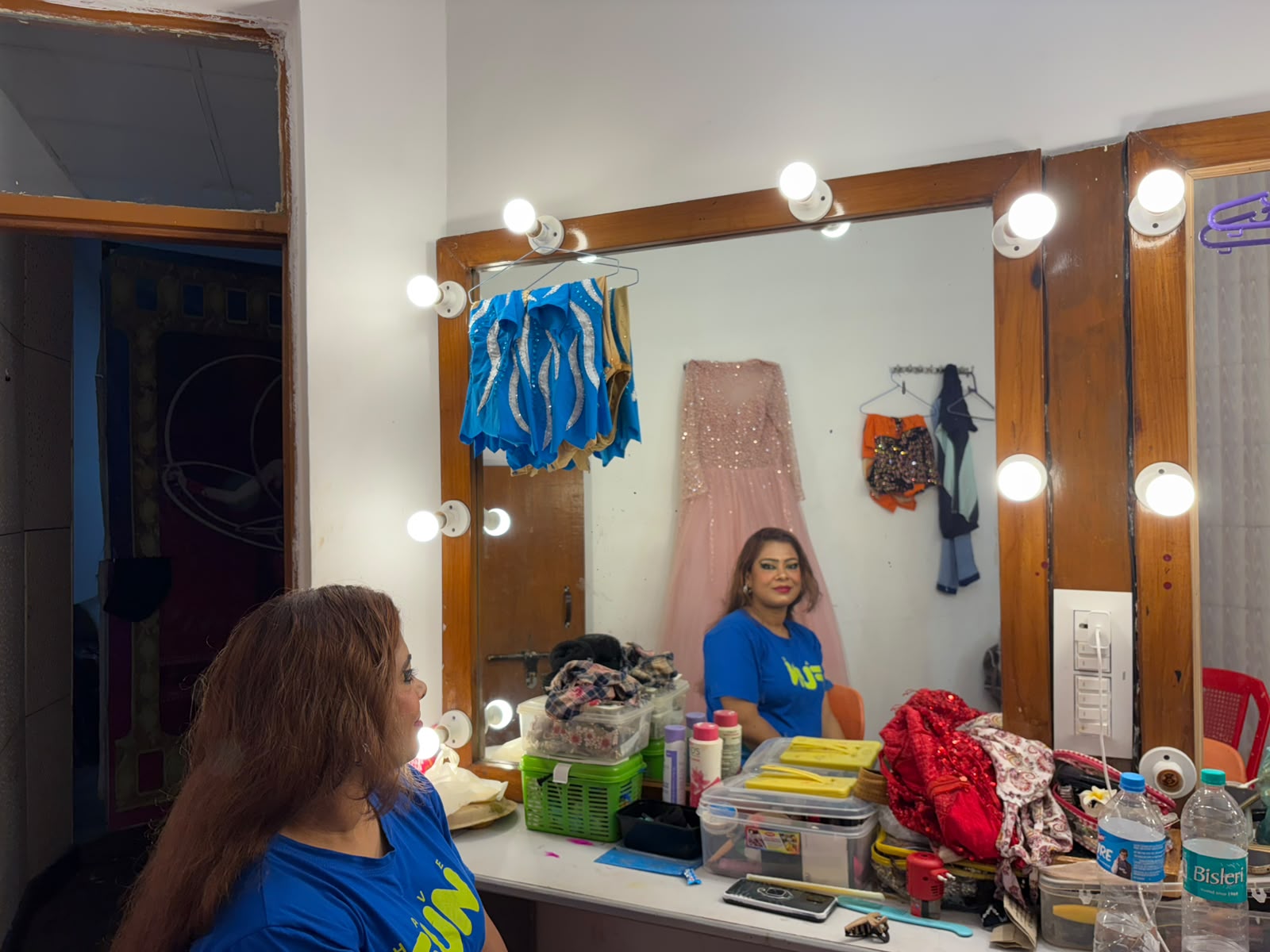 Cyclist Pinky Khan in the dressing room, getting ready for her next performance. (Express photo by Reva Thakkar)
Over the years, Rambo has outlasted nearly every one of its contemporaries. The secret, if there is one, comes from this unlikely direction.
Story continues below this ad
“They were like a saviour for us, it was a revolution”, Sujit says of the Russians. South Americans, Africans, Canadians, and Ethiopians followed over the years.
The Manipuri acrobat-performers on stage now execute acts they learned from Kenyan and Tanzanian artists.
The clown who guides you
Pushkaran’s road to this stage was fraught with hurdles as well: running away from home at a young age because his father beat him, and later being rejected as a clown applicant because of his skin colour.
“I was disheartened, but still determined,” he says. He has been on the circus circuit for 43 years now, and with the Rambo Circus for 32 of them.
Story continues below this ad
“I get many offers from other circuses now, but I won’t leave Rambo. Sujit and I are like brothers. His son even calls me father.”
Pushkaran learned an audience-couple routine by watching a Spanish act at an international festival. However, he puts his own touch to it by adding Bollywood movie audios and references.
On Friday, the audience is entirely his. When Pushkaran asks who the best couple in the crowd is, three girls in the third row excitedly take their parents’ hands and raise them, shouting, “Them! Them!”
He calls them up. Darpan and Divya have been married for 14 years. He interacts with them briefly, leaving Divya with a flower wreath and Darpan a clown’s red nose for their sporting spirit. Before Darpan even sits back in his seat, his daughter has stolen it.
Story continues below this ad
In the second row, Shivani, 22, who was gifted tickets by her mother’s boss, says, “Coming here was the best decision I made.” She adds, “I was quite nervous — it’s my first time going out alone — but I loved it.”
A grandfather who wishes to be anonymous said, “I want to show my grandson the beauty of the circus before the art form dies out.”
Fighting to be seen
Outside the auditorium, the recognition is harder to come by.
Last year, the Family Tradition Circus from Chile was formally acknowledged under UNESCO’s intangible cultural heritage framework during an event in Delhi.
Story continues below this ad
Rambo, who has been writing to the Ministry of Culture for years, has never been considered. “It’s very, very difficult reaching out to the government,” Sujit says.
“Theatre, nautanki, and cinema all get awards,” says Pushkaran. “A circus artist who has spent their whole life performing gets nothing. We just want an artiste card recognising what we do.”
“I have been asked to be on the jury in Monte Carlo and China. The respect we get internationally, we don’t receive in our own country, ” Sujit says. “But still, we have that love for our country.”
His focus now is on a circus school — a formal institution to train the next generation of Indian performers. The old model had young boys living on the grounds, training for five or six years, before they would start performing. There is currently no pipeline. Trained artists come from other circuses or from abroad, and are polished up on arrival, but Sujit aims to change that.
The Rambo Circus is open till 28th June at the NCUI Auditorium in Hauz Khas, Delhi.