
The entire foundation of the India-US bilateral trade bargain collapsed on February 20, when the Supreme Court of the United States ruled that the legal basis for the Trump administration’s reciprocal tariffs was invalid.
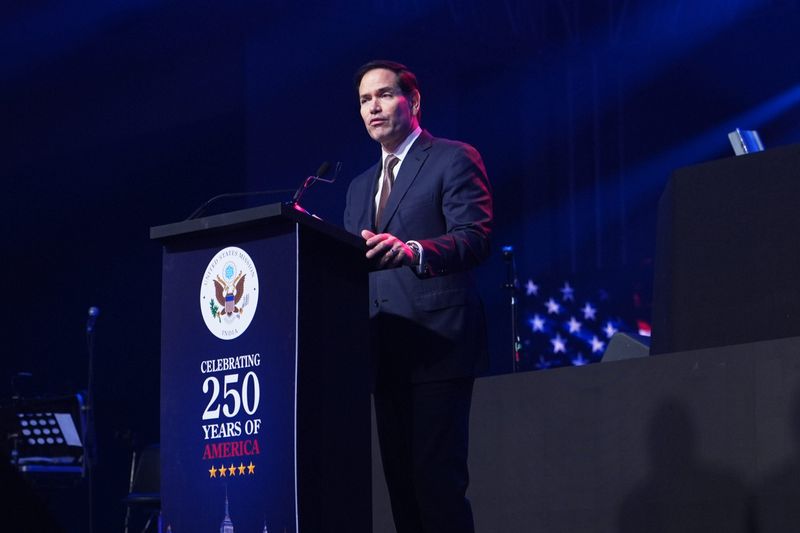
Marco Rubio, United States Secretary of State, is in India during May 23 to 26, 2026. On Sunday he posted on X about India’s commitment of purchasing $500 billion worth of American goods over the next five years.
He wrote, “Huge thanks to @USAmbIndia Sergio Gor and our American diplomats for their efforts. Because of their great work, India has committed to purchasing $500 billion in U.S. goods over the next five years focusing on energy, technology, and agriculture.”
India’s intention to purchase $500 billion worth of American goods was part of the India-US Joint Statement issued on February 6, 2026 as part of the ongoing bilateral trade agreement (BTA) negotiations.
In return of many concessions by India, Washington had agreed to lower its proposed “reciprocal tariff” on Indian exports from 25% to around 18%.
But the entire foundation of that bargain collapsed on February 20, when the Supreme Court of the United States ruled that the legal basis for the Trump administration’s reciprocal tariffs was invalid.
The ruling effectively dismantled the tariff-based framework around which the new generation of US trade deals had been negotiated.
Within hours of the judgment, the Trump administration invoked Section 122 of the US Trade Act of 1974 to impose a uniform 10% tariff on imports from all trading partners. The tariff took effect on February 24 and is scheduled to remain in force until the last week of July 2026.
The result is that every country — whether it negotiated a deal with Washington or not — now faces the same additional 10% tariff for entry into the US market, on top of normal MFN tariffs. That erased the advantage countries expected to receive in exchange for offering major concessions to the United States.
This has fundamentally weakened the logic behind the India-US BTA. If India receives the same 10% tariff treatment regardless of whether it offers sweeping concessions on tariffs, agriculture, digital trade and procurement, the commercial rationale for the agreement becomes difficult to justify.
The consequences became visible on March 15, 2026, when Malaysia walked away from its trade agreement with the United States. Malaysia had earlier accepted a negotiated tariff rate of 19% in exchange for market access concessions and policy commitments. Once the uniform 10% tariff was imposed on all countries, Kuala Lumpur declared the agreement “null and void”.
For India, the issue has become even more sensitive because of mounting pressure on the external sector and the rupee. The Indian rupee has lost nearly 12% of its value against the US dollar over the past 12 months amid rising import costs, higher oil prices, foreign investment outflows and persistent balance-of-payments pressures.
Once the reciprocal tariff framework collapsed, the economic logic of the India-US BTA itself disappears, and hence question of the $500 billion purchase commitment becomes irrelevant. The Indian government must clarify its position on Rubio’s tweet. The purchase would also significantly increase dollar outflows from India at a time when the country’s foreign exchange situation is already under stress. Large-scale imports of US energy, defence equipment, aircraft and agricultural products could further widen India’s trade deficit and intensify pressure on the rupee.
India should formally reconsider the negotiations. Once the reciprocal tariff framework collapsed after the February 20 Supreme Court ruling, the core economic justification for the agreement effectively disappeared.
Ajay Srivastava is the founder of Global Trade Research Institute (GTRI).
This article went live on May twenty-fifth, two thousand twenty six, at twenty-eight minutes past nine in the morning.
The Wire is now on WhatsApp. Follow our channel for sharp analysis and opinions on the latest developments.