

With a vibrant economy and a soaring population, India is a country to watch in the coming weeks and months in terms of trade negotiations and the impact of El Nino weather on crop production.
What’s happened
Just over a year ago, India surpassed China as the number one country in terms of population. India is now the world’s most populous nation with over 1.47 billion people. China is ranked second with 1.41 billion people.
Besides notoriety as the most populous country, India also is gaining momentum as a global economic powerhouse. According to the International Monetary Fund, India is currently ranked as the sixth largest economy in the world. (The United States is ranked first with China, Germany, Japan and the United Kingdom rounding out the top five in that order.)
Not only is India an economic powerhouse but they also have an emerging middle class. Remember how the emerging middle class in China over the last 20 years increased consumer demand for protein? The same may be true for the people of India. This may equate to more protein and food demand from India, which may result in increased U.S. commodity exports to India.
From a marketing perspective
Trade negotiations continue between the current U.S. administration and India. According to a recent article in the Financial Times, U.S. Secretary of State Marco Rubio reported that India “has committed” to purchasing $500 billion worth of American goods over the next five years, focusing on energy, technology and agriculture.”
More details on this may emerge when an American trade team visits India June 1-4. Here are five U.S. agricultural commodities that may find increased demand for export to India.
Soybeans and soy products. Soybean and soybean product demand is growing in India as a major staple for India’s sustainable protein needs.
In India, soymeal demand for feed for chicken continues to edge higher with demand just over 7.10 million metric tons annually, according to the May 2026 USDA WASDE report. India produces just enough domestically to meet that need. They have little excess soymeal to export.
Interestingly, India just this week announced it halted soymeal exports due to tightening supplies. Indian traders cancelled 25,000 metric tons of soymeal export contracts for the first time since 2021 and booked 80,000 tons of imports from African countries.
Will the trend of India importing soybean meal continue? And might the United States gain some of that business?
Soyoil domestic demand in India is near 6.2 mmt, for 2026-27, according to the USDA, with imports of 4.3 mmt. And that demand is likely to grow.
General demand for soybean imports may increase as well. According to the Economic Times, “India’s soybean imports could rise to a record 800,000 tons in the year to September 2026. India imported about 2,000 tons in the previous year, according to data compiled by the Soybean Processors Association of India.”
Wheat. India is the third largest grower of wheat in the world, following China and the European Union. According to May 2026 USDA WASDE report, India is expected to grow 121 mmt of wheat for the 2026-27 crop year, with domestic use of 110 mmt. This is the crop I’m watching the most because India essentially uses everything they grow.
Global demand for wheat continues to remain robust, and global ending stocks of wheat are trending lower. India has no room for weather issues or a wheat crop failure.
Corn for ethanol. India is the world’s sixth largest producer of corn. According to the USDA Foreign Agricultural Service, 2025-26 Indian corn production was marked at 46.2 mmt. With this crop, too, they consume all that they grow.
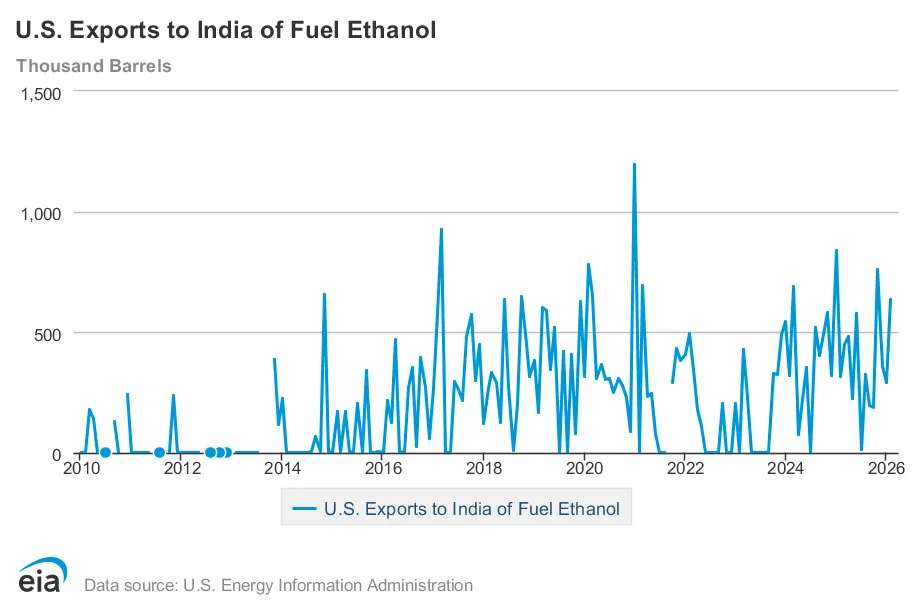
An interesting note on the corn picture is India imports a large amount of U.S. ethanol. U.S. ethanol export demand continues to grow. According to the U.S. Energy Information and Administration, Canada was the top U.S. ethanol customer in 2025 (18,898 thousand barrels), followed by the Netherlands (8,674 thousand barrels), with India coming in third (4,711 thousand barrels).
Cotton. Cotton is an important commodity to monitor in terms of both production and demand (for cottonseed oil and cotton use for the textile industry).
India is the world’s second largest producer of cotton in the world, following China. According to the USDA, for the 2026-27 crop year, India is expected to grow 24 million bales (480 pounds each) of cotton, with domestic use of 26 million bales. Most noticeable is that India uses all of the cotton they grow, and they also rely on some imports. According to the May 2026 WASDE, India will import 2 million bales. They have no room for production error.
Rice. India is the top grower of rice in the world. According to the May 2026 WASDE, rice production in India for 2026-27 is expected to be at 150 mmt, with domestic use at 128 mmt. This compares to Chinese production expected to be at 147 mmt with domestic production pegged at 145.10.
Prepare yourself
As an emerging economic powerhouse, India cannot be discounted. Traders need to watch upcoming trade negotiations and the weather in India in the coming months. Traders also, of course, must be attention to strife in the Middle East, the uncertainty of transport through the Strait of Hormuz and how that pertains to fertilizer production, and India’s need to import fertilizer for their crops.
With a strong El Nino weather pattern emerging, be mindful of its tendency to bring dryness and heat to much of Asia. According to a recent Reuters article, “India forecast an El Nino-weakened monsoon in 2026 that will bring the lowest rainfall in 11 years, fueling concerns over crops, food prices and growth in the world’s fifth-largest economy.”
Poor weather or a fertilizer shortage in India could become a game changer for grain and oilseed fundamentals heading into late 2026. Any severe weather gyration in the country may drastically lower production and shift India to relying on imports.
Reach Naomi at [email protected] or find her on X at @naomiblohm.
Disclaimer: The data contained herein is believed to be drawn from reliable sources but cannot be guaranteed. Individuals acting on this information are responsible for their own actions. Commodity trading may not be suitable for all recipients of this report. Futures and options trading involve significant risk of loss and may not be suitable for everyone. Therefore, carefully consider whether such trading is suitable for you in light of your financial condition. Examples of seasonal price moves or extreme market conditions are not meant to imply that such moves or conditions are common occurrences or likely to occur. Futures prices have already factored in the seasonal aspects of supply and demand. No representation is being made that scenario planning, strategy or discipline will guarantee success or profits. Any decisions you may make to buy, sell or hold a futures or options position on such research are entirely your own and not in any way deemed to be endorsed by or attributed to Total Farm Marketing. Total Farm Marketing and TFM refer to Stewart-Peterson Group Inc., Stewart-Peterson Inc., and SP Risk Services LLC. Stewart-Peterson Group Inc. is registered with the Commodity Futures Trading Commission (CFTC) as an introducing broker and is a member of National Futures Association. SP Risk Services, LLC is an insurance agency and an equal opportunity provider. Stewart-Peterson Inc. is a publishing company. A customer may have relationships with all three companies. SP Risk Services LLC and Stewart-Peterson Inc. are wholly owned by Stewart-Peterson Group Inc. unless otherwise noted, services referenced are services of Stewart-Peterson Group Inc. Presented for solicitation