
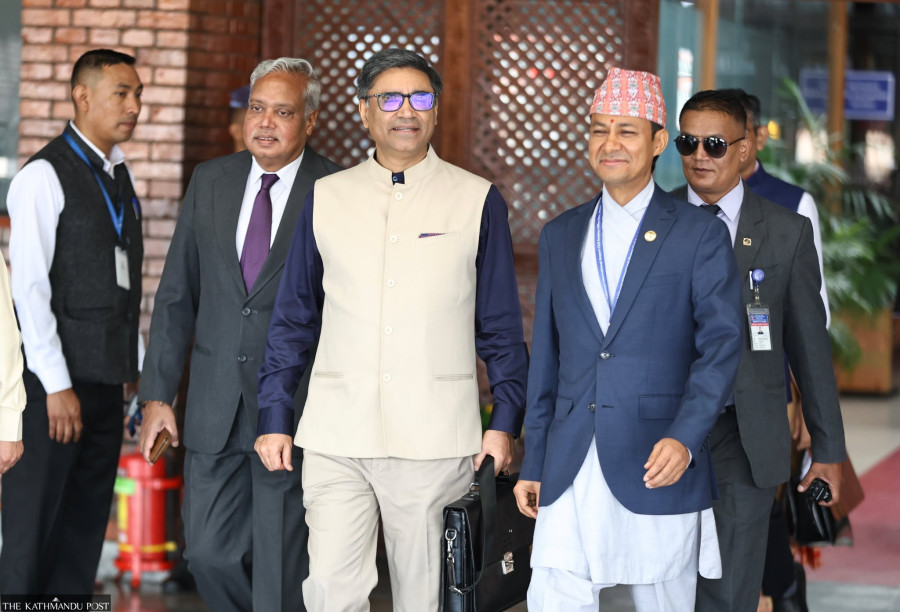
Following the formation of the Balendra Shah government on March 27, Kathmandu has seen a surge in high-level diplomatic activity, with a steady stream of visits from neighbouring countries and the United States.
After hosting two back-to-back senior-level visits from the United States and one from China, New Delhi is now sending its top diplomat to Kathmandu in the second week of May to engage with the new government.
According to two officials at the Ministry of Foreign Affairs and Nepali Embassy in New Delhi, the Indian side has communicated to the ministry that Indian Foreign Secretary Vikram Misri intends to visit Nepal on May 11–12, and has sought confirmation from the Nepali side.
To give the visit official stature, as per the protocol, the foreign secretary must send an official invitation to Misri.
Following the communication from the Indian side, Foreign Secretary Amrit Bahadur Rai has already sent a formal invitation to Misri, officials told the Post requesting anonymity as they are not authorised to speak to the media.
On April 10, Foreign Minister Shisir Khanal held talks with his Indian counterpart S Jaishankar in Mauritius during the ninth Indian Ocean Conference and discussed finalisation of projects and programmes in line with Nepal’s priorities before commencing high-level visits in the future.
During the meeting with Khanal, Jaishankar proposed sending Misri to Kathmandu to understand the priorities of the new government so that some concrete outcome could be achieved during the upcoming visits to India by Khanal and Prime Minister Shah.
Though the agenda of Misri’s visit to Kathmandu has yet to be finalised, according to people familiar with the development, he will seek to understand the priorities of the new government, what Kathmandu expects from New Delhi and how to engage political leaders at earliest possible.
During an interaction with some Nepali journalists in New Delhi on Saturday, Misri also stated that he will visit Kathmandu “very soon”.
On behalf of Indian Prime Minister Narendra Modi, the Indian foreign secretary is expected to extend an invitation to Prime Minister Shah to visit India, and while in Nepal he will call on key ministers and will hold talks with his counterpart, Rai.
“I am visiting Kathmandu very soon but we have yet to finalise the dates,” he told Nepali journalists covering parliamentary affairs. The Ministry of External Affairs of India had hosted the interaction.
Foreign Minister Khanal has been consulting ministers and taking stock of the status of various Indian-funded projects in Nepal, their progress, obstacles, and potential areas for new cooperation, said foreign ministry officials.
During the meeting between Khanal and Jaishankar in Mauritius, they had also agreed to activate all bilateral mechanisms, focusing on priorities set by the two countries and exploring new avenues of cooperation before convening high-level visits and meetings, including at the prime ministerial and foreign minister levels.
During the visit, the Indian foreign secretary could pay a courtesy call on Prime Minister Shah, who has otherwise been strictly following the protocol of not meeting with foreign officials who rank lower than presidents, prime ministers and foreign ministers.
US President Donald Trump’s special envoy to South and Central Asia Sergio Gor, who is the US ambassador to India, is also arriving in Kathmandu on April 30. Breaking with the tradition, Shah did not meet US Assistant Secretary of State Samir Paul Kapur last week and it is uncertain whether he will meet Gor, said officials.
Finance Minister Swarnim Wagle and Foreign Minister Khanal have been trying to persuade the prime minister to meet senior officials from India, China and the US in order to maintain cordial relations, and those who have helped and supported Nepal for decades, foreign ministry officials said.
After the formation of a new government in Kathmandu, barring exceptional cases, there is a tradition of Nepal’s prime ministers making India their first foreign stop.
India and Nepal have almost three dozen mechanisms, ranging from the district to the foreign minister level, covering security, water resources, irrigation, border management, boundary issues, trade, commerce, and agriculture, among others. Some meetings of these mechanisms take place regularly, while others have been pending for years.
Similarly, dozens of projects and programmes are currently being implemented in Nepal with Indian economic and technical assistance at different stages of completion.
Nepal and India have a number of mechanisms, as well as many projects and programmes, which the present government believes need to be streamlined while also exploring new avenues.
Misri will carry the list of priority back to New Delhi, will discuss those with senior Indian political leaders and pave the way for high-level visits from both the sides, foreign ministry officials said.
Kathmandu has already hosted US Assistant Secretary of State Kapur last week. He held talks with two ministers, Chair of the Rastriya Swatantra Party Rabi Lamichhane and others. At the same time, Deputy Director General at the Department of Asian Affairs at China’s Ministry of Foreign Affairs Cao Jing also visited Kathmandu and held talks with senior foreign ministry officials.