

Some notes of what struck me most from the instant classic of a pod.

The Trump administration has agency over the two variables most relevant to whether China will have enough compute to really compete with the US: how many chips they can make and how many chips they can buy. But for all the drama we’ve had this administration around whether Trump will allow Jensen to sell chips to China, we’ve had basically zero movement on the tooling side. Without access to foreign tools the US could control, Chinese chip and memory makers would not be in a position to even produce the meager amounts they can today.
This administration teased controls on sub-systems in Trump’s July 2025 AI Action Plan, but absent the headfake around the Affiliates Rule that was wound down after Beijing escalated on rare earths, we’ve had zero movement to close loopholes.
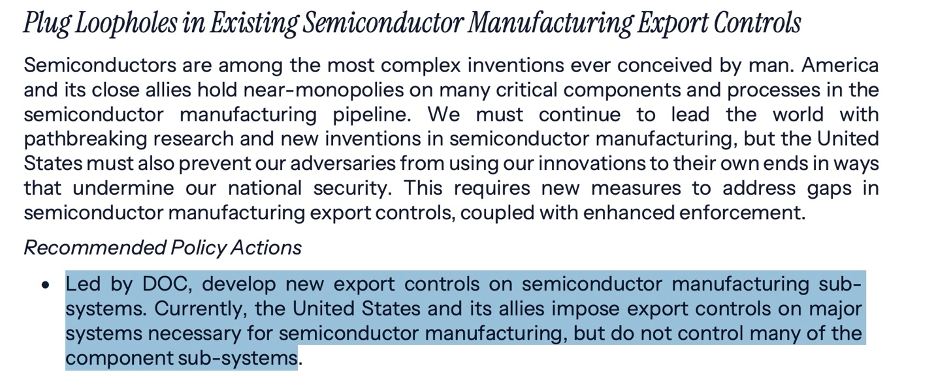
Congress is looking to take the matter into its own hands. The MATCH Act would make controls country-wide as opposed to entity-specific, address servicing of already installed equipment, and squeeze allies to comply by putting a timer on the application of the Foreign Direct Product Rule.
Which layers in Jensen’s layer cake benefit from SME and AI chip exports to China?
Only Nvidia and AMD win from AI chip exports, and nobody in the western ecosystem wins from SME exports except China and SME companies. The table walks through the stack:
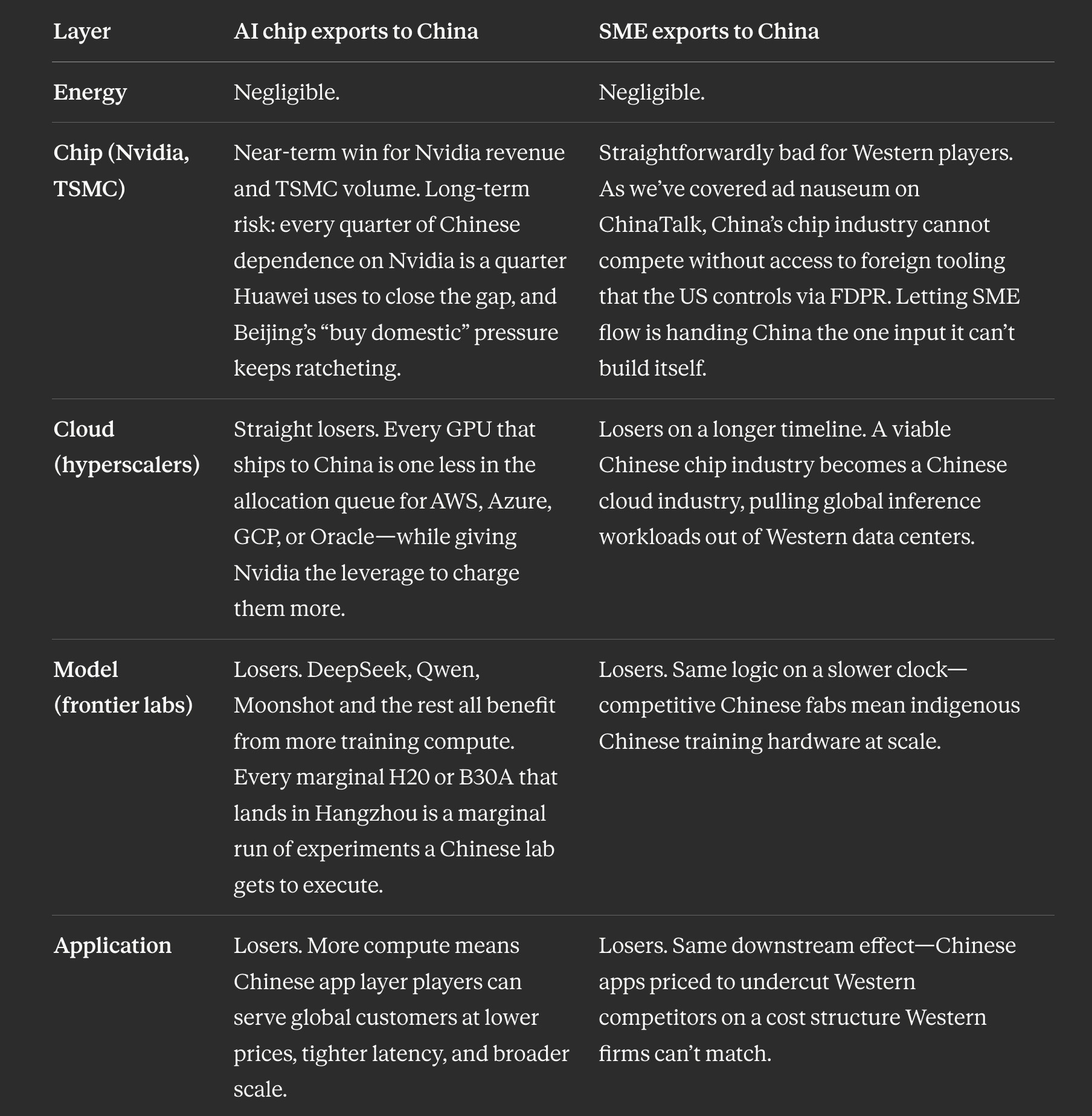
The table above illustrates commercial interests only. Widen the frame to include national security, where the Chinese fab industry that can’t exist without US tools is the single most important lever we have, and the case for holding the line on SME gets stronger still.
Beyond fear of retaliation from Jensen when it comes to chip allocation (which Jensen promised didn’t exist on the Dwarkesh podcast!) I am surprised that more of the industry hasn’t been more vocal in their support of Congressional limits to how much Trump can loosen chip controls. Congress acting also makes it less likely for SME escalation to trigger a tit-for-tat on rare earths, as legislation can tie president to the mast and give him the ability to tell Xi, “sorry but there’s nothing I can do on this.”
Since the October 2022 export controls began, Jensen Huang has been on over fifteen podcasts of over an hour or more. Almost all of those didn’t really raise chips or China.
Most unforgivable was John Hamre of CSIS, a former Deputy Secretary of Defense who runs what is ostensibly a serious national security think tank. He did not do any real homework or ask a direct export controls question, and instead took the time to joke about how dumb he is.
Dr. Hamre: I went in for an MRI recently and my wife said, make sure you take a picture; I don’t think there’s a brain up there, but I’d like to see it – (laughter) – to prove there’s something.
Mr. Huang: And what did you find out? (Laughter.)
Dr. Hamre: We were – there was – there was nothing, I mean. (Laughter.) She was right and I was wrong. (Laughter.)
It took Dwarkesh, who at 25 has not yet served as DepSecDef, to ask America’s most prominent CEO about his most controversial national security policy.
How did this interview even happen in the first place? My guess is that Dwarkesh cold-emailed Jensen, who said yes, leaving his PR team to watch through their fingers as he gave his first interview to someone who really did their homework and had the guts to bang for twelve rounds. Kudos to Jensen for taking the interview, and after Dwarkesh gave him an off-ramp to say, “You don’t have to move on! I’m enjoying it!” Kobe energy.
Jensen spent decades building a company with zero dual-use implications and practically no reason to interact with Washington. He relied on the world’s most international supply chain which would not exist without the peace that East Asia has been blessed with the past fifty years thanks to unquestioned American military preeminence. While selling chips to gamers and bitcoin miners, he had a lodestar of one day unlocking scientific advancements. And now he’s doing that, while also rapidly upgrading the technologies that provide national security without having truly grappled with their implications.
Watching a national security community get in the way of that vision of global empowerment must be infuriating. But wishing away the reality of AI’s dual use implications on cyber by saying that “the way to solve that problem is to have dialogues with the researchers and dialogues with China, and dialogues with all the countries to make sure that people don’t use technology in that way” is willfully naïve. Obama tried to negotiate some cyber boundaries with Xi at Sunnylands, and that truce lasted maybe three months. In recent years, Chinese hackers have been caught inside US power grids, water utilities, ports and pipelines. Dwarkesh is correct in saying that “If you had a cyber hacker, it’s much more dangerous if they have a million of them versus a thousand of them. So that inference compute really matters a lot.”
Jensen’s response to Dwarkesh’s repeated pressing on PLA cyber use ran as follows: “They have plenty of compute already. The amount of threshold they need for the concern you’re worried about, they’ve already reached that threshold and beyond.” But Jevons’ paradox applies for the military industrial complex too: demand for compute is skyrocketing across industries because more of it means more productivity.
Jensen also waves off the idea that compute constraints meaningfully slow Chinese labs, but algorithmic innovation itself requires compute. There is nothing special about military organizations or other dual-use technology where past a certain point more compute isn’t useful. And if we’re, as Jensen argues, five years away from “understanding the biological machine,” we’re also five years from some mind-blowing new weaponry.
For all the excitement over the past few weeks around Claude Mythos, there’s a real limit to just how pointy cyber can be. Claude Mythos 3.0 won’t be able to keep the Strait of Hormuz open.
New military technologies and doctrinal innovations are most impactful when first introduced and as adversaries adapt to them over time. As we discussed in last week’s WarTalk, the initial shock of an AI cyber capability like Mythos is real, but the playbook for a response is straightforward: air-gapped and local mesh networks, partitioned internets, and hardwired secure comms. The half-life of a first-mover edge, particularly in software, is short.
None of which is to say AI doesn’t matter for warfighting. Beyond cyber, we’ve already seen dramatic impact of AI around targeting and logistics that allowed the US to conduct an unprecedented air campaign over Iran. We’ll soon see similar leaps around command and control. But as Ukraine has reminded the world, you still need lots of stuff that goes boom to feed “the greatest of consumers.”
We will remain in an era of mass precision, where you still very much do need mass, for a long time to come. Until AI has robots building robot armies, the US will still need to do the foundational work of scaling up its defense industrial base to produce enough attritable mass to deter high end conflict. We should not expect AI capabilities on the next few years to get the Pentagon and Congress off the hot seat to reform and build.
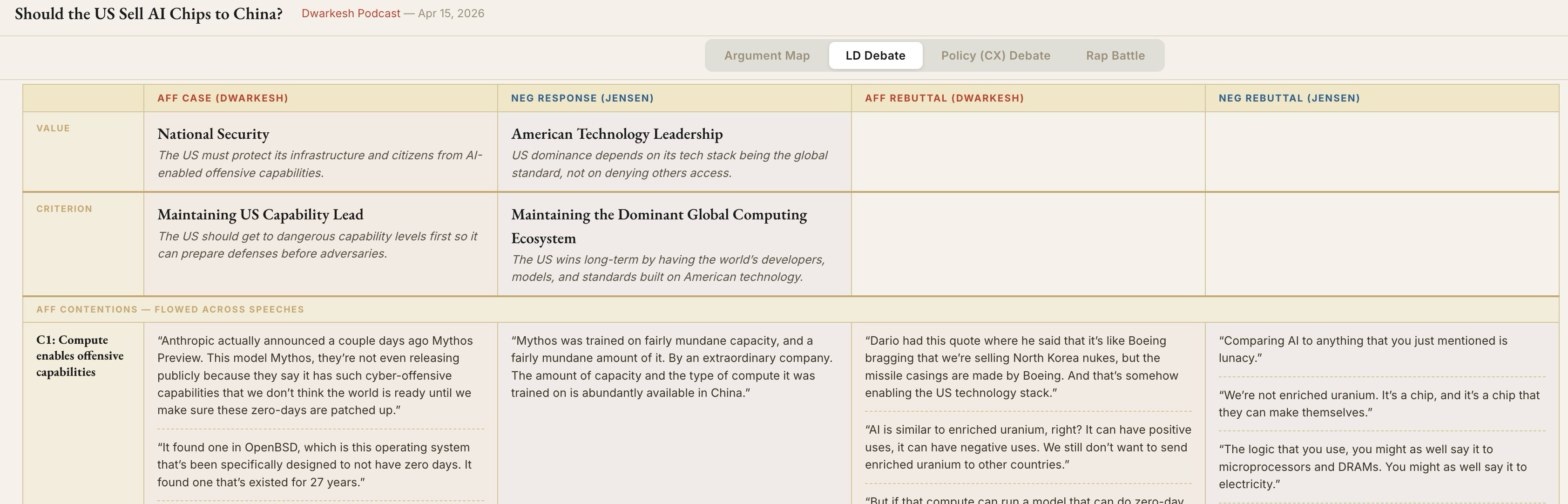
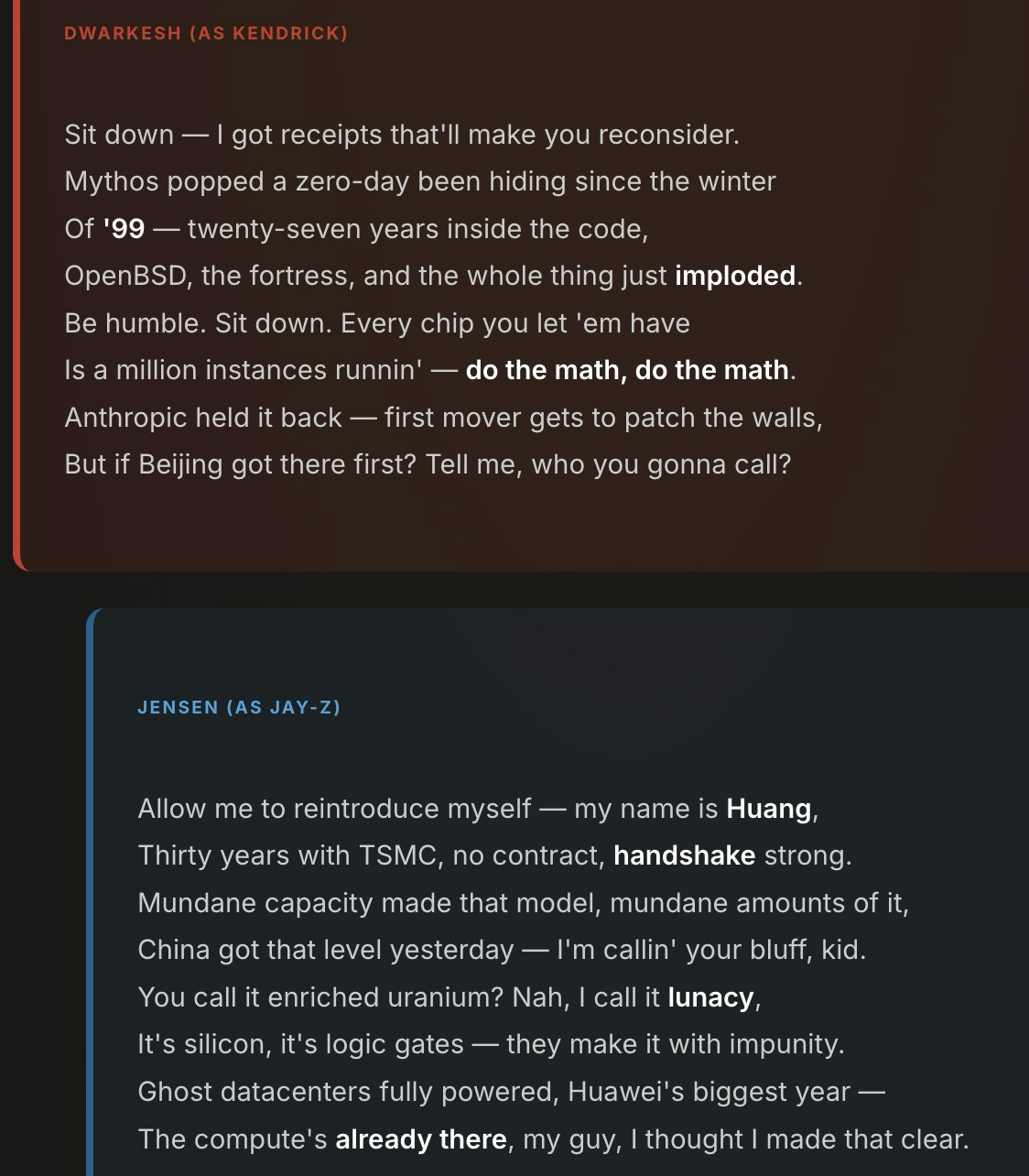
I claude coded a website that diagrams out their arguments, with different modes including LD-style high school debate and a rap battle (Dwarkesh as Kendrick, Jensen as Jay Z). Dwarkesh would have won on substance and speaker points, with Jensen’s biggest truth-stretching coming around talking about Chinese fab capacity (see this podcast I did with Chris McGuire on why Huawei can’t catch Nvidia). Even though Jensen was playing with the handicap of making his case while dancing around investors, China, and Trump, you should still take him seriously.
Dan Wang’s take (endorsed by Jensen on his Lex interview) is that American society biases too much in favor of lawyerly Ivy League polish and against China’s engineering bias. Setting aside the shade I’ve thrown at Jensen for his export control policy, Nvidia is an American company, Jensen has lived the American dream while swimming culturally upstream for decades, and the U.S. is much better off for it.
I want to close with an extended excerpt from twitter account teortaxes:
Jensen is the gangsta poster boy for American Dream. He is REALLY is Not a Loser. He’s also not a Car, but indeed is the driver. Moreover, there are almost no people alive with a greater dynamic range of lived experience, who have gone from positions many would die to escape and into a position entire institutions fight to death over, and only tightened their grip since. Xi Jinping would qualify as a peer, maybe? (Musk has less range, even though he ended up in a similar place.) These individuals are fascinating outliers, and I believe that when they deign to explain their ways, however awkwardly, us mortals should sit our asses down, listen and learn.
Jensen has basically ascended from a toilet-scrubbing immigrant runt to a demigod, from a random NPC to a Singularity Kingmaker, a whole vertebra of the Universe’s backbone; and that journey informs his views, just like Dwarkesh’s “be really good at Reasonably Conversing, insure your middle class stake” informs his. Jensen’s journey is not about luck, he is definitely not “1 SD IQ lower”. He hasn’t trained himself in our exact mode of coffee salon intelligence that allows for casually cooking up consistent, defensible, lawyerly arguments about, basically, the structure of written information. So he’s worse than us at it. Not because his epistemology is inferior, as in «less predictive»; it is just different, and insistence on Not Being a Loser is its functional part. He is supremely motivated to Not Lose, so he’ll not make self-defeating moves. How he sorts moves into self-strengthening and self-defeating is, therefore, very important, more than verbally persuasive arguments.