
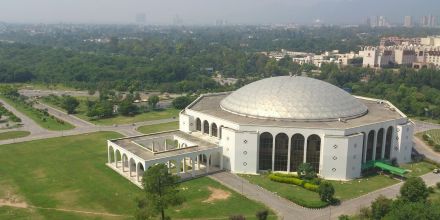
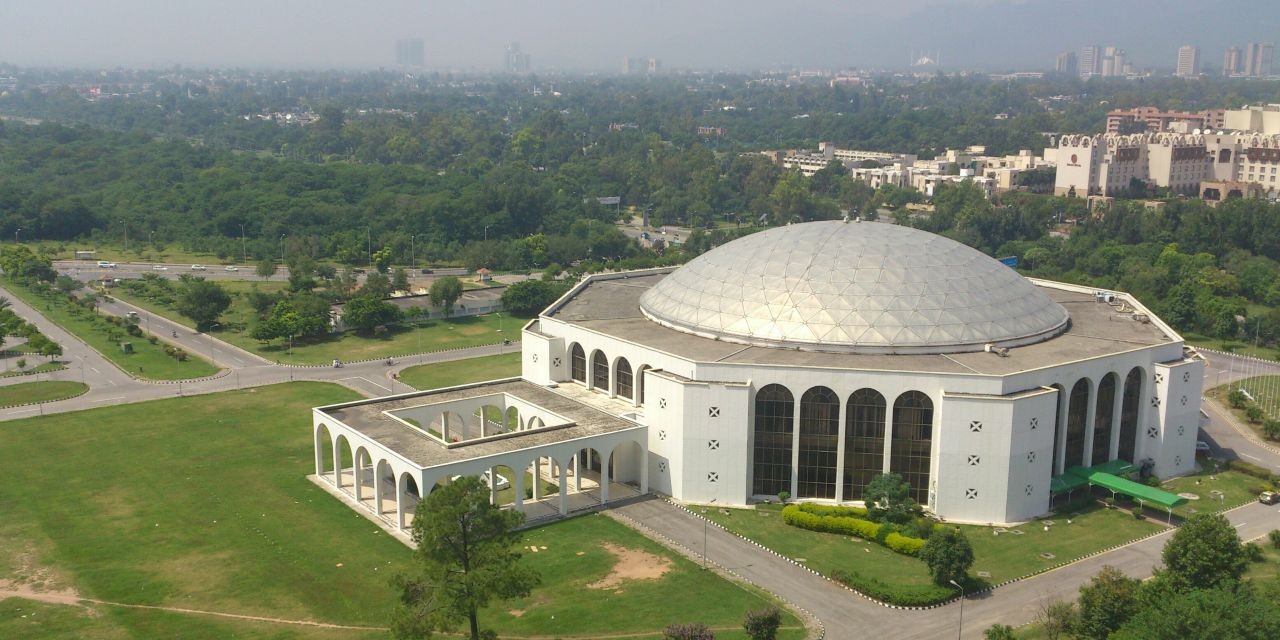
Image: Jinnah Convention Centre. Islamabad – Humza Ahmed / Wiki Commons
The world’s attention was focused for a brief moment on Islamabad. Complicated, but hopeful talks to end the war against Iran and to rescue the future of the global economy failed after 21 hours of negotiations. Meanwhile, New Delhi remains on the sideline and Beijing in the background.
There is no agreement. Both sides accuse each other of making excessive demands. Nevertheless, it was a historic meeting, as the Pakistani-mediated talks were the highest-level direct meeting between representatives of the US and Iran since the Islamic Revolution of 1979. The failed breakthrough leaves the US (and the rest of the world) with two unpalatable options: the continuation of the war or lengthy negotiations with Teheran. The world is now anxiously watching the reactions in Washington and Tehran.
Islamabad in the spotlight, New Delhi sidelined
It was also a historic meeting for Pakistan. Pakistan is back on the world stage. While its government was in the spotlight as a mediator in the complex US–Iran crisis, New Delhi was sidelined. The opposition in India criticized the Modi government’s inaction. Rahul Gandhi, leader of the opposition Congress party, described Pakistan’s growing global diplomatic role as a failure of the Modi government. This is particularly evident given India’s deep political and economic ties to the Middle East. Pakistan’s army chief, Field Marshal Asim Munir, and Prime Minister Shehbaz Sharif played a key role in the peace talks in Islamabad. The talks were being held not in Doha, Geneva, Vienna, or Ankara, but in Islamabad. This is—despite the failure of the talks—a major diplomatic success for the Pakistani government.
Why didn’t the Indian government assume this mediating role, political commentators in the capital are asking. Happymon Jacob, a professor at Shiv Nadar University in Chennai, recalls Jawaharlal Nehru’s diplomatic initiatives in the 1950s, when India’s government acted as a channel of communication between China and the US during the Korean War. India acted as part of the International Commission for the Supervision of the partition of Indochina in 1954. Nehru was also an important international actor and mediator during the Suez Crisis of 1956. However, Jacob points out, this occurred at a time when India was significantly involved in the Non-Aligned Movement.
Envy, anxiety, unease and hope in New Delhi
The backdrop for the discussions in India is the strained relationship between India and Pakistan and the diplomatic freeze between the two neighbours. India has successfully marginalized Pakistan diplomatically in recent years and used its political and economic leverage to push its own standing and exclude Islamabad from an important global role.
The Pakistani government has been skilfully pleasing and flattering President Trump for some time now. Donald Trump, who favours a personalized foreign policy and has an obvious preference for political strongmen, found a friend in Munir – “my favourite field marshal,” as he said with a grin. The daily newspaper Indian Express speaks of a “unique connectivity matrix.” The Indian government is watching Pakistan’s growing influence during President Trump’s second term with concern, as the improved Islamabad–Washington connection could damage the good relationship between Modi and Trump, which is already under considerable strain due to the trade dispute.
Following the last military confrontation between India and Pakistan in April/May 2025 about Kashmir, Trump claimed to have acted as a mediator in the conflict. The Indian government was extremely annoyed that Trump had announced the end of the conflict before India could do so. It explicitly emphasized that it had negotiated the ceasefire bilaterally with Pakistan, without the Trump administration. The Pakistani army chief, on the other hand, praised Trump and promptly received an invitation to dinner at the White House. He also nominated Trump for the Nobel Peace Prize.
On the one hand, India views Pakistan’s growing influence with suspicion and feels irritated that Pakistan was centre stage. The Indian Foreign Minister, Jaishankar Subrahmanyam, in a rather undiplomatic and somewhat pejorative remark, referred to Pakistan as a “dalal” nation. This term can be interpreted as a mediator or broker, but also as a dubious middleman nation. In contrast to many countries that thanked Pakistan’s government for its mediating initiative, India remained relatively reserved.
On the other hand, India has a strong economic interest in a lasting ceasefire. Around 40 percent of India’s crude oil imports are transported through the Strait of Hormuz. Indian exports to the Gulf States are substantial. Over 220,000 Indian nationals have been repatriated from the Gulf region since the outbreak of the war. Personal remittances from Indians working there amounted to US$51 billion in 2025. The negative economic consequences of the war for India are considerable, even if a peace agreement is reached.
A statement from the Foreign Ministry in New Delhi said: “We welcome the ceasefire reached and hope that it will lead to a lasting peace in West Asia … de-escalation, dialogue and diplomacy” are essential to ending the ongoing conflict soon.
Aside from the envy debate in India, there are good reasons why India is not a suitable mediator and why Pakistan was able to assume this role instead, despite India’s good relations with the Gulf States and with Iran. In the last week of February 2026, just days before the bombing of Iran, Narendra Modi paid a two-day state visit to Israel, where the focus was on arms imports, cooperation in the fight against terrorism, and deepening the strategic partnership. This friendship disqualifies India as a broker.
Pakistan is home to approximately 40 million Shiites, the largest Shiite group outside of Iran. While cultural and religious ties exist between Pakistan and Iran, the relationship has not always been easy. Pakistan shares a 900-kilometre troubled border with Iran. Both countries accuse each other of supporting separatists. Pakistan’s close friendship with China proved to be a positive asset in Islamabad’s mediation effort. For years, China has been Pakistan’s closest ally.
China in the background
China is increasingly active in the Middle East and protects Iran from complete international isolation. China has purchased almost all of Iran’s oil production and, according to The New York Times, has now used its influence to persuade Iran to accept the two-week ceasefire. The Chinese leadership urged Tehran to be flexible. The success of this agreement illustrates both China’s influence on Teheran and its own interest in a secure energy supply. At the end of March, the governments in Islamabad and Beijing agreed on a five-point plan for an immediate ceasefire, peace negotiations, the protection of non-military targets, maritime safety, and the primacy of the UN Charter.
China’s influence in the Middle East region has been growing for some time. An agreement between Saudi Arabia and Iran in 2023 was brokered by China, not the US. India has viewed the involvement of China, its major Asian rival with whom it still has border disputes in the Himalayas, with concern. While it welcomes stability in the region, India also fears negative repercussions for its own security interests and potential political marginalization.
It is also important for India that Pakistan’s recently improved relationship with the US government does not negatively impact the Kashmir conflict. Would Trump take sides with Pakistan? Kashmir is also one reason for India’s reluctance to act as a mediator, as the Indian government strictly rejects third-party interference in the Kashmir conflict.
While concern in India may be high, it is comparatively minor when considering the consequences of the now-failed negotiations. The hope remains that Pakistan, China, or other third parties can persuade the two adversaries, the US and Iran, to resume talks.
Related articles:
Regime Change – Sometimes It Works, Often It Doesn’t (3-minute read)
Iran War Unravels U.S. Strategy and Strengthens Russia–China Axis (3-minute read)
A Third Cold War (10-minute read)