
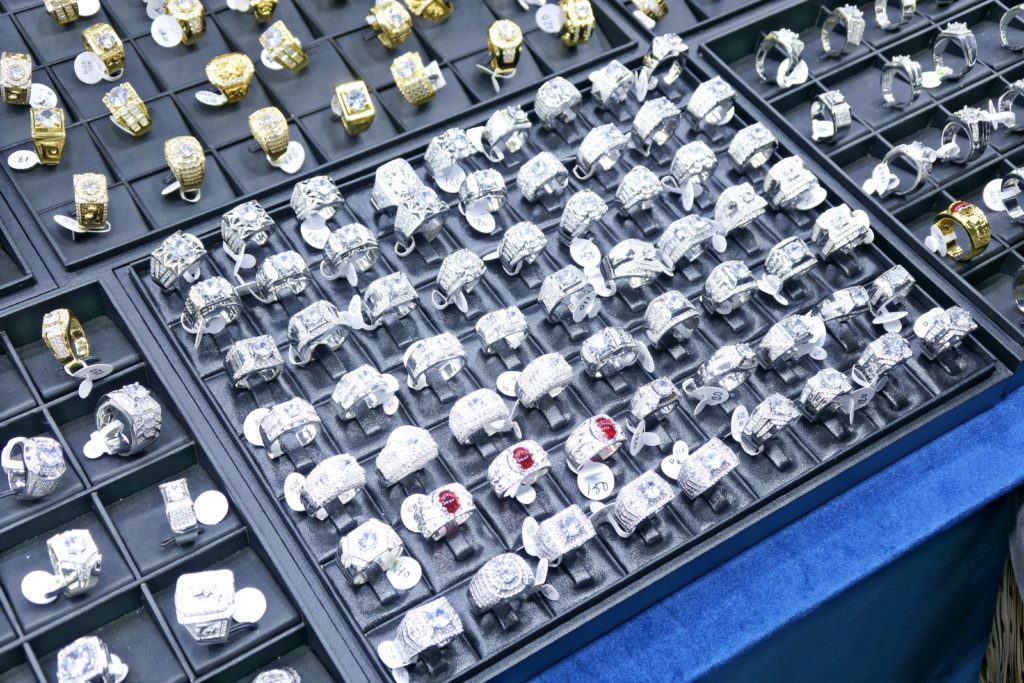
Rings at a fair in Vinh Long, Vietnam. Stock image by ProArt Studios.
Ho Chi Minh City’s bustling jewelry quarter has fallen unusually quiet. Customers aren’t browsing for engagement rings or necklaces anymore, instead they’re clutching old receipts and certificates, hoping to sell diamonds they no longer trust.
The discovery of what appears to be Vietnam’s biggest-ever diamond smuggling network has rippled through the industry. Investigators allege more than 30,000 stones worth over 1.5 trillion dong ($57 million) were brought into the country over the past two years, hidden in luggage, shoes and clothing after being sourced in India and routed through Hong Kong.
In gem-certification labs, diamonds were stripped of their original Gemological Institute of America (GIA) laser inscriptions before being re-engraved and issued with reports that overstated their quality, police said, allowing them to be sold at far higher prices. Authorities are still investigating how widely the stones spread through the market, while dozens of jewelry shops have temporarily closed.
“I’m truly worried,” Thanh Hang, an online clothing shop owner who purchased her diamond ring in Ho Chi Minh City, said. The stone had been graded by PNJ Laboratory, one of the companies under investigation.
Hang had sought a refund at the retailer in question, but found the branch was shut. In Vietnam, it’s common for jewelry stores to offer a buyback program as a sort of sales tool — it gives buyers confidence they’ll have an exit route at some point in the future, while encouraging them to return to the same jeweler when they want to upgrade or resell.
The response Hang received when she eventually got hold of the company wasn’t encouraging. “We’ll settle the payment next year,” was the best they could do, she said.
What began as a criminal investigation is now reverberating through Vietnam’s diamond trade, prompting calls for tougher regulation of the industry after it ensnared two of the country’s most well-known jewelry brands.
Phu Nhuan Jewelry JSC, the country’s largest listed jeweler, has insisted that none of the tainted diamonds entered its retail network after police detained the former head of the company’s gem certification subsidiary. PNJ said the allegations relate to the former executive, not the company. Still, Chief Executive Officer Phan Quoc Cong acknowledged the developments have “become a crisis moment for the entire industry.”
The fallout has been swift: nearly half of PNJ’s market value has been wiped out, authorities have widened inspections of the jewelry market, and consumers are increasingly questioning whether the diamonds they bought are worth what they thought.
The manager of Tam Luxury Diamond, also in Ho Chi Minh City, where much of the country’s gem trading takes place, said some days he gets up to 100 clients coming back wanting to trade in their precious stones. New customers, meanwhile, are in short supply.
A wave of arrests of prominent jewelry shop owners in mid-July triggered several well-known retailers, including Kim Ly Gold Shop, to suspend operations. A monthlong trade ministry-led inspection of the broader gemstone and precious metals markets has been set for August, with a focus on product origin and labeling.
Another major chain, Saigon Jewelry Co., came under pressure after police detained a further four people over a related smuggling ring that allegedly supplied more than 3,400 lower quality diamonds worth about 500 billion dong to its retail network between 2022 and 2024. SJC hasn’t said anything publicly and didn’t respond to a request for comment.
The government needs to implement a “proper regulatory framework for the diamond market,” Huynh Trung Khanh, vice chairman of the Vietnam Gold Traders Association, said. Despite its name, the body also deals with silver and other gemstones and its members include some of the industry’s biggest names, including PNJ and SJC.
“An independent gem certification authority is needed to strengthen oversight and bring greater transparency and accountability to the market,” Khanh said.
Until that happens, the rush of concerned customers making a beeline to retailers’ doors is unlikely to let up.
PNJ has limited daily payouts for buybacks, saying the immediate priority is to preserve liquidity, maintain operations and protect the company’s long-term value. It also plans to hire international firms to assess its diamond inventory in a bid to bolster its credibility.
For many Vietnamese families, diamonds are more than just a luxury purchase, they’re a store of wealth and prestige. The nation imported more than $122 million of diamonds during the first half of 2026, most from India and then Belgium, customs data show.
That predilection is rooted partly in history.
Decades of war, inflation and Vietnam’s former centrally planned economy, where investment options were limited and confidence in financial assets was often weak, encouraged households to hold tangible assets, like gold, that could be easily stored and passed down through generations. The preference remains deeply embedded today, even as the economy has modernized.
“If people are smuggling diamonds, however large or small numbers into Vietnam, the likelihood is they’re smuggling other stuff as well,” Kenneth Scarratt, the vice president of the World Jewellery Confederation, said. “Rubies, sapphires, emeralds… it’s probably time the customs and excise authorities in Vietnam looked a little inward and started to sort it out.”
A global surge in synthetic diamonds, of which China is the largest producer, is also complicating the picture. It’s not clear whether synthetic diamonds are part of the problem in Vietnam but they’ve become so convincing, even experts can struggle to tell the two apart.
“There’s no way a normal jeweler can just look and separate” them simply by eye alone, Bangkok-based Scarratt said.
For now, the immediate challenge is restoring confidence. With customers more cautious, retailers will have to place a greater emphasis on authenticity, certification and product provenance, Nguyen Thi Sony Tra My, a senior analyst at Maybank Investment Bank, said.
“Smaller and less-established jewelry shops could face greater challenges in maintaining customer trust and liquidity, particularly in the current environment,” she said.
Some Vietnamese are trying to eschew retailers altogether.
“I’ve been posting my diamond rings on Facebook groups with a 30% discount,” Thanh Dat, a real estate broker who lives in Ho Chi Minh City, said. But with would-be buyers pressuring him to offer 60%, “I may just keep them.”
(By Nguyen Kieu Giang, Francesca Stevens and Cao Ban)