
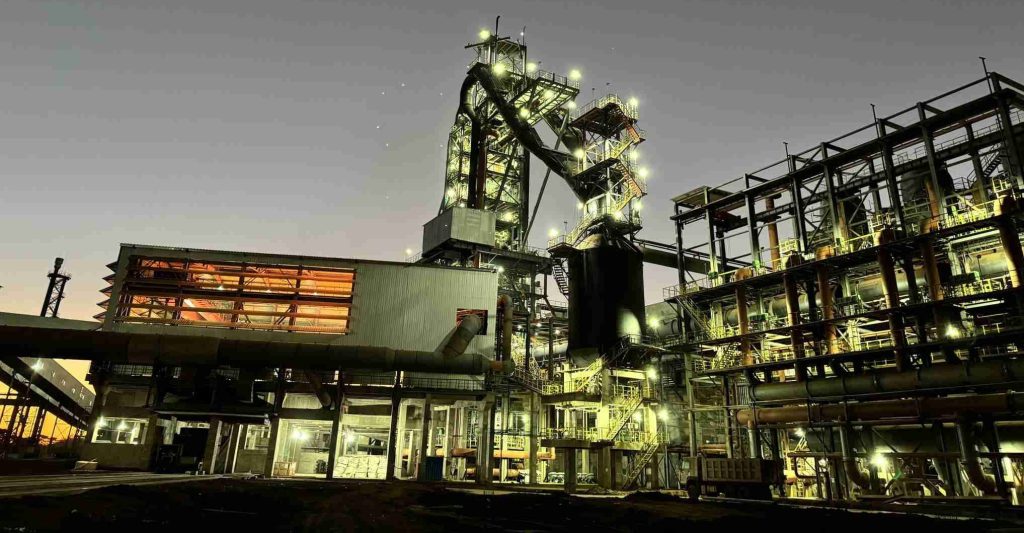
THE Southern African trade landscape may be on the cusp of a quiet but significant shake-up. In response to the emerging competitive threat posed by Zimbabwe’s Dinson Iron and Steel Company (DISCO) in Manhize, the South African government is set to release the preliminary findings of its steel tariff review in the coming week. Pretoria frames this as a necessary step to safeguard its domestic steel industry against rising import volumes—yet the implications stretch far beyond a narrow tariff adjustment.
By Brighton Musonza
The review, as reported by Reuters, was initiated earlier this year by the South African International Trade Administration Commission (ITAC) under the South African government’s ministerial directive, signals more than just a protective reflex. It represents South Africa’s willingness to recalibrate its trade policy in ways that may test the very foundations of the Southern African Development Community’s (SADC) Free Trade Area agreement—a regional economic framework long perceived as tilted in South Africa’s favour.
The Steel Market Context: From Global Dynamics to Manhize’s Disruption
The steel industry is one of the most globally interconnected sectors, its prices shaped by shifting demand in China, infrastructure booms in emerging economies, and fluctuations in raw material costs from iron ore to coking coal. In recent years, global steel markets have also been reshaped by state-led industrial policies, climate-related production limits, and rising protectionism.
South Africa, historically the dominant steel producer in the SADC region, has benefited from this interconnectedness. With legacy plants such as ArcelorMittal South Africa, Pretoria long enjoyed near-monopolistic access to regional markets, exporting both finished steel and semi-finished products to its neighbours. Zimbabwe, whose own industrial base was eroded by decades of underinvestment and economic instability, had become a net importer of steel, often sourcing from South Africa to meet demand in construction, manufacturing, and mining.
Enter Dinson Iron and Steel Company—a $1.5 billion investment by Chinese interests into Zimbabwe’s Manhizhe in Chivhu district. Designed with modern blast furnaces and integrated production lines, DISCO is set to become Africa’s largest steel plant, with projected annual output exceeding one million tonnes. Crucially, the plant’s cost base and geographic positioning allow it to compete directly in regional markets that were once South Africa’s uncontested domain.
A Brief Timeline of SADC Trade Relations and South African Dominance
1980 – The Southern African Development Coordination Conference (SADCC) is formed, aiming to reduce dependence on apartheid-era South Africa and promote regional cooperation.
1992 – SADCC evolves into the Southern African Development Community (SADC), formalising commitments to economic integration.
2000 – SADC members agree to establish a Free Trade Area (FTA), setting out a phased plan to remove tariffs on 85% of intra-regional trade.
2008 – The SADC FTA officially launches. South Africa, already industrially advanced, gains significant market access to smaller economies, exporting value-added goods while importing mainly raw materials.
2010–2020 – South Africa consolidates its role as the region’s manufacturing hub, with neighbouring states becoming major consumers of its industrial output. Trade imbalances deepen, but Pretoria defends the system as mutually beneficial.
2023 – Zimbabwe announces the Dinson Iron and Steel Company project in Manhize, signalling its intent to reclaim industrial capacity in steel production.
2025 – South Africa initiates an ITAC-led review of steel tariffs, raising questions about whether such measures breach SADC’s liberalisation commitments.
Why This Matters for South Africa
From Pretoria’s perspective, the threat is structural, not cyclical. If Zimbabwe’s steel begins flowing tariff-free into South Africa under the SADC FTA, domestic producers could lose market share both at home and across the region. The fear is not simply about losing short-term sales, but about the longer-term erosion of industrial capacity—a process that, once set in motion, is notoriously hard to reverse.
The ITAC review is therefore framed as a defensive measure: a recalibration of tariff structures to shield domestic industry from what it sees as unfairly advantaged imports. However, this raises an uncomfortable legal and political question: under the SADC FTA, both Zimbabwe and South Africa are bound to progressive trade liberalisation commitments, including the elimination of tariffs on most goods originating within the bloc. Any unilateral reintroduction of protective tariffs could amount to a breach of the trade protocol.
The Legacy of the SADC Trade Agreement: A Tilted Playing Field
Since its inception in 2008, the SADC Free Trade Area has been a paradox. On paper, it promises mutual market access and non-discrimination. In practice, its benefits have accrued disproportionately to South Africa. Its industrial advantage, mature logistics networks, and access to capital allowed it to flood neighbouring markets with value-added products, while importing relatively little from its smaller, less industrialised partners.
For years, Zimbabwe’s role in this arrangement was largely as a consumer of South African goods—from steel and processed foods to manufactured machinery—while exporting mainly unprocessed minerals and agricultural commodities. In that sense, the rise of DISCO is more than an industrial development project; it is a structural rebalancing of the regional trade equation.
If South Africa now seeks to shield itself from this competition, it risks exposing the asymmetry at the heart of SADC’s integration project—a project that has long been defended in Pretoria as a mutually beneficial endeavour.
The Mineral Economy Connection: Steel, Platinum, and Beyond
The steel dispute cannot be viewed in isolation. Zimbabwe’s mineral wealth—including platinum, chrome, gold, and lithium—gives it an unparalleled strategic advantage if industrial policy can link resource extraction to local value addition.
Platinum group metals (PGMs), for instance, are crucial to the global green energy transition, from catalytic converters to hydrogen fuel cells. South Africa currently dominates PGM production, but Zimbabwe’s reserves—second only to South Africa’s—are being eyed by global investors for downstream processing potential. If Zimbabwe begins to replicate the Manhize model in other mineral value chains, the regional economic order could shift significantly.
For South Africa, which has historically leveraged its mineral and industrial dominance to anchor its geopolitical influence within SADC, such developments could challenge its role as the region’s manufacturing hub.
The Zimbabwean Perspective: From Market Dependency to Market Maker
For Zimbabwe, the stakes are equally high. Manhize is not just about supplying rebar for construction or steel coils for manufacturing. It is about replacing imports with local production, creating supply chains that feed into the domestic economy, and eventually capturing export markets.
The domestic spill-over effects are already visible. Zimbabwean manufacturers who once imported raw steel from South Africa to produce fencing, nails, and bars for both the domestic and export markets now have the potential to source locally. The mining sector—particularly in grinding media and heavy equipment manufacturing—could significantly reduce costs and dependency by purchasing steel domestically.
However, such gains depend on the ability to trade freely across the region. If South Africa introduces protective tariffs in violation of SADC protocols, Zimbabwe risks being locked out of its most immediate and lucrative market.
Trade Disputes Without Trade Wars
It is important to stress: this is not a war, but a potential trade disagreement. In the language of international trade, disputes are not settled on the battlefield but at the negotiating table—or, in the case of SADC, through established dispute resolution mechanisms. The World Trade Organization’s (WTO) framework also provides procedural pathways should regional remedies fail.
Yet the political context cannot be ignored. Trade disputes within a regional bloc often test not only legal commitments but also political alliances. For Zimbabwe, challenging South Africa over tariffs would be a bold assertion of sovereignty within a structure that has historically favoured Pretoria.
Conclusion: A Moment of Truth for Regional Integration
The ITAC review of steel tariffs is ostensibly a technical exercise, but its implications reach deep into the future of Southern African trade relations. It will test whether SADC’s Free Trade Area is a genuine framework for balanced regional integration or merely a platform for the most industrialised member to consolidate its dominance.
For Zimbabwe, the emergence of Dinson Iron and Steel Company is both an economic opportunity and a political test: the chance to move from being a dependent market to a regional producer, and to defend that position within the rules of the game. For South Africa, the decision will be equally defining: whether to compete within the open market principles it helped enshrine, or to retreat behind protective measures that risk fracturing the regional economic order it has long led.
In either case, the steel beams rising in Manhize are more than just physical structures—they are the scaffolding of a new chapter in Southern Africa’s industrial history. Whether that chapter is written in the spirit of cooperation or confrontation will depend on how both nations choose to interpret the fine print of the agreements they once signed in good faith.