
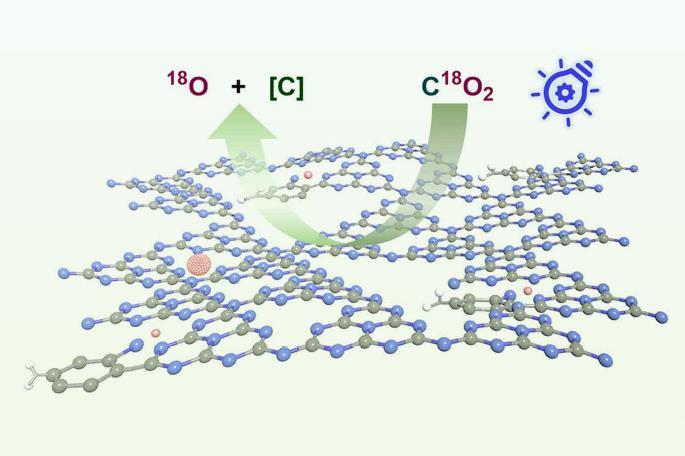
Carbon dioxide can be used to photo-oxidise alkenes into a variety of useful organic molecules under mild conditions, researchers in Germany and elsewhere have shown. The reaction, which requires only an iron-based catalyst, could potentially replace existing processes requiring extreme conditions or toxic reagents.
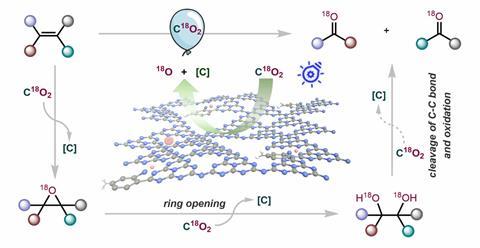
Oxidation reactions account for around 30% of the chemical industry’s total output and the oxidative cleavage of the carbon–carbon double bond in alkenes is especially valuable. Ozonolysis is commonly used, but ozone’s toxicity and explosive nature present serious safety concerns. Other mechanisms usually require hazardous reagents or conditions or generate toxic byproducts. Even molecular oxygen is a fire hazard in industrial applications.
Carbon dioxide is safe and readily available, but this is a double-edged sword as its stability arises from its weak oxidising power. In 2014, astrochemist William Jackson at the University of California, Davis in the US and colleagues showed that, in extreme ultraviolet light and high vacuum, it could photodissociate into carbon and oxygen – suggesting that this could explain abiotic oxygen production on carbon dioxide-rich exoplanets.
Before seeing the study, organic chemist Shoubhik Das at the University of Bayreuth in Germany and colleagues had already conceived of using the oxygen from carbon dioxide to oxidise organic molecules. However, he says: ‘Obviously we needed to overcome these very harsh reaction conditions.’ In conjunction with Matthias Beller’s catalysis group at the University of Rostock, the team developed a process using an iron-based photocatalyst on a modified carbon nitride support. In a mixed solvent of acetonitrile and trichloromethane the reaction can proceed under near ultraviolet or even visible light under ambient conditions. ‘Graphitic carbon nitride is well known to absorb visible light and this light is transferred to the transition metal centre,’ explains Das.
Direct splitting is still thermodynamically uphill, but the researchers hypothesise that the adsorption of carbon dioxide on an iron site distorts the molecule into a bent configuration. This lowers the energy required to dissociate it to the point that, when coupled with oxidation of the trichlomethane, the overall bond cleavage becomes favoured on the surface of the catalyst. The researchers demonstrated the production of a wide variety of organic molecules such as carboxylic acids, ketones and the pharmaceuticals donepezil and fenofibrate. They validated their model using isotopic labelling and multiple spectroscopic techniques. ‘We are discussing with many industrial collaborators and hope we can scale up the process,’ says Das. In addition, he says, ‘we want to make it more general for the whole of oxidation chemistry and, in my lab, we have already developed another five processes based on these concepts.’
‘It’s an intriguing study,’ says Bert Weckhuysen at Utrecht University in the Netherlands. ‘It’s using CO2 in a really different way – as an oxygen carrier to selectively activate a really wide range of organic molecules… I do not yet know how impactful this research is because it will depend on how practically one can operate these reactions at scale with light and very selectively produce molecules that have added value.’ He notes, however, that the reaction’s sustainability is limited by the role of the toxic trichloromethane – something acknowledged in the study. ‘It would be good if you could get a solvent that is better in its green chemistry potential,’ he says.