
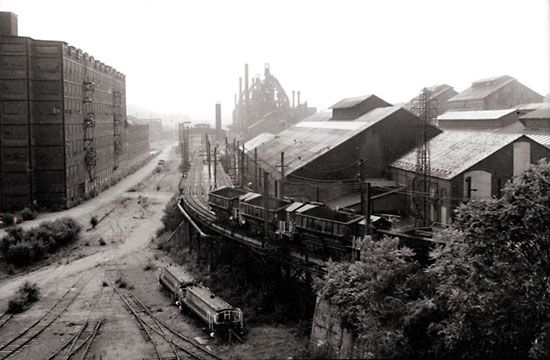
Bethlehem Steel main manufacturing facility (now defunct), Bethlehem, Pa.
Jeremy Blakeslee
Bethlehem Steel Corporation was once the United States’ second-largest steelmaker, supplying the beams, ships, and arms that helped define 20th-century industry. After decades of decline, the company went bankrupt in 2001 and dissolved in 2003.
Origin and early history
Although Bethlehem Steel was founded in 1904, its history traces to 1857, when a group of railroaders and investors of the city of Bethlehem, Pa., founded the Saucona Iron Company, which four years later was renamed Bethlehem Iron Company; the works was designed principally to turn out wrought-iron railroad rails. In 1899 the facilities were acquired by a newly formed enterprise, the Bethlehem Steel Company. Six years later, a group of investors led by Charles M. Schwab created a new holding company—Bethlehem Steel Corporation—that consolidated Bethlehem Steel Company (of Pennsylvania), the Union Iron Works (with shipbuilding facilities in San Francisco), and a few other smaller companies.
Before creating Bethlehem Steel, Schwab was one of the major figures in the founding and development of United States Steel Corporation (1901). In August 1901 he had bought control of Bethlehem Steel Company, only to see it fail in a financial scandal. Schwab borrowed and invested heavily to save the company’s assets, absorb other companies, and launch the Bethlehem Steel Corporation. The corporation thrived, partly as a result of the expanding orders for guns, munitions, and naval vessels from European powers both before and during World War I.
Expansion, decline, and bankruptcy
In the first four decades of its existence, the corporation absorbed a number of iron-ore, coal, and steel-producing properties from coast to coast. During World War II and the postwar years, it continued to expand. Like other American steel companies, Bethlehem began to diversify during the 1970s in the face of strong competition from foreign steelmakers. Its other activities included the production of plastics and related chemical products and the mining of nonferrous ores. Despite its attempt to diversify, Bethlehem Steel was ultimately brought down by several factors, including:
- Foreign competition. Cheaper imports—first from Japan and Western Europe (in the 1960s and 1970s), and later from South Korea and China (beginning in the 1980s)—eroded Bethlehem’s share of the U.S. steel market.
- Asbestos litigation. Beginning in the late 1970s and continuing through the 1990s, Bethlehem faced thousands of lawsuits from workers exposed to asbestos in its shipyards and mills, with payouts costing millions.
- Legacy costs. Heavy pension and health care obligations strained finances as the workforce shrank.
Bethlehem’s attempts at diversifying its income streams failed to offset mounting losses. In 2001 the corporation filed for bankruptcy protection, and two years later it—along with more than 20 of its subsidiaries, including Bethlehem Rail, Greenwood Mining, and Chicago Cold Rolling—was dissolved and its assets sold. Bethlehem’s surviving mills and operations were absorbed into International Steel Group in 2003 and later became part of ArcelorMittal (MT), now one of the world’s dominant steel producers.
The collapse of Bethlehem Steel was both a sign of and spur to the notorious Rust Belt, the U.S. region where steelmaking and manufacturing once thrived before succumbing to widespread unemployment and poverty.