
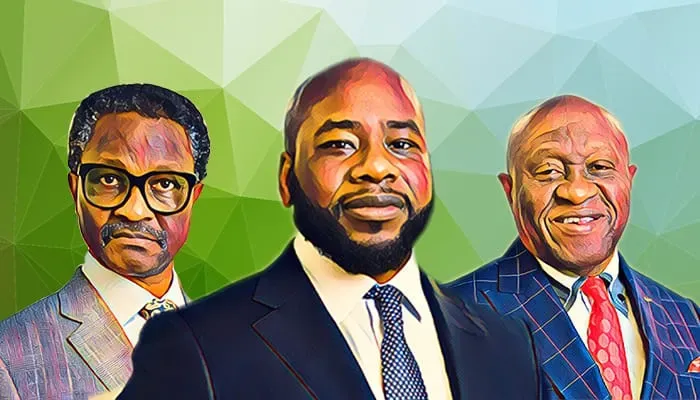
A trio of Nigerian investors led by Segun Lawson has watched the value of its shared bet on Thor Explorations hold near record levels, after the gold miner behind Nigeria’s first large-scale commercial mine reported a strong second quarter.
Thor, listed on London’s AIM and the TSX Venture Exchange, generated $77.3 million in revenue in the three months to June 30, selling 17,050 ounces of gold at an average realized price of $4,535 an ounce. The company poured 19,153 ounces from its Segilola mine in Osun State, took first-half production to 39,409 ounces, and ended the quarter with an adjusted net cash position of $225.6 million.
The results extend a run that has transformed the fortunes of the three men who hold the largest individual stakes in the company. Together, Lawson, Chief Kayode Aderinokun and Folorunso Adeoye control more than 11% of Thor, a bloc of Nigerian shareholders whose combined holding is worth close to $60 million at the current share price.
Lawson is the largest of the three. The founder and chief executive holds 31,618,905 shares, about 4.74% of the company, a stake worth roughly £18 million ($24 million) with Thor trading at 57 pence in London and carrying a market value of about £371 million ($497 million). His holding has climbed sharply over the past year as the stock surged on record gold prices, up from around $17 million when the shares stood lower in 2025.
Aderinokun holds about 22.2 million shares, or 3.33%, worth roughly £12.7 million ($17 million). Adeoye holds about 22.7 million shares, around 3.4%, worth roughly £12.9 million ($17.3 million). Neither figure makes them billionaires, but the three together form a rare example of Nigerian capital and expertise sitting at the heart of a producing, internationally listed mining company rather than the oil ventures that have long dominated the country’s resource wealth.
The largest shareholder overall is not an individual. The Africa Finance Corporation, the Lagos-based development financier backed by African governments and multilateral lenders, holds about 15.9% through its AFC Equity Investments vehicle, a stake worth roughly £60.6 million ($81 million). The corporation supplied the financing package that brought Segilola into production, including a senior secured credit facility, a gold stream prepayment and an equity investment, giving Thor the institutional backing it needed as an unproven junior in a country with no modern gold-mining record.
Each of the three Nigerian shareholders brought something different to the venture. Lawson supplied the technical and financial architecture. A geologist trained at the Royal School of Mines at Imperial College London with an MBA from Cass Business School, he worked in oil and gas corporate finance at Noble and Company and scouted West African deals at Premier Oil before co-founding Thor in 2011. He identified and led the acquisition of Segilola in 2016 and steered the project from exploration to production, pouring first gold in July 2021.
Aderinokun brought in-country mining pedigree. A traditional chief with more than three decades in Nigerian finance and mining, he chairs First Marina Trust and helped lead the first commercial exploration of Segilola through Tropical Mines, one of the deposit’s original indigenous owners. A published author and former chairman of the Association of Nigerian Authors, he also founded Nigeria’s fencing federation and advised the Osun State government.
Adeoye rounded out the group with a career spanning banking, oil and mining. President of Superior Petroleum, he co-founded Pacific Merchant Bank in 1989, which later merged into Unity Bank, and helped pioneer modern exploration standards in Nigeria through Pineridge Nigeria and Tropical Mines, the original owners of Segilola. He has been buying Thor shares as recently as last year.
The mine at the center of their fortunes had waited decades for development. Once known as the Iperindo reef, Segilola was discovered in 1945 and drew intermittent attention from the Nigerian Mining Corporation in the 1980s before passing through several owners. Thor acquired it in 2016 through a deal combining shares, cash and a royalty, and turned it into the country’s first industrial-scale gold operation, in a nation long known for oil and artisanal mining rather than formal mineral production.
The Segilola plant processed 240,769 tonnes of ore in the quarter at a grade of 2.57 grams per tonne, with a recovery rate of 93.3%. Thor reiterated its full-year target of 75,000 to 85,000 ounces and kept all-in sustaining cost guidance at $1,000 to $1,200 an ounce, keeping it among the lower-cost producers in the sector. The company declared a quarterly dividend of 1.25 Canadian cents a share, payable on August 14.
The three men are now backing an expansion beyond Nigeria. Thor completed more than 20,000 meters of drilling across its portfolio during the quarter, including underground work aimed at extending Segilola’s life, and is advancing the Douta project in Senegal toward a final investment decision, with the mining convention there expected to conclude in the third quarter. It is also exploring across licences in Côte d’Ivoire.
Lawson has framed the strategy around using Segilola’s cash flow to build a second mine, positioning Thor as a multi-country West African producer rather than a single-asset company. For the Nigerian bloc that backed the project when few would, the second-quarter figures keep a wager that once looked improbable sitting close to its most valuable point yet.