
By Wallace Mawire
Twenty Zimbabwean students have been selected to undergo further tertiary education training through the local Embassy of India for the prestigious Indian Council for Cultural Relations (ICCR) Scholarship Programme.
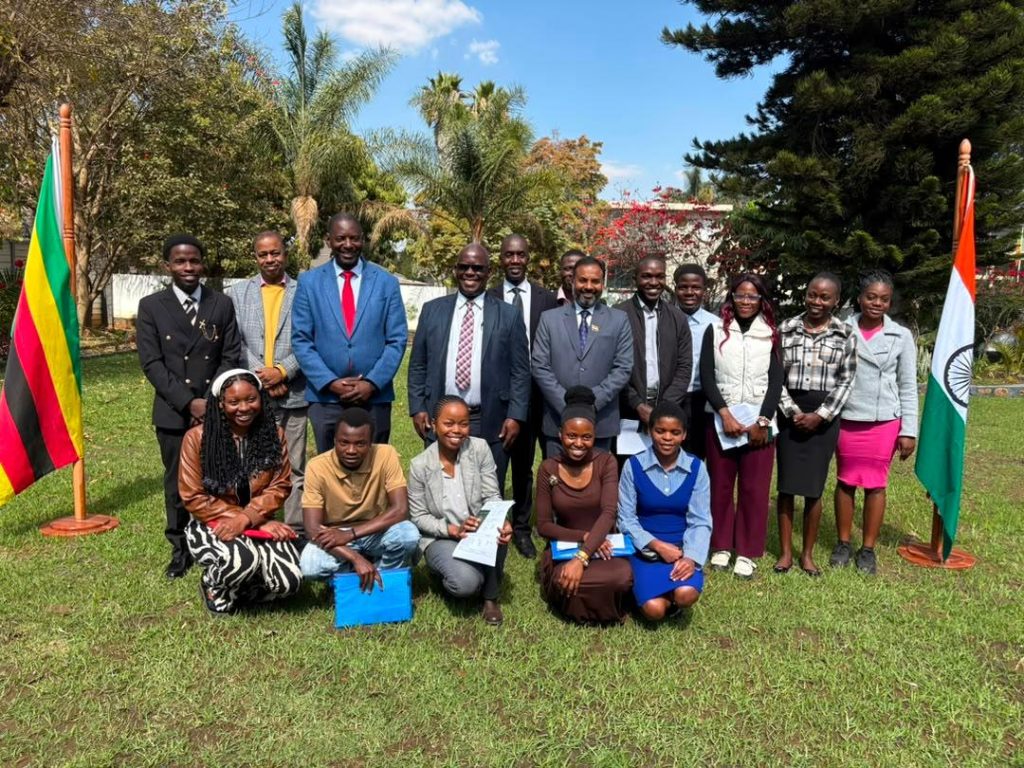
At a send-off ceremony for the 20 students held at the India Embassy in Harare, Bramha Kumar, India Ambassador to Zimbabwe said the Indian Council for Cultural Relations was established in 1950 with a mandate to foster institutionalized cultural and educational relations globally.
“Within our bilateral paradigm, the ICCR Scholarship Programme has served as a resilient pillar of India-Zimbabwe relations since Zimbabwe’s initial participation in 2010,” Kumar said.
He said historically, from 2010 through 2025, the Government of India allocated a consistent baseline of 10 fully funded scholarship slots annually to Zimbabwe.
Kumar said because the Embassy of India in Harare, in close coordination with Zimbabwean authorities, achieved a flawless 100% utilization rate of the slots every year, the India government recognized the compounding demand for advanced qualification.
He said the Government of India has structurally expanded its commitment, saying that for the 2026 to 2027 session, India has doubled the allocation of the Maitri Scholarship Scheme to 20 fully funded slots.
This is said to be accompanied by a dedicated seat under the ICCR Quad STEM Scholarship Scheme for advanced technological research, and unlimited institutional capacity under the AYUSH Scholarship Scheme for traditional medical systems.
According to Kumar, the Maitri Scholarship is designed as a comprehensive, fully funded mechanism to ensure that financial variables do not impede academic performance.
He said the the state framework entirely covers Tuition and Academic Fees with full exemption from institutional costs across undergraduate, postgraduate or doctoral matrices, subsistence Allowance covering a monthly living stipend to facilitate institutional residency, Logistical Support covering provision for free or heavily subsidized institutional accommodation, alongside fully covered international return air travel and Welfare and Academic Contingencies covering comprehensive medical insurance coverage, alongside specialized stipends for thesis and dissertation defense where applicable.
The Ambassador said through the transparent, merit-based Admissions to Alumni (A2A) portal, students are paired with premier central and state universities in India.

He said the students will be entering faculties that sit at the cutting edge of global development: from Artificial Intelligence, Data Science, and Information Technology, to advanced Engineering, Pharmacy, Macroeconomics and Environmental Sciences.
He also said the selected students earned the opportunity through their merit, dedication and hard work.
He also said as the students travel to India, they will become part of one of the world’s oldest civilizations and one of its fastest-growing economies.
Kumar said India is home to globally respected universities, vibrant research institutions, a thriving innovation ecosystem, and a rich cultural heritage.
He also expressed hope that, upon the students’ return, they would apply their knowledge and skills to contribute meaningfully to Zimbabwe’s development.
“Many ICCR alumni have gone on to become leaders in government, academia, business, healthcare, engineering, and other sectors. I am confident that you, too, will make valuable contributions to your communities and to the future of this nation,’ Kumar said.
The Government of Zimbabwe was represented at the send-off ceremony by Professor Fanuel Tagwira, the Permanent Secretary of Higher and Tertiary Education, Innovation, Science and Technology Development who thanked the India Government for their generosity in awarding scholarships to Zimbabwean students for the academic year.
Professor Tagwira said the esteemed India-Africa Maitri Scholarship Scheme, the ICCR Quad STEM Scholarship Scheme and the ICCR Ayush Scholarship Scheme is a testament to the deep and abiding friendship between India and Zimbabwe.
He said Zimbabwe has adopted the Heritage-Based Education 5.0, a framework anchored in teaching and learning, research, community service, innovation and industrialization.
He said the philosophy envisions a new generation of graduates who will apply their knowledge to produce goods and services and helping to tackle the nation’s pressing socio-economic challenges.
Tagwira said cognizant of the rapidly evolving global landscape, government acknowledges the imperative to unlearn, learn and relearn necessitating flexible and adaptive academic programmes that are relevant to national transformation.
He said the disciplines offered under the scholarship programmes including engineering and technology, Information and Communication Technology (ICT) Artificial Intelligency (AI),data science, agriculture, economics and pharmaceutical sciences among others are strategically aligned with advancing Heritage-Based Education 5.0. and supporting the second phase of Zimbabwe’s National Development Strategy (NDS2).
Tagwira also said India supported Zimbabwe’s liberation struggle and the two nations have expanded cooperation in trade, education, healthcare, infrastructure development and capacity development.
He said in the last five years alone, ICCR has offered Zimbabwe 56 fully funded courses for PhD and postgraduate studies I various fields.
“This support from India has had a positive impact on Zimbabwe’s global competitiveness through education, scientific and technical cooperation,’ he said.