
Our goal with The Daily Brief is to simplify the biggest stories in the Indian markets and help you understand what they mean. We won’t just tell you what happened; we’ll tell you why and how too. We do this show in both formats: video and audio. This piece curates the stories that we talk about.
You can listen to the podcast on Spotify, Apple Podcasts, or wherever you get your podcasts and watch the videos on YouTube. You can also watch The Daily Brief in Hindi.
In today’s edition of The Daily Brief:
-
What does it take to dig underground tunnels?
The Mumbai-Ahmedabad bullet train’s undersea tunnel showcases the engineering, geological, and financial complexities of modern tunnelling, revealing why building underground infrastructure is as much about managing uncertainty as it is about construction.
-
Plus: Chemical sector’s trade problem
India’s push to protect its chemicals industry through Quality Control Orders is raising costs for downstream manufacturers and squeezing smaller firms, highlighting the trade-offs between import protection and long-term industrial competitiveness.
We’re always chasing the day’s biggest stories. But every now and then, a dataset deserves a closer look than a Daily Brief allows.
That’s what Points & Figures is for. Our latest edition reads India’s newest health report, using data on nutrition, disease, and insurance to ask what the country is quietly paying to get healthier.
This spring, workers at Ghansoli in Navi Mumbai lowered the last parts of a massive machine into a shaft underground and assembled it there. This machine is longer than a football pitch, about as tall as a four-storey building, and it weighs more than 3,000 tonnes.
On 18 July, the machine began its journey towards Vikhroli, boring a 10-kilometre tunnel that will eventually pass under the Thane Creek. It will become India’s first undersea railway tunnel. Thirteen days earlier, a second machine had started digging from Vikhroli towards Bandra-Kurla Complex, passing beneath some of Mumbai’s busiest neighbourhoods.
These are the two tunnel boring machines building the underground section of the Mumbai–Ahmedabad bullet train. Over the next few years, these two machines will dig through kilometres of earth that no one has ever seen before.
But why build a railway underground at all? Wouldn’t it be simpler to build it on the surface? It would. But sometimes the surface simply stops cooperating.
Trains can’t climb steep slopes or take sharp turns. They need gentle gradients and wide curves, and high-speed trains need them to be even gentler. Try fitting that through a city like Mumbai and you quickly run out of space. The route runs into roads, buildings, utilities, water bodies and everything else already sitting on the surface.
Take the Mumbai–Ahmedabad bullet train. Between BKC and Shilphata, the only practical route runs beneath Mumbai and Thane Creek. So there isn’t much choice but to dig.
Before digging starts, engineers try to understand what’s underground. They drill boreholes, run seismic surveys and study the rock and soil. The International Tunnelling Association is blunt about this and says that it isn’t just paperwork. This stage decides the route, the depth, the construction method and, ultimately, the cost.
But there’s a problem with this process. A tunnel is one continuous line through a huge volume of ground, while boreholes only tell you what’s happening at the few places where you drilled. Everything in between is an educated guess. And sometimes that guess can be wrong. A fault might lie between two boreholes, or a layer of water-bearing sand might appear where the model predicted clay.
That’s the reality of tunnelling. No matter how much you study the ground beforehand, there will always be uncertainty.
To do this inherently uncertain job, a contractor has to turn all that uncertainty into a single number. It has to estimate how fast the machine will move, how quickly its cutters will wear out, how much support the tunnel will need, and how many delays might crop up from problems nobody can predict yet.
Then it has to put a price on all of that and promise to finish by a certain date.
That’s why the contract matters so much. It has to clearly define who bears the risk when the ground turns out differently than expected, instead of leaving it open to endless disputes.
Modern underground contracts try to do exactly that. The FIDIC contract for tunnelling is built around something called a geotechnical baseline report. Think of it as an agreed description of the ground conditions that the contractor is expected to price for. If the actual ground broadly matches that baseline, the contractor bears the risk. But if conditions turn out to be materially worse, it allows the contractor to potentially claim extra time or money.
It also helps the project owner. Without a shared baseline, cautious contractors would bid more than needed to cover for every possible surprise, while aggressive ones would bid low and fight over claims later. The project owner doesn’t want either.
However, the bullet train project doesn’t use this specialist tunnelling contract. The public tender refers to an older FIDIC contract, where the employer provides the design.
But the documents that explain how geological risk is actually divided between the two sides weren’t made public. They were available only to bidders who paid a fee and signed a non-disclosure agreement. So from the public record, it’s impossible to know whether the project uses a formal geotechnical baseline, or something similar.
Let’s say you’ve won the contract. You still can’t start digging. First, you have to build the machine that will do the digging.
Before tunnelling begins, workers excavate large launch shafts where the tunnel boring machine is assembled underground. The machine doesn’t arrive in one piece. Its parts are lowered into the shaft one by one and bolted together below the surface.
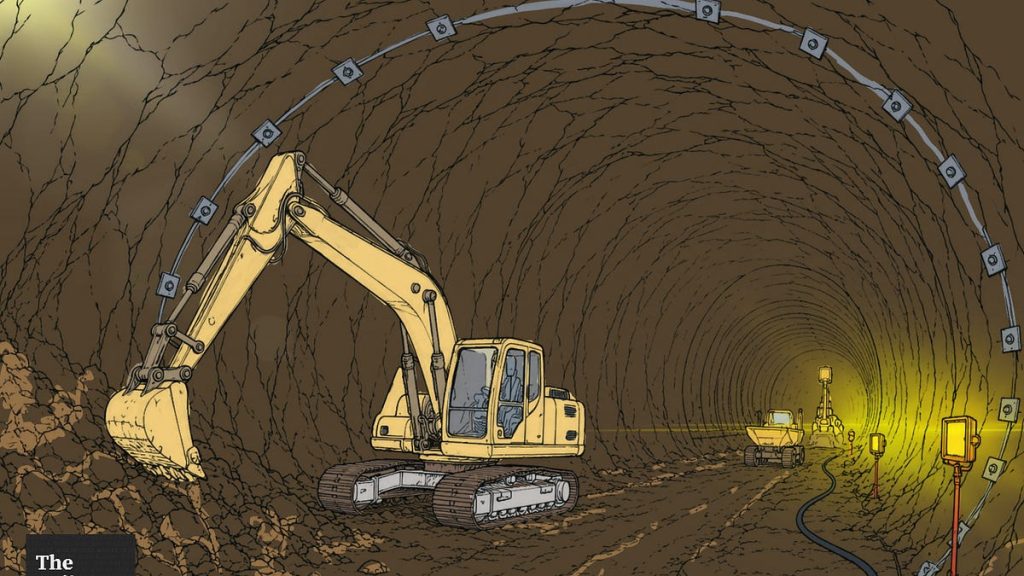
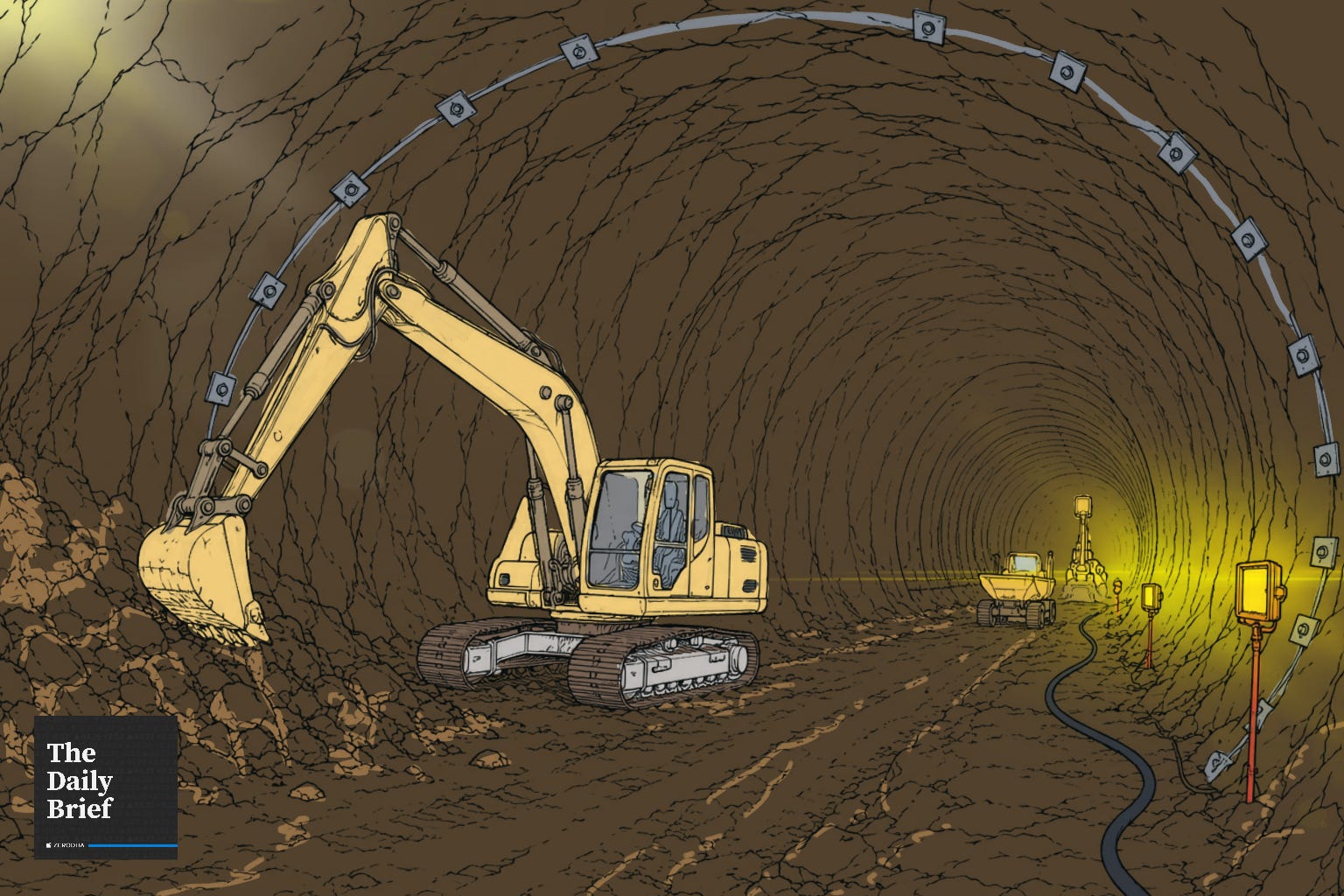
And despite the name, a tunnel boring machine isn’t just a giant drill. The spinning cutterhead at the front is only one part of a much larger system. Behind it are power systems, ventilation, equipment that installs the tunnel lining, and all the machinery needed to keep the operation running.
In other words, it’s an underground factory.
There are many ways to excavate a tunnel, depending on the ground and the project. Here, we’re only looking at one of them: tunnel boring machines, or TBMs.
Once the machine is assembled, it settles into a cycle that it repeats thousands of times.
The tunnel under Thane Creek is being dug using a Mixshield tunnel boring machine. It’s designed for soft, waterlogged ground, where both soil and groundwater are constantly pushing into the tunnel. To stop the tunnel face from collapsing because of all this pressure, the machine fills the space behind its cutterhead with pressurised and thick mixture of clay and water, called slurry. This pressure holds the ground in place while the cutterhead cuts through the soil.
The removed soil mixes with the slurry and is pumped to the surface. There, a separation plant removes the soil, cleans the slurry, and sends it back underground to be used again. The whole process runs in a continuous loop.
Not every tunnel boring machine works this way. Some use the excavated soil itself to support the tunnel face instead of slurry. Which process is used depends mostly on the ground.
As the machine moves forward, it also builds the tunnel behind it. A mechanical arm places curved concrete segments one by one until they form a complete ring. Hydraulic then pushes against this newly built ring to drive the machine forward. Grout, which is a paste of cement, water and sand is injected into the gap outside the lining to fill any empty space and reduce the chances of the ground above settling.
The machine also has to stay on course. It can’t see where it’s going, so survey instruments constantly compare its actual position with the planned route. If it starts drifting, the crew adjusts the hydraulic to steer it back on line.
Everything we’ve discussed so far assumes the ground behaves the way engineers expected. But that’s often not what happens. And when it doesn’t, things can get complicated very quickly.
Sometimes the problem is the ground itself. Sometimes it’s how the machine was operated. Figuring out which one is responsible can take years.
In 2019, a tunnel boring machine operated by ITD Cementation was digging underground. Suddenly it got flooded with water and soil as the machine went under the Bowbazar neighbourhood. The ground above sank, houses cracked and collapsed, and residents had to be evacuated.
The engineering failure soon became a legal battle. The contractor argued that it had encountered ground conditions nobody could have predicted. Kolkata Metro argued that the real problem was how the machine had been operated. Years later, the dispute is still being fought in court.
That’s the tricky part about tunnelling. When something goes wrong underground, it’s often difficult to know whether the ground surprised the machine or the machine failed to handle the ground. And the answer can decide who pays hundreds of crores in damages.
The Himalayas present a different challenge altogether. There, the problem isn’t waterlogged soil but weak, fractured rock that can’t support itself. Engineers still dig the tunnel in small sections, support it immediately, and then move forward. But exactly how much support is needed keeps changing. One stretch might need extra concrete and rock bolts. The next might need steel pipes driven ahead of the tunnel to hold the rock together before digging can continue.
In other words, even with all the planning, tunnelling is rarely a fixed process. Engineers often have to adapt metre by metre as the ground reveals what it’s really like.
If all of that wasn’t difficult enough, a contractor can be excellent at tunnelling and still struggle as a business. The biggest reason is time.
Tunnelling demands huge upfront spending. Contractors have to pay for machines, launch shafts, equipment and workers long before they earn any money. Even after the work is completed, payment isn’t always immediate. Bills first have to be measured and certified. Some money is held back, disputed bills turn into claims, and those claims can take years to resolve.
That means a contractor can successfully finish a technically difficult tunnel and still have a large part of its money stuck in unpaid bills and legal disputes.
HCC, one of India’s most experienced tunnelling companies, is a good example. It has spent years waiting to recover large arbitration claims. According to the company, most of these disputes weren’t even about unexpected geology, but about delays, design changes and changes in the scope of work.
Eventually, the machine reaches the end of the tunnel. This moment is called the breakthrough. It’s when the cutterhead finally breaks into the receiving shaft at the other end. After kilometres of digging underground, the machine has arrived exactly where it was supposed to.
But breakthrough only marks the end of excavation. It doesn’t mean the project is finished.
The tunnel still needs tracks, drainage, walkways, power cables, ventilation, signalling, fire systems and plenty of other equipment. Then come months of testing before the first train can run. The tunnel boring machine itself has to be dismantled or turned around. And for the contractor, payments may still be pending and claims may still be unresolved.
Only much later does the tunnel become what it was always meant to be: just another part of the railway.
One day, a train enters at one end and comes out the other. Passengers barely notice anything beyond a few minutes of darkness. They don’t see the years spent studying uncertain ground, the giant machine that built the tunnel ring by ring, or the commercial and engineering risks that made it possible.
That’s really the goal of tunnelling. To turn something incredibly difficult and uncertain into infrastructure so ordinary that nobody thinks about it anymore, except maybe us geeks 🙂

Think about the last time you took paracetamol: hopefully, that wasn’t anytime soon. Or even the last time you wore a nice multicolored t-shirt, or painted a wall, or wrapped something in plastic.
Every one of those things needed chemicals as an input somewhere along the way. Pharma needs chemical intermediates for its APIs, plastics and rubber need petrochemical feedstock, textiles need dyes and finishing agents, electronics need solvents and specialty coatings, and fertilisers need ammonia and phosphoric acid.
India is the world’s sixth-largest chemical producer, and the sector contributes roughly 9% of manufacturing gross value added (GVA). It covers more than 80,000 commercial products. But the sector is a pressure point for the rest of Indian manufacturing: when something goes wrong in chemicals, it cascades to industries that need it.
A new working paper from CSEP tracked about 2,700 firms that use chemical inputs across Indian organised manufacturing, and found that the biggest user of chemicals, at 29%, is the chemicals sector itself. Rubber and plastics account for another 18%, pharmaceuticals 13%, and electrical equipment about 7%. The report goes into what happens when you impose protectionist measures on them.
Before we start with what the report says, let’s glimpse at what the industry looks like.
India’s chemicals sector has a well-documented structural weakness. In 2023, the country imported $75 billion worth of chemicals and exported $44 billion — a trade deficit of $31 billion. The highest volume of chemical imports comes from China, which accounts for 30-35% of the total. In the sub-category of organic chemicals, which includes pharma intermediates, dye building blocks, and polymer precursors, India imported about $11 billion from China in 2024, while exporting roughly $1.2 billion back.
The dependency runs deep in specific product lines. About 76% of India’s bulk drug imports by volume come from China. For antibiotics, that figure is closer to 87%. The dependence is both on finished intermediates and the feedstocks that Indian manufacturers need to make intermediates.
What this means is that even where India has petrochemical capacity, it’s stuck making low-value bulk products rather than moving up the chain into higher-value derivatives like MDI, fluorochemicals, or battery materials. For instance, India converts 95% of its propylene into polypropylene, compared to 70% globally, and 75% of its ethylene into polyethylene, compared to 63% globally.
At the top of the market structure, you have massive integrated players. Reliance operates the world’s largest single-site refinery-cum-petrochemicals complex at Jamnagar. In fact, Gujarat alone produces roughly 40% of India’s chemical output. In specialty chemicals, which is the high-growth, high-value segment, companies like PI Industries, SRF, Navin Fluorine, and Aarti Industries have been winning contract manufacturing orders.
Many of these orders came in the wake of a “China+1” narrative. After the pandemic disrupted Chinese supply chains, and the Galwan standoff made governments rethink sourcing dependencies, global pharma and agrochemical companies started actively looking for alternative manufacturing bases. India was the obvious candidate: cost-competitive, technically skilled, large domestic market, and increasingly capable of meeting the regulatory standards that European and American buyers require.
The China+1 story has been the sector’s headline narrative for some time now.
But beneath these large and mid-cap players sits a vast MSME ecosystem producing the organic and inorganic intermediates that feed the bigger firms. And it’s this base layer that’s been caught in a regulatory squeeze.
Our massive trade deficit in chemicals, and the flood of cheap Chinese chemicals behind it, created a real policy problem.
Cheap Chinese imports were undercutting domestic producers by dumping their excess product in India. There were also some quality concerns behind these imports, which weren’t forced to meet Indian standards the way domestic producers had to. The government needed a tool to not just enforce quality standards on both imports and domestic production, but also bolster the competitiveness of Indian chemical products.
That tool was the Quality Control Order (QCO), that we’ve covered before on The Daily Brief. QCOs are regulations that make BIS certification mandatory for specific products before they can be sold in India. Both domestic manufacturers and importers have to comply.
In principle, QCOs are about ensuring product quality. But in practice, they’ve become one of the government’s most-used tools for restricting imports. The number of products covered by QCOs expanded from fewer than 70 in 2016 to nearly 800 by 2025.
As we’ve covered before, QCOs are most popularly used in Indian steel. The concerns behind them were similar: foreign exporters were dumping their excess stock in India, and our industry needed protection.
However, famously, that story didn’t end without trade-offs. MSMEs, which depended on high-quality imports that weren’t made in India, were now burdened with high compliance costs. So, some of those QCOs were rolled back in late 2025 after industry pushback and a high-level government review.
The chemicals story is, in many ways, a sequel. But it’s also more revealing, because chemicals sit so deeply in the supply chain that the effects are wider and harder to contain.
The CSEP paper maps exactly how fast QCOs reached the chemicals sector. Chemical-related QCOs went from essentially zero before 2018 to 52 by 2024. By that point, 57% of all chemical-using firms had a QCO on at least one of their inputs, and two-thirds faced a QCO on either the input or output side. From no exposure to majority coverage in six years, that’s one of the fastest regulatory expansions in Indian manufacturing.
The government has since pulled back, though. In 2025, India revoked 33 chemical QCOs across terephthalic acid, ethylene glycol, polyester yarns, and so on. But 28 remain in force, and the broader QCO pipeline across sectors still covers hundreds of products.
What the CSEP paper does, though, is go beyond counting QCOs. It tracks what actually happened to the firms that got caught in them, using a decade of Annual Survey of Industries data.
The core headline finding of the paper is counter-intuitive. QCOs on chemical inputs that firms buy are associated with a ~10% increase in production value. That sounds like a good thing.
But they’re simultaneously associated with a 37% decline in gross value added (GVA).
What’s going on? When QCOs restrict which chemical inputs firms can source, input costs rise. Firms that can pass those costs through do so, charging higher prices for their output. The production number, which is measured in rupees, goes up. But GVA, which strips out the cost of inputs to measure the actual value being created, falls sharply.
In essence, it only made finished products more expensive, which bolstered the topline without adding to productivity.
Now, there’s a separate question about whether this is truly a causal effect or an association shaped by other factors the regression can’t fully capture, and the authors acknowledge this. But the pattern is consistent not only across multiple robustness checks, but, as we know now, across sectors. Input QCOs are indeed associated with higher costs flowing through as higher prices, with no corresponding improvement in efficiency.
QCOs on finished outputs tell an even more uncomfortable story. These regulations are directly aimed at what firms produce using their inputs. The expectation is to improve the quality of finished products, but the authors find no statistically significant effect of QCOs on any measure: be it production, GVA, or profits. The regulations designed to boost Indian manufacturing quality aren’t measurably doing that.
There’s an interesting parallel with what’s happening on the capacity side. As per CareEdge, capacity utilisation in India’s organic chemicals segment declined from 73% in FY19 to 64% in FY24. Dyes and pigments are worse, falling from 78% to 58% over the same period.
This means QCOs aren’t compensating for a domestic supply shortage. India already has underutilised capacity in these categories. The regulations are protecting capacity that isn’t being fully used, and the cost of that protection falls on the downstream firms that buy chemical inputs.
Most importantly, India’s chemicals exports haven’t yet meaningfully risen because of these QCOs, either.
The paper’s headline results bode far less well for India’s smallest firms.
Large and medium-sized firms, which are classified as having turnover above ₹50 crore, see that 10% production increase from input QCOs. Which makes sense: they have the pricing power and scale to pass costs through. But even they take the 37% GVA hit, because higher input costs eat into the value they create.
Small firms, which have turnover under ₹50 crore, get a different deal entirely. Input QCOs don’t significantly change their production or GVA. After all, they can’t pass costs through the way large firms can. Instead, profitability falls by almost half.
Output-side QCOs hit small firms even harder. Their GVA falls by 44%, and profits fall by about 59%. For large firms, the impact on both measures is statistically insignificant. The combined effect of being exposed to QCOs on both the input and output side can completely crush the profits of small firms. But large firms more or less survive.
In sectors where firms of very different sizes compete, a uniform regulation doesn’t have uniform effects. Large firms can absorb compliance costs, invest in BIS certification, and negotiate with suppliers. Small firms, operating on thin margins and with limited bargaining power, can’t. The CSEP paper cites research showing that large firms in QCO-affected sectors actually lobby for these regulations, because they know smaller competitors will struggle.
What QCOs functionally do, then, is accelerate market concentration. They shift market share from small to large in a sector that’s already concentrated. This exact same dynamic played out with steel QCOs, where large primary producers welcomed restrictions that squeezed smaller importers.
Recognising the adverse impacts of these QCOs, the government revoked some of them, especially on foundational inputs like ethylene glycol and terephthalic acid.
But the question now is whether the remaining 28 chemical QCOs, and the hundreds still in the pipeline across other sectors, will be assessed against the evidence this paper provides. QCOs on intermediate inputs inflate production numbers while destroying value, and the burden falls overwhelmingly on smaller firms. At the same time, they don’t measurably improve the quality of output — which was their stated purpose.
The broader implication of this is also worrying: do these QCOs hurt our ability to take advantage of the “China+1” opportunity that’s been touted for so long? Making that possibility worse is the fact that the West Asia crisis has also pushed Indian importers toward more Chinese sourcing, not less. There is also the constant flip-flop of US tariff policy hanging over our heads.
This is hardly the story of one sector. It is broadly a feature of Indian manufacturing, where import tariffs designed to protect industry hurt its smallest firms while often benefiting large ones by affording them more pricing power. The CSEP paper is one among many other pieces of evidence that tariffs can often be too blunt a tool to boost national productivity.
1. Low-cost airline SpiceJet has added three Airbus A320 planes to its operational fleet under a short-term “damp lease” (where the lessor provides the crew and maintenance). The move helps the airline expand flight routes and meet rising passenger demand during busy travel seasons.
Source: The Hindu
2. Novo Nordisk filed a lawsuit against rival Eli Lilly, claiming the company uses misleading and outdated clinical trial data in its weight-loss drug advertisements. The lawsuit alleges that Eli Lilly compares the highest doses of its own drugs against lower doses of Novo’s Wegovy and Ozempic to make its products look superior.
Source: Mint
3. India’s central bank (RBI) decided to keep its key benchmark interest rate unchanged as it continues to monitor inflation levels. Analysts expect interest rates to remain stable for now as the central bank balances economic growth with stable prices.
Source: Trading Economics
4. Quick commerce apps like Blinkit and Zepto are increasingly becoming the go-to platforms for buying beauty and high-end personal care products. Industry reports show that easy access to fast delivery is driving shoppers to buy more premium items through these apps instead of traditional retail stores.
Source: ET
5. The state government of Odisha is drafting a dedicated gems and jewellery policy alongside a specialised industrial park. The state plans to capitalise on the rapidly growing lab-grown diamond market and build a manufacturing ecosystem similar to Surat.
Source: BS
– This edition of the newsletter was written by Pranav & Manie.
Our team at Markets is always reading, often more than is healthy. This time we changed the format: no curation, no bias, just every link open on our tabs. Everything from why the rupee really cratered to the cult of longevity to how banks actually fund themselves.
On CNBC, Amit Tripathi flagged that India’s largest AAA banks were paying 225 basis points over the repo rate for three-month money, spreads that only show up in a crisis. We sat down with him, Nippon’s CIO for fixed income, to unpack why the repo rate isn’t really how banks fund themselves and why liquidity, not the policy rate, sets the real cost of credit.
Watch the full episode below:
The full conversation is on our YouTube Channel, or if you like listening, you can check out Spotify or Apple Podcasts.
Our team at Markets reads a lot of earnings call transcripts and sits through a lot of management interviews.
That’s what The Chatter is for: a weekly newsletter that digs through what India’s biggest companies are saying and pulls out the sharpest insights on businesses, industries, and the wider economy.
Join us on WhatsApp, where we share interesting soundbites from concalls, articles, and everything else we come across throughout the day. You’ll also get notified the moment a new video or article drops so that you can read or watch it right away.
Thank you for reading. Do share this with your friends and make them as smart as you are 😉