
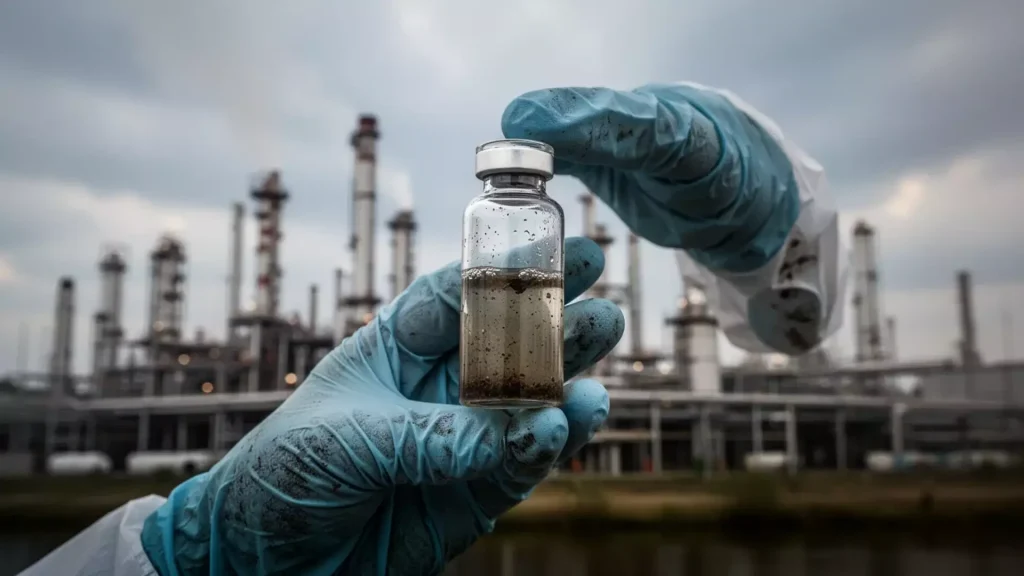
A government-funded study published on 18 July 2026 has uncovered elevated rates of kidney cancer near the AGC Chemicals Europe factory in Thornton-Cleveleys, Lancashire — reigniting concerns over the health impacts of PFAS “forever chemicals” and raising urgent questions for employers and regulators across the UK.
The findings challenge a recent multi-agency conclusion that no further investigation into local cancer rates was necessary. Medical experts and residents are now calling for additional research, including blood testing for PFOA levels in the affected community.
Contamination Legacy in Lancashire
The AGC Chemicals Europe facility is believed to have released approximately 49 tonnes of PFOA — a known carcinogen — between the 1950s and 2012. The Environment Agency has already issued precautionary advice for residents living within one kilometre of the site, recommending they wash and peel homegrown produce and avoid eating eggs from local allotments. At least two allotment sites in the area have been closed.
Advertisement
The devastating health consequences of industrial chemical contamination highlighted in this article show why proper management of hazardous substances is critical. For UK businesses handling chemicals like PFOA or any other dangerous materials, a compliant COSHH risk assessment is not just good practice — it is a legal requirement under UK law. The free COSHH Risk Assessment Toolkit provides 43 ready-to-use templates, checklists and toolbox talks to help you identify risks, document your assessments and protect your workforce. Download the free COSHH Risk Assessment Toolkit
Law firm Leigh Day is currently investigating potential legal claims linked to the contamination. The case adds to a broader picture of environmental risk: over 17,000 contaminated sites have been identified across the UK and Europe.
US Legal Action Intensifies
The UK findings coincide with a surge of legal activity in the United States. On 17 July 2026, New York Attorney General Letitia James filed a lawsuit against major chemical manufacturers including 3M, DuPont, Chemours and Corteva, seeking funding for PFAS cleanup and demanding adequate consumer warnings.
In North Carolina, a long-running lawsuit involving 2,658 plaintiffs against Chemours and DuPont was settled out of court on its scheduled trial date of 18 July 2026. While specific terms remain confidential, recent Chemours regulatory filings indicated litigation liabilities exceeding $360 million. State officials have also criticised a separate federal settlement involving the company’s Fayetteville Works plant as insufficient.
Regulatory standards are tightening. New York is moving to codify limits for several PFAS variants at 10 parts per trillion (ppt), while the US Environmental Protection Agency (EPA) plans to lower the federal limit for PFOA and PFOS to 4 ppt by 2029.
Advertisement
As regulators focus on hazardous substances like PFAS, many UK employers may be surprised to learn which dangerous materials are present in their own operations — and what legal duties apply. The free COSHH toolkit helps you identify overlooked hazards, from cleaning agents to industrial chemicals, and provides a step-by-step framework to assess and control exposure. Get the free COSHH Toolkit
Wider Health Concerns and New Research Tools
Recent research has broadened understanding of how environmental pollutants affect human health. A study published in the European Heart Journal this month detected microplastics and nanoplastics in 84% of heart attack patients examined, compared with significantly lower rates in patients with stable coronary artery disease. The study noted that smokers exposed to high levels of air pollution were six times more likely to have detectable plastics in their blood.
In Southern California, federal authorities have launched an investigation into a potential cancer cluster in Ladera Ranch, where at least nine children have been diagnosed with Ewing sarcoma — a rare cancer — since 2007. In response, the local homeowners association imposed a 60-day moratorium on certain landscape pesticides.
Scientists are increasingly turning to advanced technology to address these complex environmental risks. A review published in Pediatric Research on 18 July 2026 highlights how artificial intelligence and “omics” techniques — such as metabolomics and epigenomics — can better characterise how chemical mixtures affect children. Meanwhile, researchers in Georgia have launched the state’s first Superfund research centre with $15 million in funding to study how climate change and rising sea levels may accelerate the spread of contaminants from toxic sites.
Disclaimer zu unseren Artikeln: Keine Anlageberatung, keine Kauf oder Verkaufsempfehlung. Angaben zu Kursen, Unternehmen und Märkten ohne Gewähr; Änderungen jederzeit möglich. Börsengeschäfte können zu hohen Verlusten führen. Unsere Beiträge werden ganz oder teilweise automatisiert mit Unterstützung von AI erstellt und geprüft.