
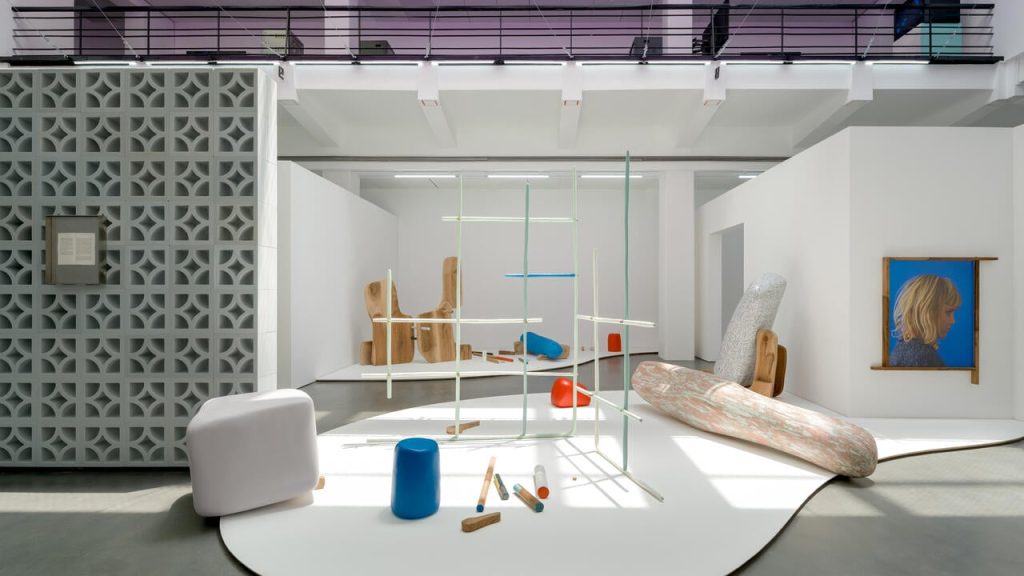
The title of this group exhibition, ‘Youth Palace’, is a retranslation of the state-funded Children’s Palace educational programme active across China and the Soviet Bloc between the 1950s and 1990s. However, this ambitious initiative, in which working-class children learnt hobbies such as music, dance and theatre, was never truly egalitarian. It equipped participants with cultural skills while forming a new socialist subject and mobilizing their desire to become an ‘optimal’ child in accordance with ideological imperatives.

Occupying all five floors of the Rockbund Art Museum, the show – containing 35 artists and collectives – also includes a four-month curriculum of artist-led workshops and courses. Curator X Zhu-Nowell has rendered the Chinese title as the homophonic transliteration you-si-pa-li-si (youth palace) rather than the conventional shao-nian-gong (children’s palace), a decision that distorts associations of the original, suggesting an attempt to challenge the structure’s apparatus. It seeks to unmoor the Children’s Palace, the first of which was established in Shanghai’s Marble Hall in 1953, from age while refusing to take a strong position on the complex ambivalences arising from the programme.
On the ground floor, Puppies Puppies’ installation Defence (2026) features looped video of people undertaking self-defence training, projected amid an interactive gym with punching bags decorated in the colours of the transgender flag. Against a backdrop of regressive attitudes to gender, exhibiting this work feels both risky and brave. Whereas the original shao-nian-gong fostered competition among children, this installation attempts to equip visitors with skills of protection rather than discipline, gesturing to the necessity for many queer people to defend themselves.

In Fake Moves on the Streets (2024) by Peng Xueying, on the second floor, mannequins in football kits stand frozen on artificial turf, surrounded by scattered balls for the audience to kick, while four televisions display videos of actors dribbling footballs through Guangzhou, passing through Zhongda fabric market and Kanglu garment district before arriving at the former Lujiang football field, which is today used as a labour hiring square. In the area where a commercial logo would typically appear on a player’s shirt, Peng has added badges printed with football terminology combined with garment-manufacturing jargon, such as ‘Shift Across/Side Seam Closing’. By drawing parallels between football players and garment makers, Peng makes the labour of the latter perceptible, pointing to how both athletics and uniforms regulate the body. The mannequins and fake grass are rendered stranger by a dim, eerie atmosphere and a sense of the uncanny, akin to passing by a sportswear section in a dead mall.
Diego Marcon’s video installation Ludwig (2018) employs a massive projection and a booming soundtrack that overwhelm everything else. In the looping video, a CGI boy, illuminated by a single matchstick, attempts to learn a classical-inspired aria aboard a storm-tossed ship. The flame he holds burns down, scorching his finger, while the melancholic song he sings is truncated mid-sentence. This bleak, repetitive pedagogical method induces frustration and fatigue, though the mood shifts towards the end to a more jubilant one via music subtly redolent of Gloria Gaynor’s ‘I Will Survive’ (1978). It is a brilliant, unsettling juxtaposition: a circular trap of systemic exhaustion interrupted by a sonic phantom of resilience.

The works in ‘Youth Palace’ that seem to be most politically charged manifest their concerns through implication, analogy and allegory. At times, the exhibition references the language of discipline instilled within shao-nian-gong while remaining unable to speak entirely outside it. Zhu-Nowell has set an impressive and ambitious precedent for reimagining a complex area of Chinese history, and the subsequent exhibition is, for those who experienced shao-nian-gong, haunted by the idea that rigorous training – be it singing, football or self-defence – might have meant something other than stringent discipline.
‘Youth Palace: or, some small acts of self-making’ is at the Rockbund Art Museum, Shanghai, until 20 September
Main image: ‘Youth Palace’, 2026, exhibition view. Courtesy: the Rockbund Art Museum, Shanghai