
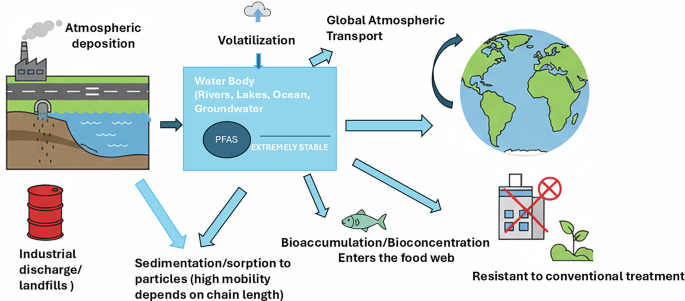
Per- and polyfluoroalkyl substances (PFAS) are synthetic chemicals that have gained attention due to their persistence and occurrence in both aquatic and terrestrial ecosystems. These substances are introduced into the environment largely through their extensive applications in various industries. They are commonly found in firefighting foams, pharmaceuticals, textiles, cosmetics, food packaging, paints, and electronics1,2,3. The distinctive properties of PFAS, including thermal and chemical stability, as well as hydrophobicity, contribute to their wide application. This may also lead to the widespread occurrence of chemicals in terrestrial and aquatic living organisms, ultimately reaching humans4,5,6. Over the past decade, the presence of PFAS has gathered significant attention due to their widespread distribution in the environment, remarkable persistence in various ecosystems, and alarming potential for bioaccumulation in living organisms1,7.
The environmental distribution, fate, and transport of PFAS are heavily influenced by the length of their hydrophobic fluorocarbon chains. PFAS with longer chains are generally thought to possess a greater potential for bioaccumulation in humans and other organisms, raising concerns about their long-term effects on health and ecosystems4,8,9. A study conducted in 2001 marked a significant turning point by revealing the widespread occurrence of PFAS worldwide10. This groundbreaking research detected contamination in a variety of wildlife species, including birds, mammals, and fish, in regions far removed from industrial sites, highlighting the persistent nature of these substances and their ability to travel across the globe and infiltrate diverse environments10.
PFAS infiltrate aquatic systems through various point sources, with wastewater treatment plants (WWTPs) being significant contributors11. In addition to these facilities, other sources include industrial runoff, atmospheric release from some PFAS sources or through incomplete combustion through incineration, atmospheric deposition, leachate from landfills, and the storage and use of aqueous film-forming foams (AFFF) during both training drills and actual fire emergencies11,12,13. Notably, WWTPs often receive discharges containing PFAS primarily from consumer products used in daily life. These harmful compounds can be washed away during routine activities, such as washing clothes or cleaning surfaces, and ultimately enter the wastewater collection system, potentially leading to the contamination of water bodies11. The rising detection of PFAS in wildlife has become a global concern, encompassing a wide range of species, including marine mammals, invertebrates, reptiles, amphibians, fish, and birds1,5,12,14.
This persistent contamination raises concerns about the health of ecosystems worldwide. Furthermore, humans are exposed to these harmful chemicals through various pathways, such as the ingestion of contaminated drinking water, dietary intake of affected foods, inhalation of dust, exposure to indoor air pollutants, and even through the use of certain cosmetics15,16,17. Studies have reported the presence of PFAS in serum, plasma, and whole blood18,19,20,21. In human blood samples, 25 different PFAS compounds have been identified. The most dominant compounds include PFOSA (with a median level of 0.14 ng/mL) and PFHxA (with a median level of 0.62 ng/mL)19. A similar ratio was observed for 6:2 diPAP, which has a median level of 0.03 ng/mL19. A recent report on PFAS levels in the blood of the Chinese population found that the predominant PFAS compounds are PFOA and PFOS, present in both red blood cells and plasma18. The plasma mass fraction (Fp) for PFCA compounds with chain lengths C4 to C7 increased from 0.76 to 0.82, while there was a decrease in Fp for PFCAs with chain lengths from C7 to C13. Additionally, PFOS precursors exhibited variable partitioning; for example, 6:2 diPAP showed a high mean Fp of 0.87, whereas N-MeFOSA and N-EtFOSA demonstrated moderate Fp values of 0.66 and 0.70, respectively18.
Each of these sources underscores the urgent need to address the prevalence of PFAS in our environment and its potential impact on human health and wildlife. These compounds are highly bioaccumulative and persistent, and thus remain in the environment, demonstrating a remarkable ability to distribute widely across various ecosystems22,23,24. Multiple pathways of release, coupled with specific environmental conditions and the inherent chemical characteristics of these substances, significantly influence their migration and fate12. Due to their exceptional mobility and resistance to degradation, PFAS can infiltrate water, soil, air, and living organisms, resulting in extensive and enduring environmental contamination. Such qualities pose serious and far-reaching threats to both ecosystems and human health11.
The understanding of the environmental fate and transport of PFAS is governed by a complex interplay of their unique chemical characteristics, prevailing environmental conditions, and their interactions with various biota and sediments. PFAS are particularly notorious for their high mobility, environmental persistence, and potential for long-range transport, which enables them to travel considerable distances through aquatic systems, often leading to widespread contamination23,25,26.
Due to their distinctive carbon-fluorine bonds, PFAS exhibit remarkable resistance to degradation in the environment, allowing them to persist for years or even decades. These compounds readily accumulate in sediments and living organisms, with their distribution influenced not only by natural hydrological processes but also by human activities such as industrial discharges, wastewater treatment practices, and agricultural applications23,25,26.
Several critical factors exert influence over the environmental behavior of PFAS. Their chemical properties, notably their chain length and the presence of various functional groups, significantly shape their mobility and persistence. Short-chain PFAS, which generally contain fewer than six carbon atoms, exhibit increased water solubility and mobility, making them more likely to leach into groundwater and surface waters23,25,26. In contrast, long-chain PFAS, characterized by longer carbon chains (typically more than six carbon atoms), exhibit a greater propensity to sorb to sediments and accumulate in the tissues of organisms, leading to biomagnification through the food web. Understanding these dynamics is essential for assessing the environmental risks posed by PFAS and formulating effective remediation strategies23,25,26.
Environmental factors such as pH, turbidity, and dissolved oxygen can increase the concentrations of PFAS. Conversely, factors like salinity, temperature, and electrical conductivity tend to reduce PFAS concentrations27. Additionally, organic matter in water and sediments plays a vital role in the partitioning and bioavailability of PFAS. Areas close to point sources, such as industrial discharges and WWTPs, typically show higher levels of PFAS. However, atmospheric and hydrological transport can spread these contaminants far from their initial sources27.
PFAS are often found in varying concentrations in surface water, generally increasing downstream as a result of cumulative inputs. Sediments serve dual roles as both reservoirs and secondary sources of PFAS, especially for long-chain compounds24,28. In aquatic organisms, the bioaccumulation of PFAS is influenced by the type of compound, environmental conditions, and specific traits of the species. Typically, bioconcentration from water is more pronounced than biomagnification through food webs24,28. Furthermore, aquatic vegetation can absorb significant amounts of PFAS, potentially creating exposure pathways for herbivores29. This highlights important avenues for further research and management strategies to address PFAS contamination in aquatic ecosystems23,26,28,29.
Microplastics further influence PFAS behavior by adsorbing them and altering their environmental transport and toxicity profiles. Collectively, these factors highlight the complexity of PFAS dynamics in aquatic ecosystems and underscore the challenges in assessing and managing their environmental impact30.
This review aims to provide an integrated, process-based conceptual framework that connects physicochemical properties, interfacial partitioning, precursor transformation, atmospheric transport, and cryosphere remobilization across environmental compartments. It also summarizes the current state of knowledge regarding the fate and transport of PFAS in natural environments. The focus of this review is on the mechanisms that control PFAS mobility and persistence throughout air, water, soil, sediments, and the cryosphere. This approach contrasts with earlier assessments that often examine PFAS behavior in isolated matrices. The role of volatile and zwitterionic precursors as both dispersed and delayed sources of PFAS is given special attention. This review highlights the cryosphere’s climate-sensitive function as both a sink and a secondary source of PFAS. Additionally, it examines the role of microbial transformation in altering the speciation of PFAS, rather than leading to complete mineralization. By integrating both legacy and emerging PFAS, this review aims to enhance conceptual understanding and provide guidance for risk assessment, monitoring, and remediation options within a unified perspective on environmental cycling.
This review provides a novel, integrative perspective by explicitly linking chemical properties, environmental transport processes, and precursor dynamics across multiple compartments, highlighting knowledge gaps in PFAS mobility, transformation, and secondary sources. Unlike previous reviews that typically focus on specific PFAS classes or isolated matrices, our framework highlights different compartment interactions and emerging PFAS, offering actionable insights for future monitoring, risk assessment, and remediation strategies.
Natural degradation of PFAS in aquatic systems
The influence of physicochemical properties on the fate of PFAS
The unique physicochemical characteristics of PFAS, such as chain length, the presence of functional groups, solubility, partition coefficients, and molecular structure, significantly influence their environmental behavior31,32,33. These characteristics influence the stability, mobility, and degradation potential of PFAS in the aquatic system. The hydrophobicity and lipophilicity of PFAS affect their ability to partition among various environmental matrices, including soil, water, and air. Shorter-chain PFAS, being more mobile and soluble in water, have a higher possibility of contaminating groundwater34,35,36. Enhanced solubility compared to long-chain PFAS may reduce bioaccumulation potential. However, it also facilitates long-distance transport and environmental dispersion. In contrast, longer-chain PFAS tend to be more resistant to degradation and less soluble, which helps explain their persistence in natural systems. Their functional groups can significantly influence the reactivity and interaction of PFAS with biological and environmental matrices31,32,37,38. For example, differences between sulfonate and carboxylate groups affect electrostatic interactions, sorption affinity and bioaccumulation tendencies. Concerns about the toxicological effects on the entire food chain arise from the fact that perfluorinated moieties can increase bioaccumulation in both aquatic and terrestrial organisms. Their behavior is further determined by the partition coefficients, which show how PFAS are distributed across various environmental systems27,32,39. For example, preferential absorption by organic materials in sediments or biota is suggested by a high octanol-water partition coefficient (Kow), whereas a low Kow indicates a tendency to remain in aquatic environments40.
Table 1 shows the summary of key physicochemical properties of PFAS. The persistence, mobility, and potential for bioaccumulation and distribution of PFAS in various environmental compartments, such as air, surface water, groundwater, soil, and living organisms, are all determined by these characteristics.
The fate, transport, and environmental behavior of PFAS are greatly affected by their tendency to accumulate at solid-water and air-water interfaces. The length of the carbon chain and the hydrophilic head group, which usually consists of functional groups like sulfonates or carboxylates, are important factors that affect interfacial partitioning. These behaviors can be further influenced by environmental factors, including pH levels and the substance’s ionization state, which influence how PFAS interact with different matrices12,32,39,41.
The distinctive characteristics of the PFAS compounds, as well as the features of the surrounding soil or sediments, are important considerations when it comes to adsorption. Different PFAS have a range of affinities for different solids, which can either promote or prevent their adsorption. These soils or sediments may be rich in organic carbon or include significant levels of proteins and iron or aluminum oxides. Their unique chemical configuration that enables more robust interaction with soil particles and biomolecules, linear isomers of PFAS often exhibit a higher propensity for sorption and bioaccumulation than their branched counterparts12,42,43. In an aquatic system, the balance between mobility and persistence is shaped by both molecular characteristics and environmental factors. Some characteristics enhance retention and bioaccumulation, while others promote dispersion. This interplay of factors makes it difficult to predict natural degradation. Factors that limit movement can also reduce interactions with processes that help break down PFAS. Therefore, it is essential to understand how these factors interact to accurately assess the natural reduction of PFAS in aquatic environments.
Fate and transport of PFAS in water
Mobility and persistence
The exceptional chemical and thermal stability of PFAS is one of their defining characteristics. These compounds exhibit remarkable resistance to degradation when exposed to harsh chemicals and elevated temperatures, often exceeding several hundred degrees Celsius. This stability is primarily attributed to the strength of the carbon-fluorine (C-F) bond, which boasts an extraordinary bond energy of ~485 kJ/mol44. In comparison, the bond energy of the carbon-oxygen (C-O) bond is notably lower at around 358 kJ/mol. In addition, fluorine’s high electronegativity results in strong C-F bonds, which contribute to the low surface energy of PFAS molecules and their remarkable resistance to both polar and nonpolar substances44. This resistance enables a variety of applications, particularly for PFAS that contain polar functional groups and exhibit surface activity. The mobility of PFAS can be affected by organic carbon, pH, the presence of polyvalent cations, and salinity44.
The fate and transport of PFAS primarily depend on their unique physical properties, which include solubility, density, boiling point, melting point, low polarizability, vapor pressure, chemical stability, thermal stability, persistence, and mobility. PFAS can separate into mobile colloids, facilitating their movement through various environmental matrices44. Atmospheric transport of PFAS is illustrated in Fig. 1.

Transport of PFAS in the environment.
The physicochemical characteristics of PFAS, including their charge, chain length, and functional groups, are closely related to their mobility in the natural environment. Short-chain PFAS can easily move through soil and into groundwater because they are generally more mobile than long-chain chemicals. In contrast, longer-chain PFAS, which are neutral or positively charged, tend to be retained in the soil or solids. However, due to their slow desorption rates, they can still act as long-term sources of groundwater pollution. On the other hand, negatively charged PFAS are typically quite mobile12,44,45.
The dynamics at the air-water interface, solid-water contact points, and the non-aqueous phase liquid-water interface play a crucial role in the subsurface transport of PFAS. Various processes, including partitioning, complexation, and interfacial adsorption, can moderate the movement of these persistent contaminants; however, they do not offer a complete solution for their removal from the environment46. Moreover, several factors significantly influence the mobility of PFAS, such as the concentration of organic carbon, the presence of co-contaminants, and the characteristics of the soil type, each contributing to the complex behavior of these substances in the subsurface ecosystem12. Table 2 shows the occurrence of various PFAS in natural systems. Although PFAS are frequently characterized as highly persistent and mobile environmental pollutant, their actual behavior in natural systems is influenced by a complex interplay between their molecular properties and varying environmental conditions. Key factors such as soil composition, pH levels, temperature, and moisture content can significantly affect the adsorption and retention of PFAS in soils and sediments. In addition, certain soil types with high organic carbon content may temporarily trap PFAS, slowing their initial migration through the environment. However, this retention can lead to the formation of long-term reservoirs within the subsurface, where PFAS can persist for extended periods. Such reservoirs may continually release these compounds back into groundwater or surface water, sustaining contamination. Understanding these dynamics is critical for developing effective strategies to mitigate the risk associated with PFAS pollution.
PFAS fate and transport mechanisms
The chain length and different functional groups of PFAS influence their behavior. Short-chain PFAS tend to remain dissolved in water, while long-chain PFAS are more likely to adsorb to sediments and bioaccumulate in organisms12,25,47,48. Key transport mechanisms include surface runoff, leaching, sediment transport, and atmospheric deposition13,49. The partitioning of PFAS is affected by physicochemical parameters such as pH, organic carbon content, and salinity. Degradation of PFAS is minimal; most are highly persistent, with precursors slowly transforming into more stable end products13,50. PFAS exhibit complex environmental behavior due to their chemical stability, amphiphilic nature, and wide range of precursor compounds. Their environmental distribution is influenced by precursor transformation, atmospheric transport, environmental mobility and biological or abiotic transformation processes. The following subsections summarize the major mechanisms controlling PFAS behavior in environmental systems.
Transformation of precursors and atmospheric transport
Volatile PFAS precursors
PFAS compounds, such as FTOHs and perfluoroalkane sulfonamides, can volatilize, travel long distances in the atmosphere and degrade into stable compounds like PFOA and PFOS. This process explains the detection of a wide range of perfluoroalkyl acids (PFAAs, C2-C11) in remote polar ice cores and surface snow45,51,52. FTOHs are identified as likely atmospheric precursors for long-chain PFAAs. Direct long-distance atmospheric transfer of PFAS, such as PFCAs and PFSAs, from populated or industrialized areas to remote locations like the polar regions is not typically facilitated by their low volatility and high solubility, as these substances primarily exist in their deprotonated forms in the environment. Despite this, several methods have been investigated for the long-distance transport of PFAS to the polar regions51,53,54. One such method involves the distribution of PFAS from source regions to distant Arctic marine ecosystems via long-range ocean currents. Research has shown that PFAS can travel long distances through marine aerosols. Additionally, studies indicate that volatile PFAS precursors can travel significant distances in the atmosphere, degrade into PFAAs, and eventually deposit54,55. Fluorotelomer acrylates (FTAs), fluorotelomer alcohols (FTOHs), perfluoroalkane sulfonamido ethanols (FASEs), and N-alkylated perfluoroalkane sulfonamides (FASAs) have been detected in various ecosystems within the polar regions. These compounds are derived from complex industrial processes and have gained attention due to their persistent nature and potential environmental impact51,56,57,58.
Research indicates that FTAs and FTOHs can act as volatile precursors that volatilize into the atmosphere, leading to the formation of degradation products associated with PFAS. As they travel through the atmosphere, these substances can undergo various photolytic and oxidative transformations, contributing to the production of by-products that may be harmful to both wildlife and human health56,57. For example, once released into the environment, FTAs can break down into shorter-chain PFAS compounds, which are known for their bioaccumulation potential and widespread prevalence in water sources. Understanding the atmospheric behavior and degradation mechanisms of these fluorinated compounds is crucial for assessing their long-term environmental effects and risks associated with PFAS contamination56,57,58. Volatile PFAS precursors play a key role in the long-range transport of PFAS. Among these PFAS, FTOHs, and FTAs are most widely studied. FTOHs can undergo atmospheric oxidation to form terminal PFAAs, while FTAs may hydrolyze in aquatic environments and contribute to PFAS formation.
FTOHs are among the most commonly found precursors of PFAS in the environment due to their widespread use and higher volatility compared to other telomer compounds59. Reported concentrations in surface waters and wastewaters typically vary widely59,60. In water samples, certain homologues, particularly the 8:2 FTOH, are most frequently identified as the dominant species. This prevalence may be attributed to its greater production volume or specific environmental partitioning characteristics59,60. While FTOHs are usually found in lower mass-based concentrations in sediment matrices, they are still significant as they often lie within a relevant range. These sediment concentrations are important because they act as reservoirs from which FTOHs can be released back into the water column59,60. Table 3 shows the comparison of FTOH concentrations reported in different locations.
The transformation of volatile precursors, such as certain fluorinated compounds, and their long-range atmospheric transport are significant factors in the widespread detection of PFAS in both remote terrestrial and aquatic ecosystems. These precursors can undergo various degradation processes, including photolysis and microbial action, leading to the formation of terminal PFAS compounds that are known for their exceptional chemical stability and persistence in the environment. This persistence, coupled with the continuous influx of PFAS from precursor degradation, complicates efforts aimed at reducing overall environmental concentrations. It underscores the critical need to consider not only direct emissions from manufacturing and industrial use but also the secondary formation pathways that contribute to PFAS accumulation in the environment. Comprehensive fate assessments must therefore integrate these to develop effective strategies for mitigating the environmental impacts of PFAS.
Fluorotelomer acrylates (FTAs) are less commonly reported than fluorotelomer alcohols (FTOHs), often due to limitations in analytical technology, such as method limits of quantification and limits of detection. Additionally, FTAs can quickly hydrolyze in aquatic environments. Concentrations of FTAs in water typically fall within a range that makes their identification challenging, often approaching the analytical limit of quantification in many studies59,61.
Fluorotelomer betaines (FTBs) and fluorotelomer acrylate-based oligomers (FTABs) are two examples of other fluorotelomer-based chemicals that are significant, particularly at locations affected by aqueous film-forming foams (AFFF). Concentrations of these related substances have been detected in impacted surface waters, indicating localized high-level contamination associated with certain industrial activities or firefighting operations62,63.
Recent studies indicate that polyfluorinated compounds often demonstrate strong sorption properties, with various environmental compartments acting as significant reservoirs for persistent contamination. For instance, zwitterionic and cationic precursors, which are transformation products of sulfonamide-based compounds, can account for as much as 97% of the total PFAS mass in soils at sites impacted by AFFF64. The precursor N-Methyl perfluorooctane sulfonamidoacetic acid (NMeFOSAA), a type of FASA, has been found in relatively high concentrations in biosolids. However, it was either not detected or only present in minimal levels in soils treated with these biosolids, even after prolonged applications. In these soils, the concentration of PFAS is 4.1 µg/kg or lower across municipal agricultural sites in Pima County, Arizona. This significant discrepancy between the levels found in biosolids and those in the receiving soils provides strong evidence at the field scale for the rapid attenuation and transformation of NMeFOSAA after land application. This transformation is likely due to biotic or abiotic processes occurring in the soil environment65.
These results highlight the importance of precursors in determining the spatial distribution of PFAS, by combining their transformation pathways with localized runoff and long-range transport66,67, PFAS have demonstrated their ability to persist in urban streams (up to 2234 ng/L in water) and various soils (max nearly 160,000 µg/kg for terminal PFAS)68,69.
The most noteworthy discovery about volatile precursors is their proven ability to produce a long-lasting underground source of terminal PFAAs, indicating a crucial mechanism for chronic groundwater contamination70. Some zwitterionic fluorotelomer precursors have been found in groundwater at concentrations as high as 8300 ng/L, while other precursors and their transformation products have been measured at remarkably high concentrations. For example, perfluorohexane sulfonamide has been found to reach a maximum of 448 ng/g in soils and 3.4 mg/L in groundwater at an AFFF site64. The concentration of linear PFOA in soil and water, which suggests that it forms from fluorotelomer precursors (associated with FTOHs and FTAs), provides additional evidence of precursor transformation64. The distinct transport patterns of these substances, where substantial quantities of precursor transformation products can be found in depth, suggest that source zones in soil and vadose zones serve as long-term sources for pollutants71. Because of their high concentration and their potential to act as a delayed source of recalcitrant perfluoroalkyl compound, the volatile precursors (FTOHs, FASAs, and FASEs) must be thoroughly characterized in order to perform an accurate mass balance and risk assessment for water, sediments and soils64. Figure 2 shows the transformation and atmospheric transport of volatile PFAS precursors.

Transformation and atmospheric transport of volatile PFAS precursors.
The analysis of emerging PFAS in aquatic environments shows that FTABs are highly prevalent and found in significant amounts, underscoring their role as widespread pollutants. The zwitterionic nature of FTABs is particularly important, as it influences their detection and environmental behavior across various matrices. Particularly, the newly identified 6:2 FTAB is extremely common in surface waters in Tianjin, China, detected in over 86% of sampled locations. The concentration of this substance markedly increased at a contamination hotspot, reaching levels as high as 1300 ng/L72. The examination of newly discovered PFAS in aquatic habitats reveals a high frequency of these substances. Similarly, a study of Canadian surface waters focused on PFAS linked to AFFF found that FTABs were particularly prevalent. In urban areas and locations affected by firefighting foams, concentrations of 6:2 FTAB were detected at levels as high as 16–33 ng/L. This suggests its use for purposes beyond firefighting73. FTABs serve as important indicators of contemporary PFAS contamination, as evidenced by their consistent detection in environmentally relevant and often elevated quantities. The investigation reveals that the contamination profile extends beyond just water, sediments playing a crucial role as sinks for FTABs and FTSs, which are their precursor compounds. Research on French surface sediments confirmed the prevalence of FTABs, with 6:2 FTAB found in 38% of samples and 8:2 FTAB in 24% of samples. The levels detected were reported to be comparable to benchmark pollutants such as L-PFOS74. The amphiphilic properties of these newly discovered zwitterionic compounds contribute to their strong association with solid matrices72, highlighting their significance in sediments. Since FTSs and related sulfonamide precursors act as time-release capsules for their gradual transformation to more stable PFAS, their presence in both Canadian waters and French sediments underscores the role of PFAS in environmental cycling73,75.
The environmental distribution of PFAS is significantly shaped by the presence of precursor compounds. Specifically, volatile precursors, which can easily evaporate into the atmosphere, and zwitterionic precursors, which possess both positive and negative charges, play crucial roles as both transport and long-term sources of terminal PFAS. This is particularly evident in groundwater and sediments, where these compounds can accumulate over time. The interplay between transformation processes, where precursors are chemically altered into terminal PFAS, adsorption onto soil or sediment particles and localized contamination events creates a complex scenario that illustrates that PFAS mobility cannot be accurately predicted by merely assessing the properties of the terminal compound alone. Each precursor can contribute differently based on factors such as environmental conditions, chemical stability, and interactions with other materials in the environment.
Environmental mobility and deposition
The global cryosphere serves as a long-term sink for pollutants, and increasingly, as a significant secondary source of pollution. The widespread presence of PFAS in the world’s most remote areas highlights a serious environmental issue. The highly persistent products, known as PFAAs, can be easily removed from the atmosphere through wet and dry deposition and transported over great distances. They accumulate in various frozen environments, including sea ice, glacial ice, and snow44. Figure 3 illustrates the process of PFAS deposition, mobility, and remobilization within the cryosphere. This deposition process often occurs due to the atmospheric transformation of other fluorinated compounds. As a result, PFAAs have been detected in ice cores from the Arctic and Antarctic, providing historical documentation of global pollution44,76. The storage and eventual fate of persistent chemicals are influenced by specific physicochemical processes occurring in the cryosphere. For decades or even centuries, these chemicals have been sequestered in snowpack and glacial ice44. Among these, ultra-short-chain PFAS substances, such as TFA, dominate the contamination profile in surface snow44,77. In the marine environment, chemical enrichment of PFAS occurs as a result of sea ice formation. PFAS, especially the less soluble long-chain compounds (e.g., PFOA), preferentially partition into brine channels, liquid pockets created when seawater freezes, which become concentrated over time44,76. The concentrations of substances in these microhabitats are significantly higher than in the surrounding seawater. Brine channels serve as critical survival niches for cold-adapted organisms at the base of the marine food web, leading to a dramatic increase in localized biological exposure. This enrichment holds urgent ecotoxicological importance in such ecosystems44,76.

PFAS deposition, mobility and remobilization in the cryosphere.
The primary threat to the environment is the accelerated shrinkage of the cryosphere, brought on by global warming, which significantly alters the function of snow and ice. When permafrost thaws, sea ice retreats, and glaciers melt, buried PFAS are remobilized and released with the meltwater44,76. This process introduces a significant pulse of contaminants into nearby aquatic ecosystems. As a result, the previously frozen environment transitions from a passive sink for pollutants to an active secondary source44,76. Studies indicate that this release occurs in a fractionated manner, influenced by the unique characteristics of the perfluoroalkyl acids, rather than happening uniformly. During the early melt season, the more saline runoff is associated with the release of short-chain PFAS, which are more water-soluble. In contrast, the less mobile long-chain PFAS may be released later, meltwater could flow or remain trapped in the ice structure for a longer period of time78. Under-ice seawater and coastal zones are directly impacted by this annual influx of contaminated meltwater, resulting in brief but significant increases in PFAA concentrations44,76. The Arctic biota is affected by bioaccumulation due to polluted water plumes becoming bioavailable and entering the polar food web. PFAS pose a risk of biomagnification throughout the food chain, endangering wildlife and indigenous groups that rely on these food sources. This is concerning because PFAS are extremely persistent and resistant to degradation. Hartz et al. used a 12.3-meter ice core from the Lomonosovfonna ice cap (on an Island north of Norway) to provide a crucial historical record of air deposition. Their study identified 26 different PFAS compounds, concluding that TFA is the predominant pollutant and exhibits a rising deposition trend51. This research is highly relevant to our understanding of the fate and transport of PFAS in the environment. Additionally, the study effectively links various PFAS compounds to their atmospheric origins. It suggests that short-chain PFCAs may result from the breakdown of hydrofluorocarbons (HFCs) and other chemicals that replace chlorofluorocarbons (CFCs). In contrast, long-chain PFCAs are believed to arise from FTOHs51. The analysis demonstrates that seasonal snowmelt and subsequent runoff from Arctic glaciers serve as significant chronic sources for introducing both legacy and emerging PFAS into Arctic fjords and marine ecosystems. The study also confirms that critical compounds like TFA and PFOS remain mobile during meltwater percolation51. The ecological consequences of contamination are highlighted in a study by Dai et al., which demonstrates that marine organisms show significant concentrations of up to 26.2 ng/g dry weight, with PFOS accounting for 80% of the total PFAS found in amphipods. It is crucial to confirm the environmental impact of the contamination detected in ice by establishing that PFOS and certain PFCAs are not only present but are also actively biomagnifying within the Arctic benthic food web22. These “pristine” ecosystems are not only affected by legacy PFAS compounds like PFOS and PFOA, but they are also witnessing the emergence of novel PFAS compounds. Specific substitutes such as HFPO-DA, 6:2 FTS, and 8:2 FTS have been identified in these areas79. The prevalence of these replacement substances underscores the widespread contamination issues related to PFAS and highlights the global nature of chemical pollution, illustrating that even the most isolated environments are impacted by human activity and the persistence of these substances in the environment79. In a comprehensive examination of snow samples collected during the summer of 2016 at the Dome C ice core drilling station in Antarctica, researchers identified 16 distinct PFAS compounds. Among these pollutants, PFOA emerged as the most prevalent, accompanied by a series of shorter-PFCAs such as PFPeA, PFHpA, and PFHxA. Notably, ~10% of the PFCAs analyzed were longer-chain variants, spanning from C9 to C14. Furthermore, the study revealed quantities of these substances ranging from 4.7 to 13 pg/L, marking the first identification of the novel replacement chemical HFPO-DA in the pristine Antarctic snow44,80. Historical data obtained from ice core samples collected between 1977 and 2015 reveal a concerning presence of PFOA in the high Arctic, with baseline concentrations measured at ~66 pg/L. These values are believed to represent background contamination, primarily attributed to atmospheric transport of pollutants from industrial regions located far from the Arctic. The continuous identification of both legacy and contemporary PFAS in these remote cryosphere environments underscores the extensive mobility of industrial pollutants and highlights their origins from non-local sources. This ongoing environmental monitoring suggests a pervasive distribution of harmful chemicals, posing potential risks to Arctic ecosystems and the health of indigenous communities reliant on these environments44,77,81. In general, these observations indicate that the cryosphere not only stores PFAS for long periods but can also release them during melting events. This process highlights the importance of considering climate-driven remobilization when evaluating the long-term fate and environmental impact of PFAS.
Microbial transformation of PFAS
Microbes primarily participate in the biotransformation of PFAS rather than fully breaking them down into harmless end products. Research shows that microbial communities are more active in processing polyfluorinated precursors than in processing PFAAs. This indicates that the limits of microbial action are well known; microbes can change the form of these chemicals, but they cannot destroy the strongest part82,83,84. Key microbial activities associated with PFAS degradation include reductive defluorination, where microbes remove fluorine atoms from the carbon backbone, C-S bond cleavage, which involves breaking bonds between carbon and sulfur atoms, and various oxidative processes such as hydroxylation and decarboxylation. These microbial transformations can lead to the release of fluorine ions into the environment or the production of shorter-chain PFAS, which, while potentially less toxic, can still pose significant environmental risks and are usually more mobile85,86,87.
Mixed microbial cultures from various environmental sources, particularly soils, sediments, and activated sludge, were utilized for the biotransformation of PFAS82,88,89. Previous studies have demonstrated that bacteria are able to break down PFAS precursors more effectively, as these compounds are easier to transform. In addition, PFOA and PFOS are highly resistant to biotransformation. The biodegradation of 6:2 FTAA and 6:2 FTAB was investigated using aerobic sludge from WWTPs. During the degradation of both compounds, significant products identified included 6:2 FTSAm, 6:2 FTOH, 5:3 FTCA, PFHxA, and PFPeA82,88.
The composition and functional activity of microbial communities within environmental matrices primarily influence the processes and outcomes of PFAS biodegradation. In a study, activated sludge from WWTP was shown to convert 6:2 FTSA into metabolites such as 5:2 FTOH, PFHxA, 5:2 ketone, and PFPeA under aerobic conditions33. Additionally, aerobic sediment microorganisms exhibited significantly faster biotransformation of 6:2 FTSA, producing the same metabolites, along with others such as 6:2 FTCA and 6:2 FTOH90. Due to the accumulation of substantial transformation products, the sediment system ultimately reached a considerably higher degree of degradation. Conversely, under anaerobic sediment conditions, no biotransformation of 6:2 FTSA occurred, indicating that microbial desulfonation is a crucial yet rare limiting step in its environmental degradation82,90.
PFOA and PFOS are highly resistant substances that were long believed to be non-biodegradable. In addition, compounds such as trifluoropentanoic acid and FTOH can be transformed through microbial processes. The thermodynamic challenge of fully reducing fluorinated bonds contributes to their resistance. PFOS and PFOA exist at the lower limit of biological redox reactions due to their extremely low redox potential, which is ~450 mV83,91,92. Consequently, the reduction of these substances cannot be effectively linked to microbial respiration at such low potentials. Additionally, transferring electrons from microbial growth substrates to PFAS for C-F bond reduction is not energetically favorable for microbes, as these substrates usually have redox potentials higher than 450 mV83,91,92.
Previous research indicates that activated sludge from sewage treatment plants can reduce the concentration of short-chain PFAS83,84,93. However, the biodegradation of their precursor chemicals has increased levels of PFAS, particularly PFOS and PFDS, during the activated sludge process. Interestingly, when using diverse sources of inoculation, such as sludge from various WWTPs, there is no compelling evidence of microbial breakdown of PFAS in either anaerobic or aerobic conditions93.
Environmental factors heavily influence the degradation rates of compounds. Notably, EtFOSE degrades significantly more slowly and has longer half-lives in marine sediments94. Additionally, soil pH can significantly affect biodegradation efficiency. In sulfur-limited environments, compounds such as 6:2 FTSA and 6:2 FTAB degrade quickly, indicating that microbes tend to utilize more readily available sulfur sources before initiating the transformation of PFAS92.
One important, although often incomplete, aspect of the fate of PFAS is their microbiological transformation in natural aquatic environments. This process primarily involves biotransformation, where certain microbial communities target PFAS precursors, such as FTOH, through co-metabolism, often occurring in aerobic conditions92. Summarize the various studies on microbial transformation of PFAS, including the matrix and the main transformation products presented in Table 4. Importantly, this microbial activity frequently leads to the production of highly stable terminal PFAS compounds. As a result, rather than completely removing the contaminants, microbial processes tend to change their form, significantly impacting the transport and persistence of PFAS in the environment93. These observations indicate that microbial activity often changes the form of PFAS rather than eliminating them, thereby influencing their transport, persistence, and long-term environmental distribution.
Alternative PFAS
As of April 20, 2024, the comprehensive database of PFAS compounds and their alternatives now includes detailed information on 1697 distinct PFAS substances utilized across 325 different applications covering 18 specific categories95,96. This classification system is essential for effectively identifying suitable and safe substitutes, as it accurately breaks down broad application categories into more coarse, specific uses. The extensive range of applications for PFAS is influenced by their unique chemical properties, allowing them to fulfill up to eight different functional roles, such as surfactants, wetting agents, or surface protectants95,96. These versatile compounds can also provide a variety of services, up to nine within a single application, including lubrication, stain resistance, and thermal stability. By organizing PFAS substances in this manner, the database serves as a crucial resource for industries seeking to mitigate environmental and health risks while transitioning to safer alternatives95,96. For example, in solar coatings, PFAS functions as binders, UV stabilizers, and waterproofing agents simultaneously. This complex functionality underscores the challenge of finding a single substitute material that can replace PFAS in all of these roles. Therefore, a comprehensive strategy is necessary, often involving a combination of alternative materials97. The transformation of PFAS includes various precursor compounds and their transformation products and intermediate reaction pathways, as illustrated in Table 5.
To effectively reduce the risks associated with harmful chemicals, the most practical approach is often to replace them with safer alternatives. However, recent case studies have shown that this strategy can lead to unintended consequences and regrettable substitutions that may compromise public health98. For example, when manufacturers phased out PFOA, a well-known environmental pollutant linked to various health issues, they began using hexafluoropropylene oxide dimer acid (HFPO-DA) as a replacement in the production of fluoropolymers, which are commonly used in non-stick coatings and water-repellent fabrics. Recent studies suggest that HFPO-DA may also pose risks to human health and increased levels of this chemical have been detected in drinking water supplies. This raises significant concerns about the safety of such substitutes99,100,101.
As a direct result of the phase-out of long-chain PFAS, two distinct categories of fluorinated substitutes have become increasingly prevalent in the environment: ether substitutes and short-chain PFAS. These substitutes are now frequently detected in diverse environmental samples, indicating their widespread dispersal and persistence in ecosystems. Strict regulations governing PFAS have led to the dominance of short-chain PFAAs in environmental samples. Among these, compounds such as PFBA, PFBS, PFPeA, and PFHxA are the most prevalent102,103. Common alternative PFAS detected in the various matrices are summarized in Table 6. At the same time, next-generation ether substitutes for PFAS, such as 6:2 Cl-PFESA, DONA, and HFPO-DA, are becoming increasingly common in soil, water, and living organisms103,104,105. This widespread presence, often observed near landfills and manufacturing facilities, indicates that the environmental burden of fluorinated chemicals has not been eliminated; instead, it has merely been transferred to other chemically similar substances103,106,107,108. Due to their altered structures and smaller size, these compounds are often more soluble in water, which allows them to move easily from polluted sources into surface and groundwater. Their mobility means they can be found in various environmental matrices, including soils, sediments, and living organisms102,108. Research indicates that these substances can readily infiltrate the food chain. For example, studies have shown that ether-PFAS can be absorbed by plants, accumulating in both roots and shoots107. This accumulation represents a significant exposure pathway that is influenced by the specific chemical structure of the compounds107. The transition to fluorinated substitutes has heightened concerns about toxicity and environmental harm. Research indicates that certain ether-substituted chemicals, for example, GenX, exhibit harmful effects on aquatic organisms similar to those of legacy PFAS. These effects include metabolic disturbances and the induction of oxidative stress104,109,110. Additionally, these substitutes can bioaccumulate in food webs, with short-chain compounds often reaching elevated levels in aquatic environments104,110. These alarming results highlight a significant research gap, as many recent alternate PFAS lack comprehensive toxicity data.
Degradation half-life of PFAS
PFAS transformation rates in water and sediments vary depending on environmental conditions and compound structure. Numerous studies have already revealed the half-life periods of specific PFAS compounds. For example, the half-life of PFOA in environmental matrices, specifically in soil and sediment samples, is approximately six months. This information emphasizes the persistence of PFOA in these ecosystems and highlights the potential for prolonged environmental contamination111. In addition, the half-life of N-ethyl perfluorooctane sulfonamido ethanol (N-EtFOSE) varies from less than a day in sludge (ranging from 0.7 to 4.2 days) to significantly longer in marine sediments, where it can last from 44 to 160 days, depending on temperature. FTOHs break down much more slowly under anaerobic conditions, with a half-life of 30–145 days. In contrast, they decompose more quickly in aerobic conditions, taking less than 2–7 days94. A study shows that in anaerobic conditions, the biotransformation of 8:2 FTOH and 6:2 FTOH occurs at a slow rate, taking ~145 and 30 days, respectively. In contrast, under aerobic conditions, the transformation can occur within just 2–7 days for 8:2 FTOH and 6:2 FTOH106,112. This process can lead to increased levels of 5:3 fluorotelomer carboxylic acid due to the hydrogenation of 5:3 fluorotelomer unsaturated carboxylic acid in landfills106,112. As a result, under reducing conditions, PFAS that typically serve as intermediates in oxidizing environments may exist as transformation products. Furthermore, the differences between the PFAS species found in leachate from garbage collection trucks and landfill leachate indicate that there are distinct biodegradation processes occurring in long-term anaerobic environments such as landfills113. According to Ruyle et al., sulfonamido PFAS precursors present in vadose zone soils have extremely long biotransformation half-lives. For instance, C4 sulfonamido precursors, which convert to PFBS, have an estimated half-life of ~670 years. Similarly, C6 sulfonamido precursors, which lead to PFHxS, have an estimated half-life of around 340 years. The remarkable persistence of PFAS precursors in unsaturated soils at AFFF-impacted sites is underscored by the observation that they generally exhibit a biotransformation half-life of more than 66 years in the vadose zone114. Table 7 shows the PFAS compounds, corresponding matrix, half-life and reference.
The behavior of 6:2 diPAP (polyfluoroalkyl phosphate diesters) in vadose zone environments highlights the challenges associated with the transformation and persistence of PFAS precursors. Despite a significant portion of the precursor remaining sorbed to the soil after prolonged exposure, research conducted in controlled unsaturated soil columns demonstrated that 6:2 diPAP undergoes detectable changes over two years, ultimately yielding downstream perfluoroalkyl acids (such as PFBA, PFPeA, PFHxA)115. Strong sorption effectively extends the environmental lifetime of 6:2 diPAP by restricting its mobility while also facilitating both biotic and abiotic breakdown115. Moreover, the incomplete transformation indicates a long-term, gradual source of more stable PFAS compounds being released into groundwater. These findings align with broader patterns observed in other precursor chemicals, where sorption-driven sequestration in the vadose zone creates long-term reservoirs that contribute to sustained, low-level PFAS fluxes into surrounding environmental matrices115.
FTOHs are likely produced as byproducts during the generation of fluorotelomer-based precursors. As a result, we can expect an increase in the detection of 8:2 FTOH in areas affected by AFFF (aqueous film-forming foam)116. Previous studies have indicated that 8:2 FTOH is prone to biotransformation in oxygen-rich environments, including various ecological settings such as soil, brackish water, and activated sludge116. Previous studies have identified PFHxA and PFOA as stable biotransformation products. Previous studies show that the biotransformation of 8:2 FTOH in digester sludge has a half-life of ~145 days117. Additionally, Li et al. demonstrated that the biotransformation of 8:2 FTOH in anaerobic activated sludge occurs rapidly, with a half-life of only about five days118.
The occurrence of PFAS in the environment is a widespread and challenging global problem, as indicated by their detection in diverse environmental areas, ranging from distant polar regions to urban water sources. Their distinctive chemical composition, characterized by the remarkably strong C-F bond, makes them virtually non-degradable. This durability, along with high mobility driven by the atmospheric transport of volatile precursors and the oceanic spread of ionic PFAAs, ensures their global circulation and accumulation in environments such as the cryosphere and sediments. Importantly, environmental pollution is not confined to stable end products; the elevated levels and transformational capacity of precursors (e.g., FTABs, FTOHs) indicate that present-day contamination serves as a long-term source that will continuously produce more persistent PFAAs. The combined impact of their resistance to degradation and ongoing remobilization, particularly from melting ice and thawing permafrost resulting from climate change, highlights the urgent necessity for thorough monitoring, stringent regulatory measures across all PFAS categories, and innovative remediation methods to alleviate the ongoing risk to global ecosystems and human health.