

The chemical sciences contributed £60.5 billion to the UK economy in 2023, a new report from the Royal Society of Chemistry (RSC) has found. The report reveals how chemistry supports innovation and growth across a range of sectors and industries, and calls for action at all levels of government from local to national to strengthen the chemistry skills pipeline.
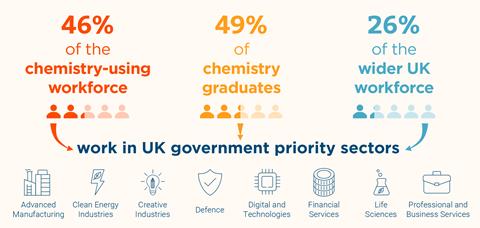
Chemistry’s economic contribution, measured by gross value added, grew by 18% between 2019 to 2023, the report finds, and its overall annual contribution to the UK economy is approximately equivalent to the whole tourism sector. The chemical sciences are also highly productive – the average value added per worker within this field is £98,300, compared to the UK average across all sectors of £73,300. Further, the report shows that 49% of chemistry graduates work in UK government priority sectors, including clean energy, advanced manufacturing and defence.
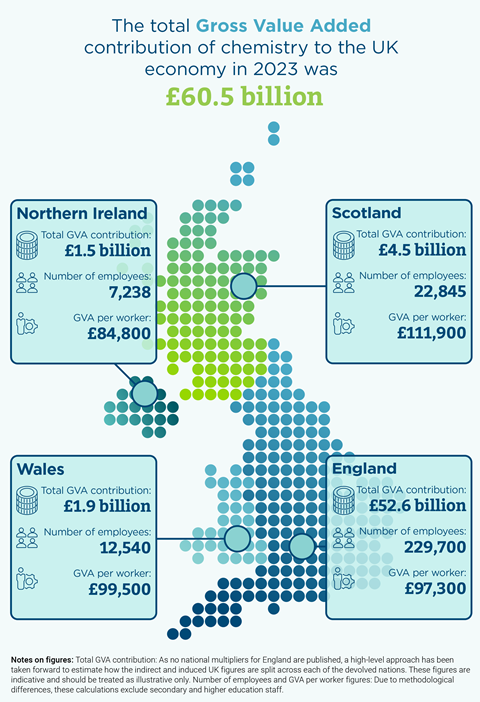
Gross value added, GVA, is a measure of the value of goods and services produced in an area, industry or sector.
However, the report also warns that chemistry’s contribution to the UK economy is threatened by national and global issues. It highlights how challenges such as the financial pressure on universities, volatile geopolitics, rising energy prices and growing global competition affect chemistry’s ability to deliver on its economic potential.
The report notes that these factors affect different regions and ecosystems differently. It therefore calls for action at the level of local, devolved and UK governments to recognise and embed chemistry as a component of local economies, improving its visibility and strengthening pathways between research and industry.
Building the pipeline
‘Chemistry is foundational to the UK economy,’ says Charlotte Lester, lead policy advisor, higher education and research landscape at the RSC, who led the research. ‘If we look at the priority sectors that the UK government has identified for growth in its own strategies, we can see chemistry-using workers being significantly present in sectors like life sciences, defence, advanced manufacturing and clean energy.’
Helen Pain, chief executive of the RSC, said: ‘Our research underlines how chemistry is not just a critical national capability, but a local growth asset, supporting jobs, businesses and innovation in communities right across the UK. If the UK is serious about inclusive growth and access to opportunity, ensuring access to chemistry education and careers in every part of the country must be a priority. It is critical that we maintain this pipeline [that] depends on strong local education and training pathways, from schools and colleges through to universities and technical provision, linked closely with employers and regional economic priorities.’
Chemistry is enabling diverse and high value career pathways across the UK economy
Charlotte Lester, lead policy advisor, higher education and research landscape at the RSC
The report’s recommendations state that reforms to higher education and research funding should recognise chemistry’s value and safeguard its skills pipeline. ‘[Chemistry] is enabling diverse and high value career pathways across the UK economy. But we already know this pipeline is under pressure,’ Lester adds. For example, the report notes that UK university chemistry courses have been cut in recent years, and some departments have closed. The RSC has previously warned that these closures are creating an uneven provision of chemistry training across the UK.

Lester notes that another recommendation is to strengthen the innovation pathways from the lab to commercialisation. ‘We’re really strong in the UK in chemistry research and discovery, but we know there are challenges in scaling up innovations and that creates challenges retaining value locally and nationally,’ she says.
The report’s findings are a foundation ‘from which to articulate chemistry’s strengths and where they are present,’ Lester continues. ‘There is scope to lean into those strengths and potentially lean into [them] differently depending on where you are. We’re not looking at a one-size-fits-all model.’ She says the report’s picture of the chemical sciences’ strategic importance at different levels ‘puts us in a really good position to engage with different types of stakeholders, whether we’re talking about national governments or in local or combined authorities’.
Laurie King, a materials chemist at Manchester Metropolitan University says the report makes a compelling case for chemistry. ‘[£60.5 billion] averaged per worker and how much higher that is than the wider sectors – that’s incredibly useful evidence,’ she says. ‘[Engineering] uses the concept of the invisible engineer, or invisible engineering … why not use that in chemistry? With the closing of UK chemistry departments, it’s a good time to hear about this,’ she concludes.
Sharon Todd, chief executive officer at the Society of Chemical Industry, says: ‘Chemistry is not a sector of the past, it is a big contributor today and it continues to grow despite the headwinds. It is essential for achieving the UK Industrial Strategy and supporting it should be front of mind for anyone who is prioritising growth for the UK.’
The report comes as Andy Burnham, who is widely predicted to become the UK’s next prime minister, set out his plans for greater devolution of power in the country. In a speech on 29 June, Burnham said he intends to build ‘a more collaborative politics in Westminster, by taking power out of the centre and putting it in the hands of the people and places who can use it best … creating a new sense of agency, possibility and hope flowing around the country’.