
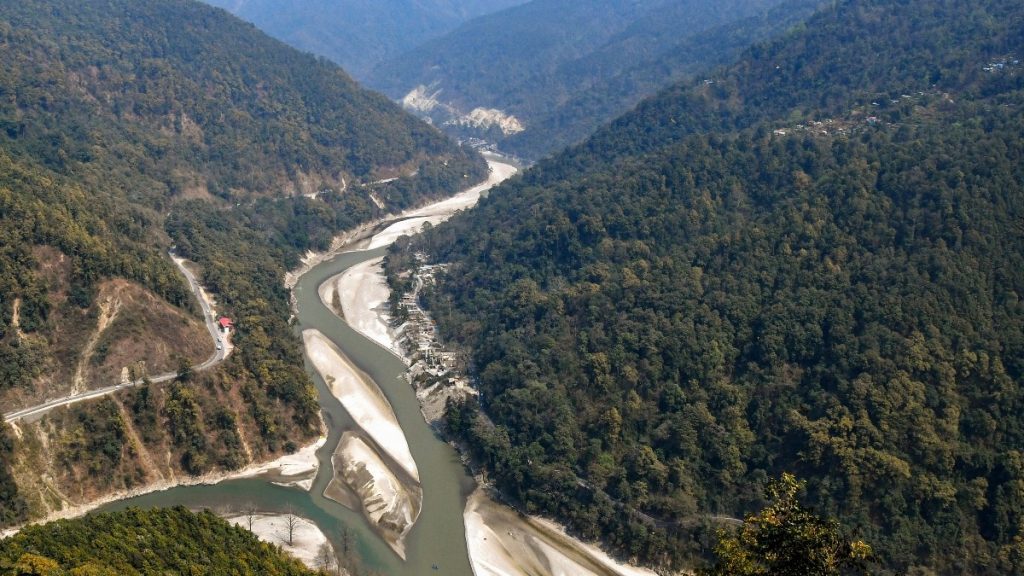
During Bangladesh Prime Minister Tarique Rahman’s visit to China, the two countries signed an agreement to conduct a feasibility study for the Teesta River Comprehensive Management and Restoration Project (TRCMRP). While the plan to reshape the Teesta River’s catchment area in northeastern Bangladesh through large-scale river engineering and infrastructure development represents growing ties between Dhaka and Beijing, the plan is likely to raise concerns in New Delhi, given the project’s proximity to India’s strategically sensitive Siliguri Corridor, according to experts.
Teesta, a 414-km transboundary river, originates in the eastern Himalayas, flows through Sikkim and West Bengal before entering Bangladesh, where it joins the Jamuna River (known as the Brahmaputra in India). Teesta has also long been a bone of contention between New Delhi and Dhaka, primarily over Bangladesh’s demands for a greater share of its water resources.
“India, which had offered to fund the Teesta project with about $1 billion before the Muhammad Yunus government came to power, had been pursued by China since 2016,” strategic affairs and national security expert Tara Kartha told India Today Digital. “The key point is that the Teesta River runs along our border, coming within 10-12 km of it at certain stretches, and lies right next to the strategically sensitive Siliguri Corridor. It is certainly part of Beijing’s expanding footprint.”
Although the Teesta project was unveiled in 2020, it never moved beyond the planning stage, with then Prime Minister Sheikh Hasina withholding final approval amid economic constraints and India’s concerns over a major Chinese-backed project in a sensitive border region.
The latest agreement by the BNP government of Tarique Rahman revives Beijing’s long-standing interest in Teesta and reflects the broader strategic competition between India and China for influence in Bangladesh. While limited to a feasibility study for now, it could pave the way for greater Chinese involvement in one of Bangladesh’s most significant infrastructure projects near the Chicken’s Neck of India.
This risk is magnified by the entity executing the project. PowerChina is not a private, detached contractor. Rather it is a massive state-owned enterprise whose corporate and strategic priorities align directly with the Chinese military-civil fusion doctrine and the Communist Party’s broader geopolitical goals. The company has a history of executing dual-use infrastructure across Asia and Africa, where civilian engineering often lays the groundwork for strategic leverage.
The Chinese involvement “adds a strategic dimension to the Teesta dispute”, according to a 2024 piece by Associate Fellow with the Observer Research Foundation’s Strategic Studies Programme Sohini Bose, and Senior Fellow with ORF’s Neighbourhood Initiative and editor of ORF Bangla Anasua Basu Ray Chaudhury.
WHAT IS THE TEESTA PROJECT THAT CHINA WILL WORK TOGETHER WITH BANGLADESH?
The TRCMRP is a major river engineering and development initiative proposed by Bangladesh “to manage flooding, improve water security, restore the river ecosystem, and unlock economic potential along the Teesta River”.
The plan includes “extensive river dredging, embankment construction, land reclamation, and river training works to stabilise the Teesta’s course,” according to reports. It also envisions developing roads, irrigation systems, urban centres, tourism facilities, and special economic zones along the riverbanks. The project aims to “improve agricultural productivity, reduce flood damage, improve navigation, and create employment opportunities in the region”.
The TRCMRP traces its origins to September 2016, when the Bangladesh Water Development Board signed an MoU with Chinese engineering company PowerChina to prepare a master plan and feasibility study. The project received an official government framework in May 2019 with the preparation of the Preliminary Development Project Proposal and was publicly unveiled as a mega river restoration initiative in 2020.
The government led by Bangladeshi Prime Minister Sheikh Hasina commissioned feasibility studies and unveiled the proposal in 2020. However, her administration never granted final approval or secured financing, as it sought to balance ties with China and India, with New Delhi expressing concerns over a major Chinese-backed project near the strategically sensitive Siliguri Corridor.
WHY BANGLADESH CHOSE CHINA FOR THE TEESTA PROJECT?
There are two main reasons why Bangladesh chose to partner with China for the Teesta River Comprehensive Management and Restoration Project (TRCMRP). The first is the project’s sheer scale. Bangladesh plans to excavate 140 million cubic metres of river sediment, reclaim 171 sq km of land, construct 82 jetties, reinforce embankments, and build a 224-km road network along the river.
At roughly 171 sq km, the reclaimed land would be nearly as large as Chandigarh and about one-eighth the size of Delhi.
Bangladesh PM Tarique Rahman has pledged to implement the Teesta plan “at any cost”.
Such a massive undertaking demands both substantial financing and advanced engineering expertise. China is among the world’s leading builders of dams and river infrastructure, with extensive experience in flood control and irrigation. Chinese firms have also delivered major projects in Bangladesh, including the Padma Bridge, completed in 2022.
The second reason is the long-running deadlock between Bangladesh and India over sharing the Teesta’s waters. Bangladesh has long sought a larger share of the river’s dry season in the winter to support irrigation, but despite agreeing on the broad contours of an interim pact in 2010, the two sides never finalised a deal.
The principal hurdle has been the opposition from former West Bengal CM Mamata Banerjee, who argued that diverting more water to Bangladesh would hurt farmers in the eastern state. Since water is a shared subject under India’s federal system, New Delhi has been unable to proceed without Kolkata’s consent.
China also moved faster than India. In 2024, New Delhi offered to finance the $1-billion Teesta project, but political turmoil following Hasina’s ouster stalled talks. With India’s proposal left in limbo during the interim regime of Muhammad Yunus, the Tarique Rahman government instead revived cooperation with Beijing during the prime minister’s visit to the Asian nation.
WHY SHOULD INDIA BE CONCERNED ABOUT CHINA-BANGLADESH TEESTA TANGO?
New Delhi has serious reasons to be concerned about the China-Bangladesh agreement on the feasibility plan for the Teesta River Comprehensive Management and Restoration Project.
The core of India’s anxiety is geographical proximity. The Bangladeshi project areas of Nilphamari and Rangpur lie directly adjacent to India’s Jalpaiguri district, the precise location of the highly strategic Chicken’s Neck, or Siliguri Corridor. The narrow strip of land—measuring a mere 22 kilometres wide at its tightest point—is India’s sole land bridge connecting the northeastern states to the rest of the country. Any disruption or hostile presence in this area could severely affect connectivity to India’s Northeast, making developments in this region a significant security concern.
According to strategic expert Tara Kartha, China’s influence in Bangladesh reinforces India’s two-front security challenge, with Beijing expanding its strategic reach as Pakistan continues to exploit vulnerabilities in the Northeast.
“Sitting along India’s northeastern border essentially means that India now firmly faces a two-front situation, with Pakistan looking over China’s shoulder at every turn. The Pakistani threat is more dangerous on a day-to-day basis, as it involves destabilising the Northeast, and that activity has already begun. Meanwhile, China’s presence in Bangladesh has increased in leaps and bounds, with ties even to Jamaat-e-Islami. It is also projecting its soft power effectively,” Kartha told India Today Digital.
According to ORF fellows Sohini Bose and Anasua Basu Ray Chaudhury, the China-backed Teesta project raises concerns because “expanded Chinese involvement in the Teesta Basin is apprehended to breed internal unrest, create security risk and intensify geopolitical competition in an already sensitive region.” The piece was published by the ORF in March 2024, when Bangladesh under Hasina was weighing a China-backed Teesta project.
The ORF fellows argued that the issue was no longer confined to water sharing, warning that “Chinese presence in the Teesta Basin could potentially transform a technical bilateral dispute into a broader security concern for India” owing to its proximity to the strategically vital Siliguri Corridor.
Consequently, stationing a large contingent of Chinese engineers, surveyors, and technical personnel so close to this sensitive, narrow border zone naturally raises major security alarms in New Delhi.
WHERE DOES INDIA STAND ON CHINA-BANGLADESH TEESTA COOPERATION?
Even though India’s offer to fund the Teesta project didn’t materialise, New Delhi, for its part, continues to engage with Dhaka on the issue of the sharing of the river’s water resources.
This was confirmed by Foreign Secretary Vikram Misri, who in October 2025 said that India would continue discussions with Bangladesh on water-related issues, including the Ganges and Teesta water-sharing treaties. “The Ganges Water Treaty is still valid, and we will continue to discuss related issues within the framework of the Joint Rivers Commission,” Misri was quoted as saying by Bangladeshi newspaper The Daily Star.
On June 3, foreign ministry spokesperson Randhir Jaiswal, on being asked about Rahman’s visit to China, noted that India’s views on the Teesta Project had been conveyed to Dhaka, and that New Delhi’s approach to the Teesta issue would take into account “all related developments.”
“India’s development assistance for projects in Bangladesh is based on a mutually agreed roadmap, which is regularly reviewed. Our views on the Teesta River project have previously been conveyed to the Bangladesh side. We will factor all related developments into our overall approach to the Teesta issue,” Jaiswal was quoted as saying by news agency ANI.
However, strategic expert Tara Kartha said India must accelerate the execution of strategic projects and improve their quality to remain strategically competitive. “New Delhi could consider roping in countries such as Japan and Russia to expand the footprint of friendly, non-threatening partners,” she suggested. “…The most important aspect is to project a friendly face to Bangladesh and calibrate political narratives accordingly, particularly in the border states,” she said.
“Chief ministers should not be allowed to comment on foreign policy issues,” Kartha added.
For now, whether the feasibility study of Teesta ultimately translates into a full-fledged project remains to be seen. But if China secures a long-term role in shaping the Teesta Basin, the river is likely to evolve from an India-Bangladesh bilateral water dispute into an area of India and China’s race for strategic space.
– Ends