
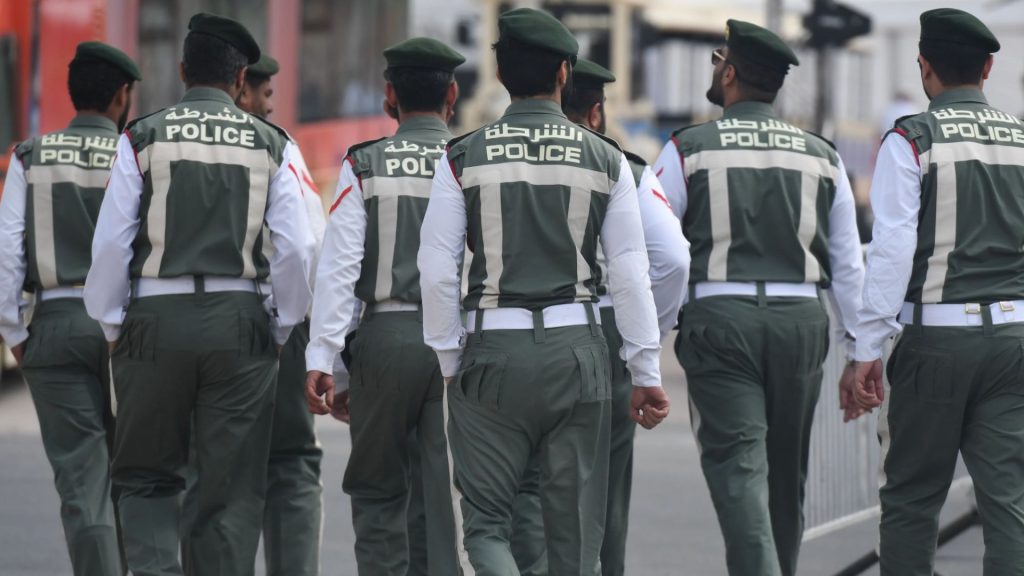
DUBAI cops hellbent on locking up dissenters have allegedly been snooping on private WhatsApp messages to sanction arrests.
Police ruthlessly hunted down an Emirati flight attendant who privately shared footage of smoke billowing from the site of an Iranian drone strike in the city.
On feeling his building shake from the impact, the airline worker had decided to record the scary situation and send it to a closed WhatsApp group of colleagues.
But even though the clip was not publicly posted, Dubai‘s digital sniffer dogs were reportedly straight on his case.
According to a police report, the clip was detected through “electronic monitoring operations”.
It is unclear whether the messages were accessed via infiltration or leaked by a member of the group.


But an elite cyber crime unit was allegedly formed to continue gathering evidence in order to identify the culprit.
The unwitting flight attendant was subsequently located, lured to a meeting point and cuffed by police.
He remains in detention after the case was escalated to State Security Prosecution, where charges include publishing information deemed harmful to state interests.
Radha Stirling, CEO of Detained in Dubai, said: “Dubai Police have now explicitly confirmed they are conducting electronic surveillance operations capable of detecting private WhatsApp messages.
“Individuals are being tracked, identified, and arrested not for public statements, but for private exchanges between colleagues.”
Stirling added that a slew of related arrests have dramatically upped the ante on Dubai’s residents and turned the city into a quasi-police state.
She said: “We have just been alerted to a deeply concerning case involving a comedian who has now been detained for nearly a month after performing a one-line sketch.
“He was called into a police station without explanation and has remained in detention for over 28 days under the UAE’s cybercrime laws.
“If this is how the law is being applied, then thousands of expatriates could be at risk, not just for social media posts, but for jokes, satire, or even private messages.”
Stirling has called on global tech platforms to address weaknesses in their security.
She said: “Companies like WhatsApp must answer urgent questions about user privacy.
“If private communications can be detected and used as the basis for arrest by overreaching or hypersensitive states, users worldwide need clarity on how their data is being accessed.”
A Meta spokesperson said: “We protect personal messages with end-to-end encryption using the Signal protocol, which secures your messages before they leave your device.
“This means that no one outside of the chat, not even WhatsApp or Meta, can read, listen to, or share them.”
The Sun has contacted the UAE Ministry of Foreign Affairs for comment.
The UAE has faced growing accusations of arresting tourists for daring to speak negatively of the country and using kangaroo courts to lock them up.
An eerie handwritten note smuggled out of a hellhole Emirati jail by a Brit prisoner claims that he and 15 others were beaten up by police.
More than 50 Brits have been arrested in Dubai and Abu Dhabi for sharing evidence of drone attacks.
The note shared with The Sun by advocacy group Detained in Dubai was just two lines, but carried a chilling message.
It claimed that the Brit prisoner was beaten by UAE cops and remains locked up without hope of a trial to clear his name.
One line of the note read: “On my case there is 15 people, we all got beaten by the special police force, the case will never go to court.”
It was smuggled out of a UAE jail and passed to Detained in Dubai last month.
It gave details of the packed conditions suffered by those locked up in UAE prisons.
Stirling told the Sun: “A British citizen currently held in the UAE has smuggled out a handwritten note stating that he and fifteen other prisoners in his cell have been beaten by police.”
She highlighted previous cases of UK citizens being beaten up in UAE jails, including Brit grandad Albert Douglas, who was tortured to within an inch of his life in Dubai’s dangerous Al Barsha prison.
She also claimed many of those arrested have bypassed the British Foreign, Commonwealth and Development Office (FCDO), because they don’t think it can help them.
Iran has targeted Dubai and Abu Dhabi with hundreds of drones since the start of the Iran war.
Attacks included drone debris causing a huge blaze on the side of the Burj Khalifa and hitting the ritzy Fairmont hotel on the Palm Jumeirah.
Yet as missiles soared through the skies above the cities, Emirati authorities threatened residents with huge fines and jail time for sharing footage of the attacks.
Repressive rules mean anyone sharing or taking photos of Iranian attacks in the UAE could face up to five years behind bars and be fined thousands.