
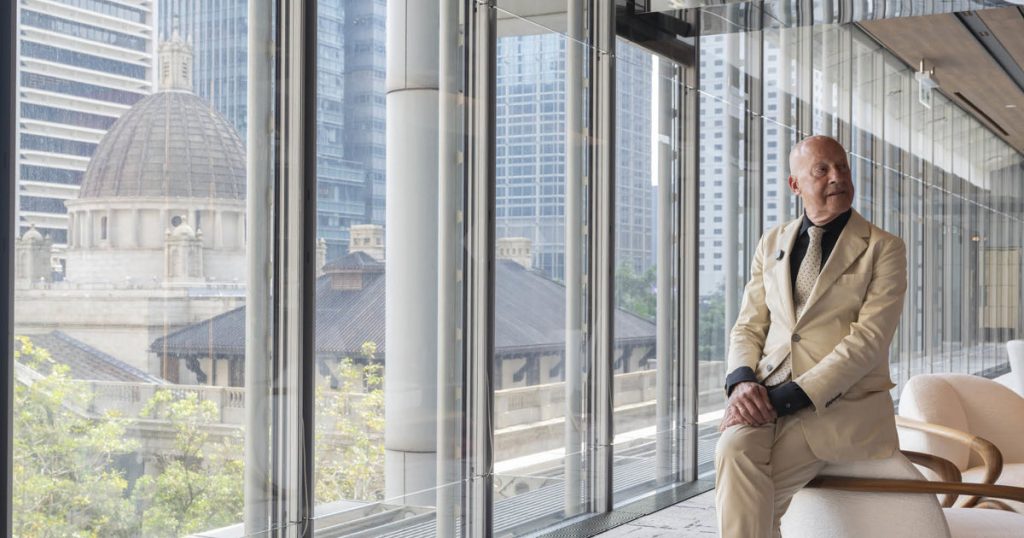
This year marks the Hongkong and Shanghai Bank Headquarters 40th anniversary. To commemorate this milestone, Lord Norman Foster visited Hong Kong to attend celebrations held by HSBC.
Completed in 1986, the Hongkong and Shanghai Bank Headquarters addressed the nature of banking in the city and how it should be expressed in built form. From the outset, the emphasis was on flexibility, allowing the building’s layout to be reconfigured with ease, and fast construction on a restricted site was achieved through the use of prefabricated ‘kit of parts’ elements.
Lord Norman Foster, Founder and Executive Chairman, Foster + Partners, said: “Design is ultimately about anticipating the future – creating buildings and cities that are resilient, humanistic, and open to change. The Hongkong Bank building was a radical departure from the typical office tower; it was also an expression of optimism, of confidence in the city’s future, and of the extraordinary energy that defines Hong Kong. I have always said that such projects are never the work of an architect alone – it depends on enlightened patronage, on those with the courage to support innovation, and on a shared belief that design can help shape better cities for generations to come.”
Maggie Ng, Chief Executive Officer, HSBC Hong Kong, said: “The fourth-generation HSBC Main Building is a powerful symbol of HSBC’s growth alongside Hong Kong. For 40 years, it has supported the daily interactions of millions of customers with colleagues. Its timeless modern design reflects Hong Kong’s vitality as an international financial centre and its unique character as a place where East meets West. HSBC will continue to partner with the Hong Kong community and contribute positively to society.”
During his visit to the city, Lord Foster also participated in the Hong Kong Architectural Legacy Symposium, organised by the Design Trust and supported by HSBC. The symposium honoured Lord Foster, who was Guest of Honour and recipient of the Design Trust Legacy Award 2026.
The event celebrated the many contributions that craft the optimistic spirit of Hong Kong, delving into the layered, hidden stories of how cities shape culture, and how the culture of architecture and patronage, in turn, shapes cities. It also highlighted the profound impact of design on urban identity and the continuous evolution of Hong Kong’s unique architectural landscape.