
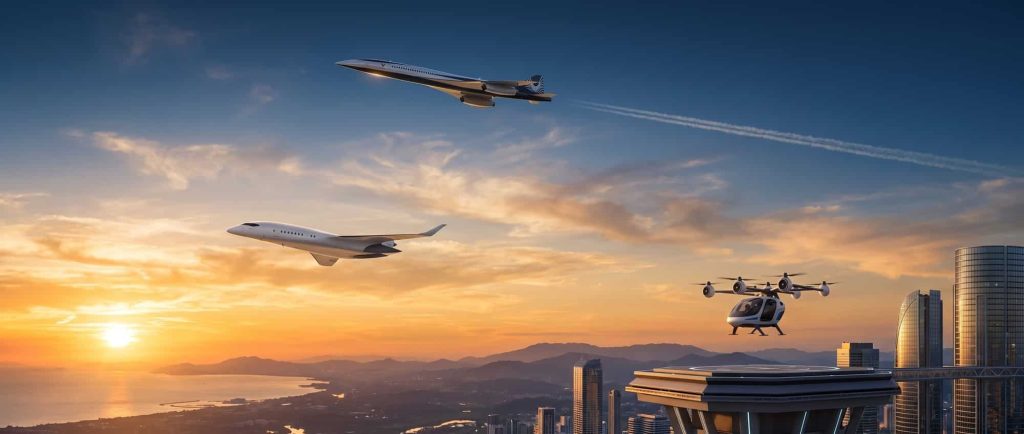
Aviation is undergoing its most dramatic transformation since the dawn of the jet age. After decades of incremental improvements, a wave of radical new aircraft designs is converging: supersonic airliners that promise to halve travel times, hydrogen-powered planes that emit only water, blended-wing airframes that slash fuel consumption by half, and electric aircraft that are already flying. These futuristic aircraft are no longer science fiction. They are in development, in testing, and in some cases, already airborne.
1. Supersonic Is Back: Boom Overture and NASA X-59
For the first time since the Concorde retired in 2003, supersonic commercial flight is within reach. Two programs are leading the charge, each with a different approach to breaking the sound barrier without disturbing communities below.
Boom Overture
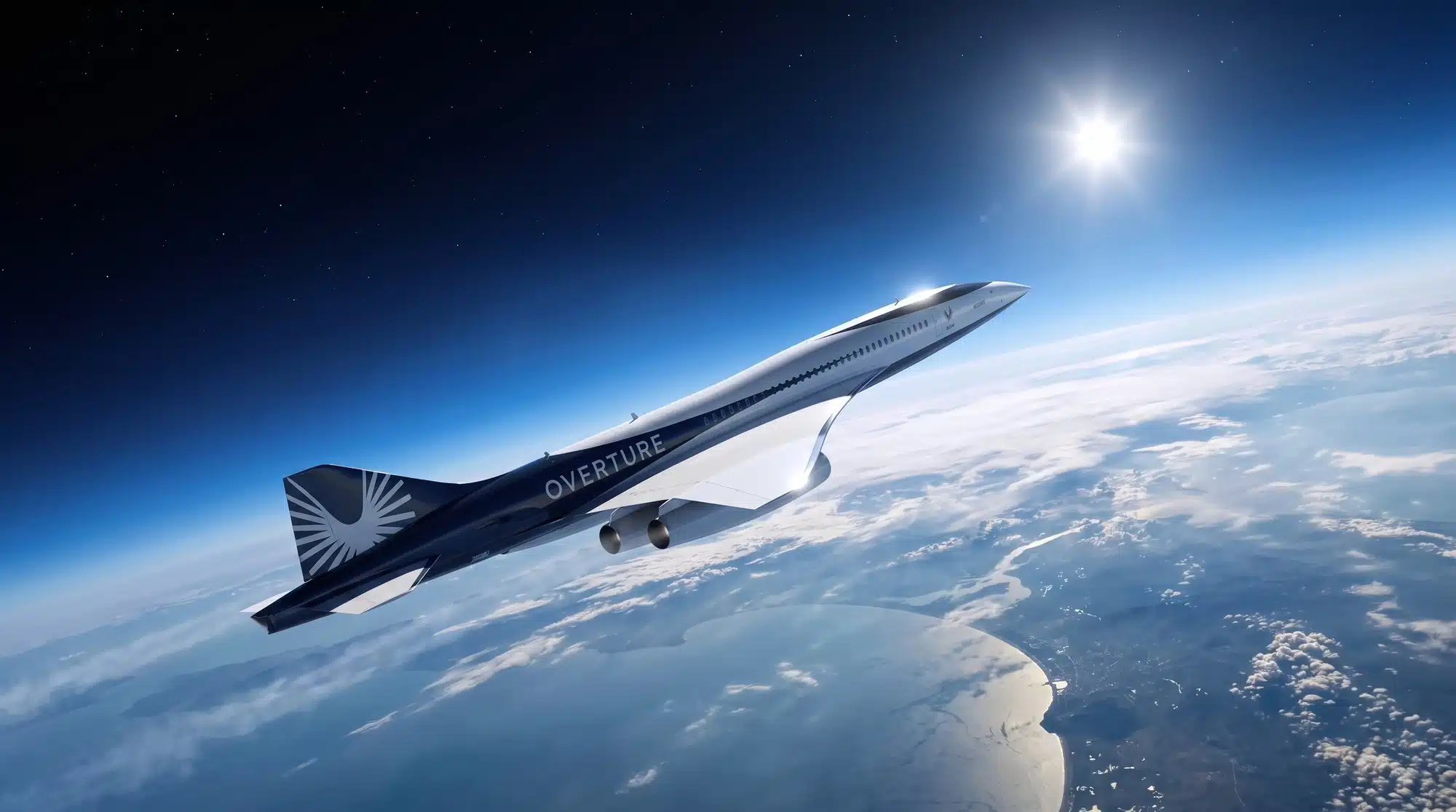
On January 28, 2025, Boom Supersonic’s XB-1 demonstrator reached Mach 1.12 at 35,290 feet over the Mojave Desert. It marked the first time a privately developed civil supersonic jet broke the sound barrier without government backing. The flight also demonstrated “boomless cruise” capability, a physics phenomenon called Mach cutoff that prevents sonic booms from reaching the ground, confirmed by sensors on the surface.
The full-scale Overture airliner is designed to cruise at Mach 1.7 at 60,000 feet, carrying 64 to 80 passengers in an all-business-class configuration over a range of 4,250 nautical miles. That translates to New York to London in roughly four hours, or Tokyo to Honolulu at twice the speed of conventional jets over water.
Boom has secured approximately 130 orders and options, including firm commitments from United Airlines (15 aircraft plus 35 options), American Airlines (20 plus 40 options), and Japan Airlines. The company plans to roll out the first full-scale prototype by 2027, with FAA certification targeted for 2029 to 2030. However, independent analysts at Forecast International consider that timeline speculative, noting that the Symphony engine, a clean-sheet design Boom is developing in-house, will require considerable certification time. Entry into service may slip into the 2030s.
In a surprising pivot, Boom also announced in December 2025 that it is applying its supersonic engine technology to AI data center power. The company introduced Superpower, a 42-megawatt natural gas turbine designed for waterless operation in hot, dry conditions. Crusoe, an AI infrastructure company, placed a $1.25 billion order for 29 Superpower turbines, signaling that Boom’s engineering expertise may have applications well beyond aviation.
NASA X-59 Quiet Supersonic
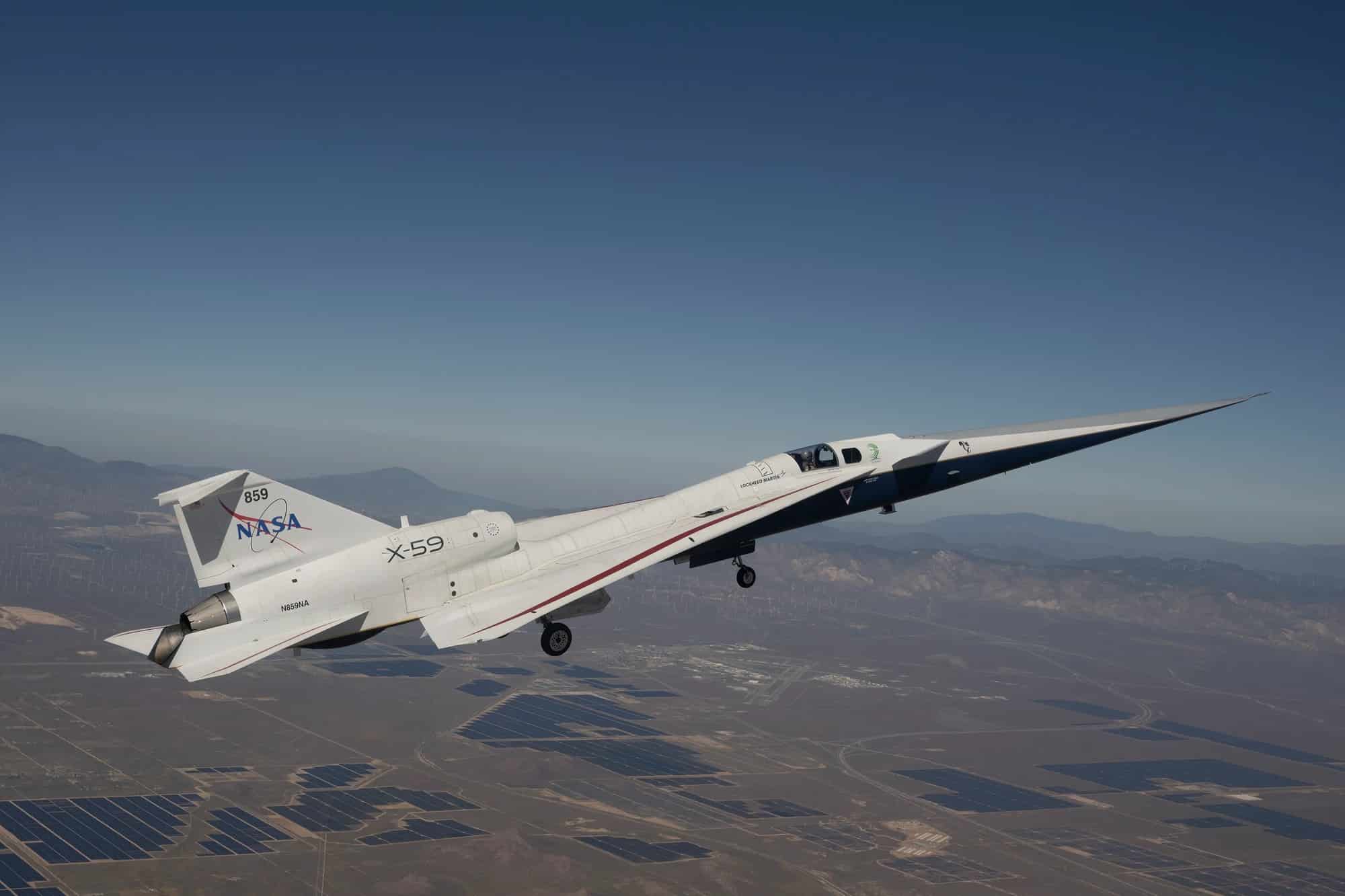
NASA’s X-59 QueSST (Quiet SuperSonic Technology) aircraft completed its first flight in October 2025 from Plant 42 in Palmdale, California. The aircraft has since achieved its target speed of Mach 1.4 at 55,000 feet, the exact conditions it will fly during community overflight tests. The X-59 is designed to produce a soft “thump” rather than a sonic boom, thanks to its elongated nose and carefully shaped fuselage. If successful, the technology could convince regulators to lift the 50-year ban on supersonic flight over land, opening routes that account for the vast majority of air travel.
The X-59 cruises at approximately Mach 1.4 and will fly over select U.S. communities to gather data on public perception of its noise signature. NASA plans to share that data with the FAA and international regulators to inform new supersonic noise standards.
2. Hydrogen-Powered Flight: Airbus ZEROe and ZeroAvia
Hydrogen is emerging as a leading candidate for decarbonizing aviation, and two programs are taking fundamentally different approaches to harnessing it.
Airbus ZEROe
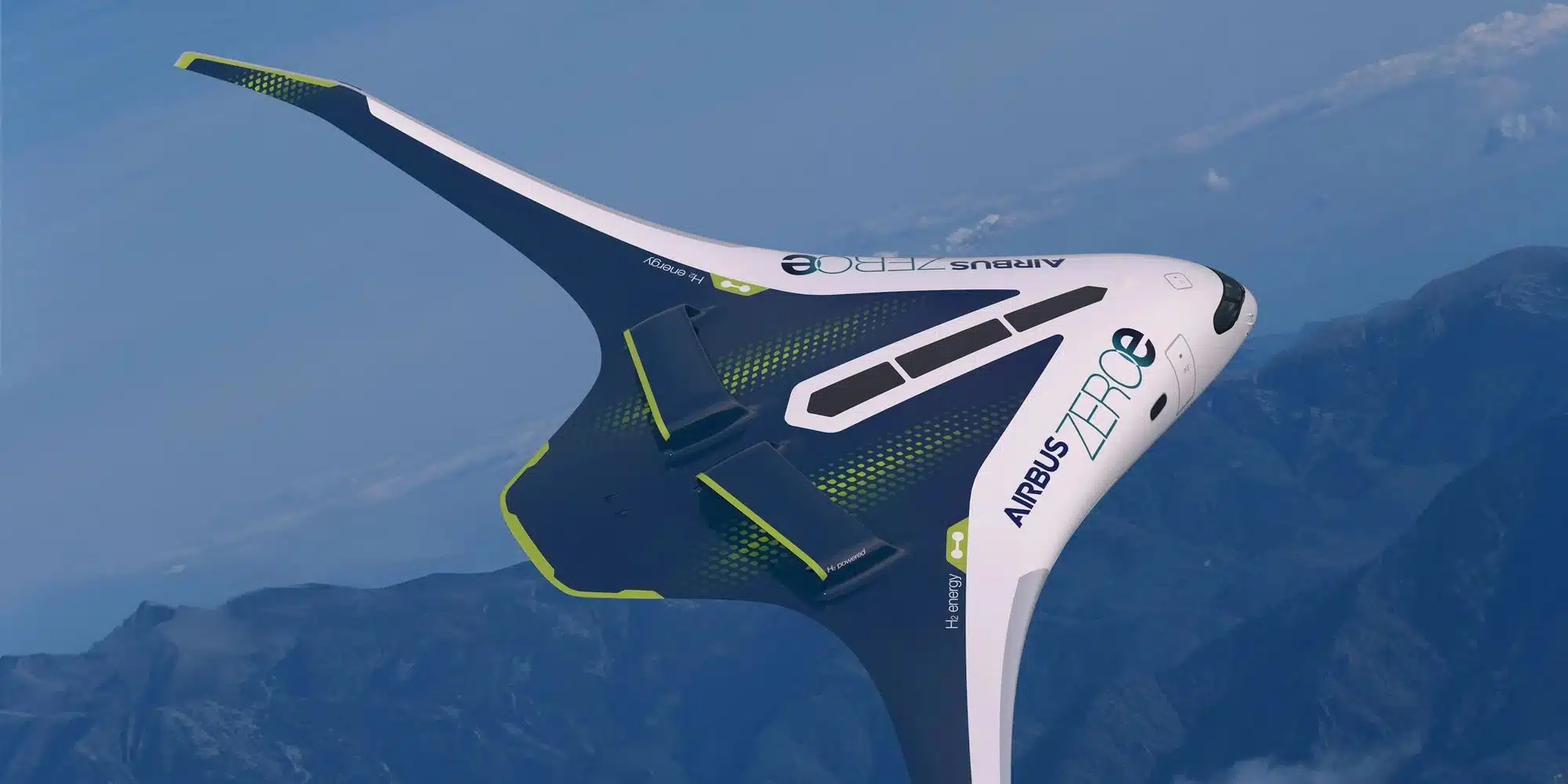
Airbus launched its ZEROe program in 2020 with three concept aircraft: a hydrogen-combustion turbofan (120 to 200 passengers), a turboprop (up to 100 passengers), and a blended-wing body (up to 200 passengers). The original target was entry into service by 2035.
In 2025, Airbus down-selected hydrogen fuel cells over hydrogen combustion as the preferred propulsion pathway. The current concept features four 2-megawatt electric propulsion engines, each driven by its own fuel cell stack, supplied by two liquid hydrogen tanks. The only byproduct is water vapor. However, the timeline has shifted significantly. Airbus now targets the late 2030s to 2040 for commercial service, reflecting the complexity of certifying an entirely new propulsion system and the infrastructure challenges of liquid hydrogen at airports worldwide.
Airbus has been testing hydrogen technology on a modified A380 testbed, with flight campaigns conducted in 2023 and 2024. The company’s broader innovation pipeline also includes the Wing of Tomorrow program, which has produced three 17-meter ground demonstrators and is moving toward full-scale flight testing on an A321neo platform, expected to run through approximately 2029.
ZeroAvia Hydrogen-Electric Engines
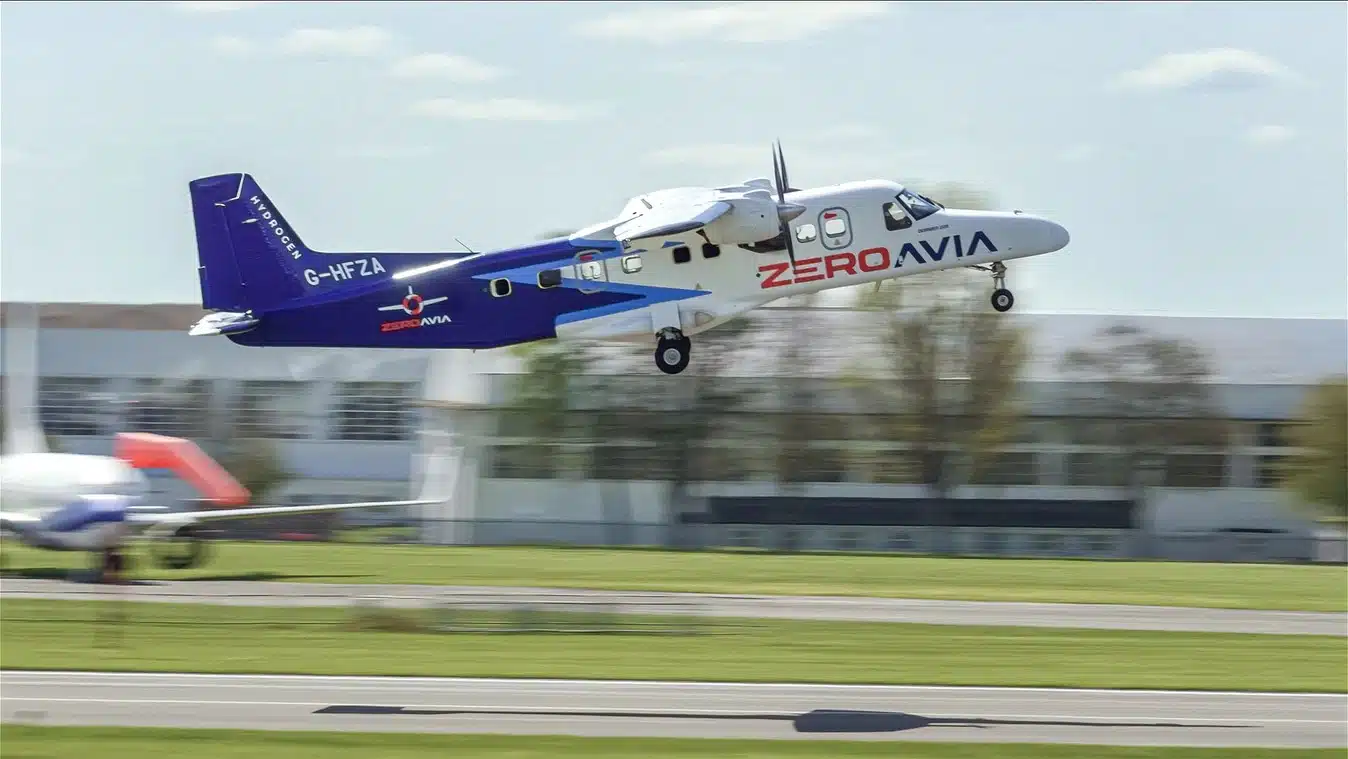
While Airbus is designing entirely new airframes, ZeroAvia is taking a retrofit approach: replacing conventional engines with hydrogen-electric powertrains on existing aircraft. The company has been flight-testing its prototype on a Dornier 228 since 2023, with a notable 35-minute test flight in April 2024.
ZeroAvia’s ZA600 engine targets the 9-to-80-seat regional aircraft market, with a range of approximately 300 nautical miles on hydrogen fuel cells. The company aims for FAA certification by the end of the 2020s, which would make it one of the first certified hydrogen-electric propulsion systems for commercial aviation.
3. The Blended Wing Revolution: JetZero Z4
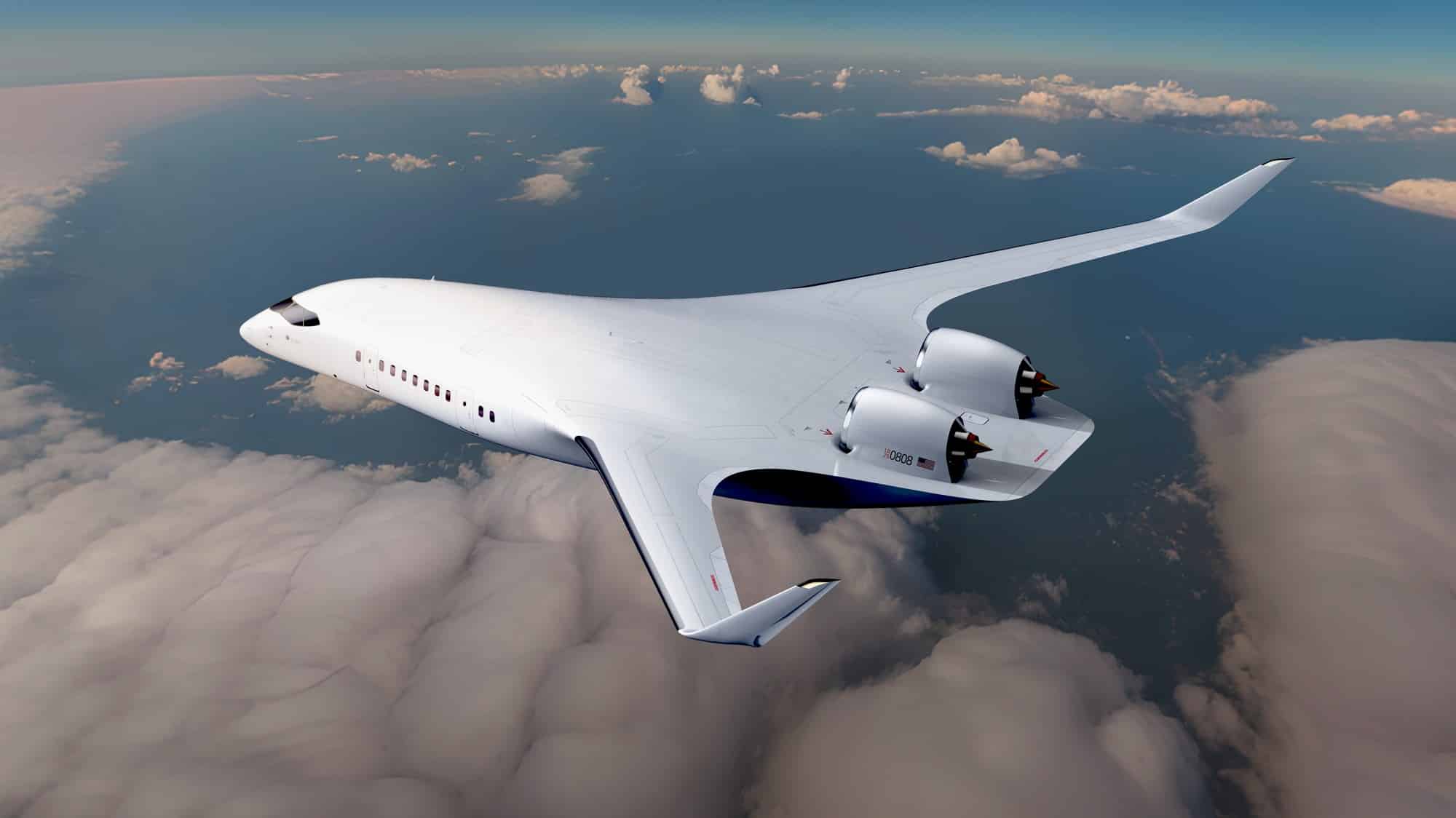
JetZero’s Z4 represents one of the most radical departures from conventional aircraft design in decades. Instead of the traditional tube-and-wing configuration, the Z4 uses a blended-wing body (BWB) where the fuselage itself generates lift. The result is an aircraft that looks like a flying wing, with a wide, flat cabin and engines mounted on top of the rear fuselage.
The numbers are striking. JetZero claims the Z4 could reduce fuel consumption and carbon emissions by up to 50 percent compared to contemporary aircraft of similar capacity. The aircraft is designed to carry up to 250 passengers and operate at higher altitudes than conventional jets.
The U.S. Air Force awarded JetZero a $235 million contract to build a full-scale demonstrator, with the first flight targeted for 2027. Commercial operations could begin as early as 2030. One of the Z4’s most practical advantages is airport compatibility: the aircraft is designed to use existing jet bridges, runways, and boarding infrastructure, eliminating the need for costly airport modifications.
The cabin design also offers passenger experience benefits. Wider boarding doors and multiple aisles could speed up boarding and turnaround times, while the broad fuselage allows for more personal space and designated overhead storage in all seating classes.
4. Electric Aviation Takes Off: Heart Aerospace ES-30
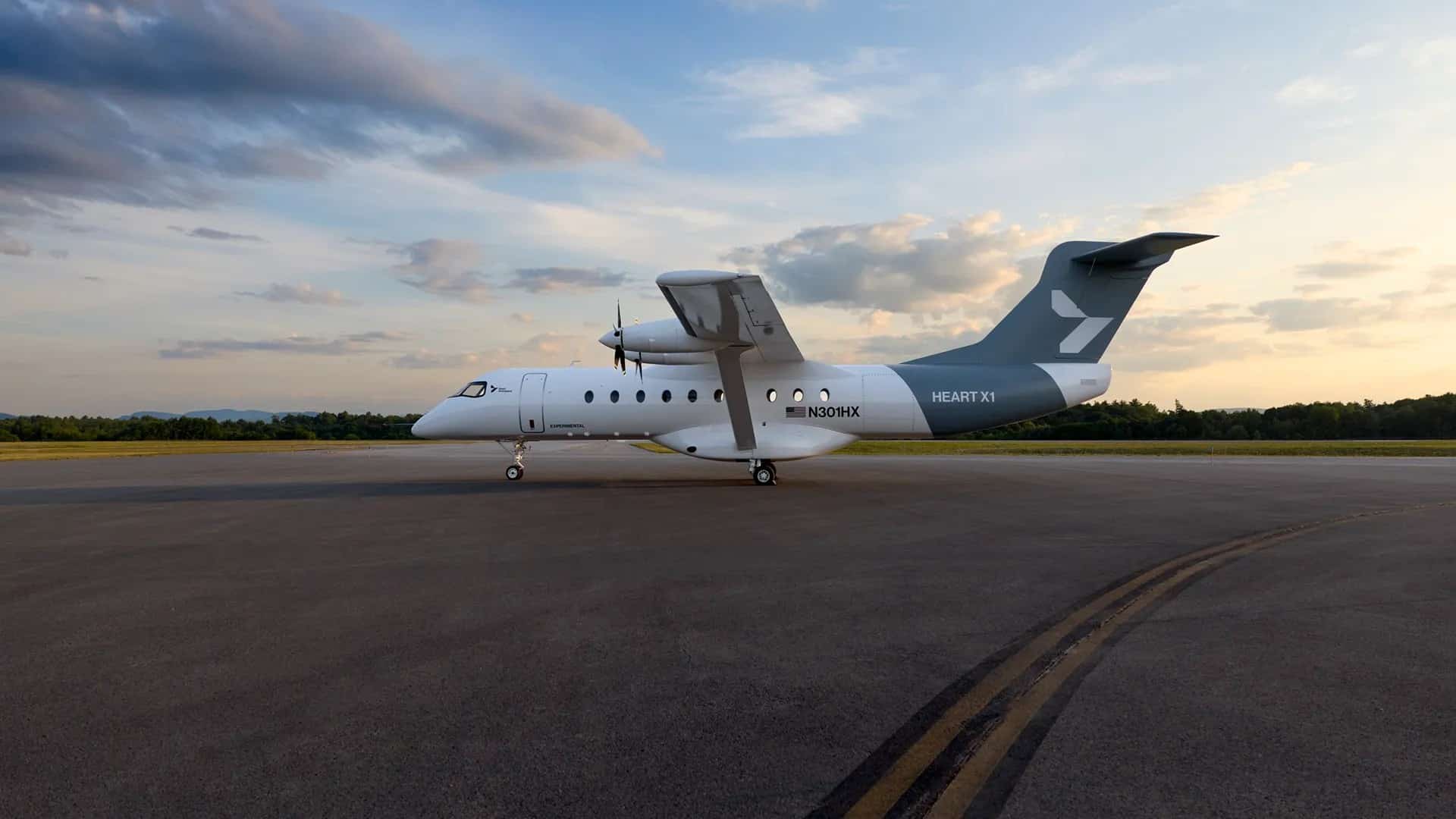
On August 12, 2026, Heart Aerospace’s X1 demonstrator completed its maiden flight over Plattsburgh, New York. The 25,000-pound aircraft flew for 27 minutes in an FAA-approved test, making it the world’s largest all-electric airplane to take to the skies. The milestone was largely overlooked in mainstream coverage, but it signals a significant step forward for battery-electric regional aviation.
The production ES-30 is designed as a 30-seat regional airliner with three range configurations: 124 miles (200 km) on battery power alone for zero-emission flights, 249 miles (400 km) in hybrid mode at full passenger load, and up to 497 miles (800 km) with reduced passenger capacity. Entry into service is targeted for approximately 2028.
Heart Aerospace has attracted interest from major carriers, including Air Canada, United Airlines, and Mesa Airlines. The ES-30 is designed to serve short-haul routes that are currently uneconomical with jet fuel aircraft, potentially opening new direct connections between smaller cities and regional airports.
Heart Aerospace is not alone in the electric aviation space. NASA’s X-57, an all-electric experimental aircraft based on a modified Tecnam P2006T, demonstrated distributed electric propulsion with 14 motors along the wing leading edge. IL has covered the NASA X-57 program in detail, along with other zero-emissions aircraft initiatives across Europe.
5. eVTOL Air Taxis: The Urban Air Mobility Revolution
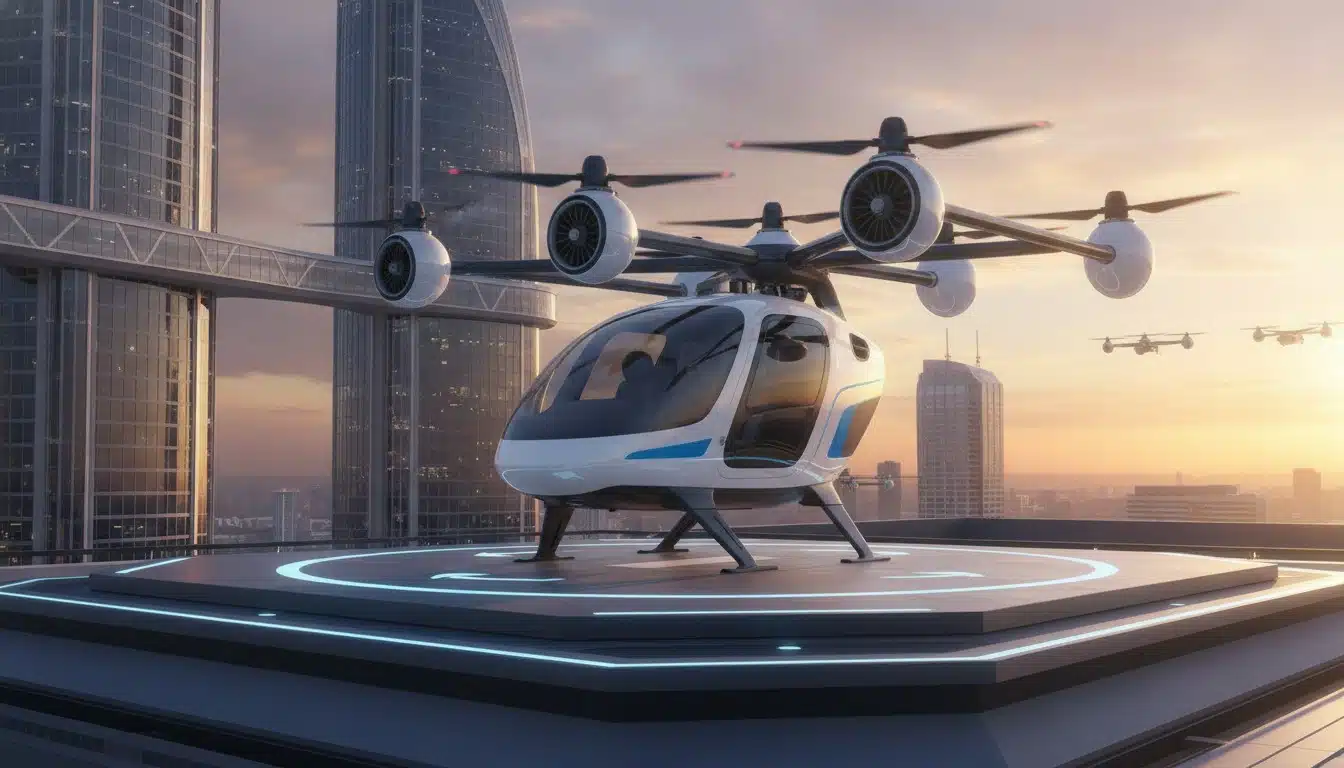
Electric vertical takeoff and landing (eVTOL) aircraft are moving from prototype to production faster than many expected. These compact, battery-powered vehicles are designed to carry 4 to 6 passengers on short urban hops, bypassing ground traffic entirely.
On August 19, 2026, the world’s first eVTOL vertiport received regulatory approval, marking a critical infrastructure milestone for urban air mobility. Without dedicated landing and charging facilities, eVTOL services cannot operate at scale, and this approval signals that regulators are taking the category seriously.
Several companies are approaching commercial launch:
- Joby Aviation has conducted extensive flight testing and is targeting FAA certification for air taxi operations in the near term.
- Archer Aviation is developing its Midnight eVTOL for urban routes, with a focus on short-haul commuter flights.
- Lilium is building an electric jet that takes off vertically and transitions to forward flight, offering longer range than rotor-based eVTOL designs.
The category is also expanding beyond the U.S. and Europe. India’s Sarla Aviation completed integrated flight testing of its Sylla 1.0 demonstrator in under a year, moving from concept to mid-air testing at remarkable speed. Meanwhile, the LEO Solo has gone up for preorder as an FAA Part 103-friendly, single-seat personal eVTOL that requires no pilot license, targeting late 2025 delivery.
6. Futuristic Aircraft at a Glance
The table below compares the key specifications and timelines of the futuristic aircraft programs covered in this article.
| Aircraft | Type | Propulsion | Passengers | Range | Timeline |
|---|---|---|---|---|---|
| Boom Overture | Supersonic airliner | Symphony turbofan (SAF) | 64 to 80 | 4,250 nmi | 2029 to 2030 (target) |
| NASA X-59 | Quiet supersonic demonstrator | GE F414 engine | 1 (pilot) | Research aircraft | Flying (2025) |
| Airbus ZEROe | Hydrogen airliner | Hydrogen fuel cell | Up to 200 | TBD | Late 2030s to 2040 |
| ZeroAvia ZA600 | Hydrogen-electric retrofit | Hydrogen fuel cell | 9 to 80 | 300 nmi | End of 2020s (target) |
| JetZero Z4 | Blended wing body | Jet fuel + SAF | Up to 250 | TBD | 2030 (target) |
| Heart ES-30 | Electric regional airliner | Battery + hybrid | 30 | 124 to 497 mi | ~2028 |
| eVTOL (various) | Urban air taxi | Battery electric | 4 to 6 | 100 to 150 mi | 2025 to 2027 |
7. What Will Airplanes Look Like in 2050?
Looking beyond the aircraft already in development, aerospace manufacturers are investing in technologies that could define aviation for the second half of the century.
Airbus’s ZEROe concepts represent just one strand of the company’s innovation pipeline. The Wing of Tomorrow program is developing longer, more efficient wings with foldable tips that can extend during flight for maximum aerodynamic efficiency and fold back for airport gate compatibility. Three 17-meter ground demonstrators have already been built, and full-scale flight testing on an A321neo is expected to run through approximately 2029.
Boeing’s X-66A, developed in partnership with NASA, features a truss-braced wing design that could deliver 8 to 10 percent fuel savings over the best current single-aisle jets. The aircraft is expected to fly by 2028 and could influence the design of next-generation 130-to-210-seat aircraft in the early-to-mid 2030s.
Engine technology is advancing just as rapidly. The CFM RISE (Revolutionary Innovation for Sustainable Engines) open-fan architecture promises more than 20 percent fuel burn reduction compared to today’s most efficient single-aisle engines. Airbus is testing the RISE on a modified A380 testbed, with flight campaigns planned before the end of the decade.
All of these programs share a common goal: making aviation compatible with the industry’s commitment to net-zero carbon emissions by 2050. Sustainable aviation fuel (SAF) is a critical bridge technology. Today’s fleet can operate on up to 50 percent SAF blends, and next-generation engines are being designed for 100 percent SAF compatibility, which can reduce lifecycle carbon emissions by up to 80 percent compared to conventional jet fuel.
The Flying-V concept, developed by KLM and TU Delft, offers another glimpse of what 2050 aviation might look like. Its V-shaped design integrates the passenger cabin into the wings, carrying roughly the same number of passengers as an Airbus A350 on approximately 20 percent less fuel. A small-scale model has flown, but commercial service is unlikely before 2040 at the earliest.
Frequently Asked Questions
What is the most futuristic plane in the world?
As of 2026, the Boom Overture and JetZero Z4 are among the most futuristic aircraft in active development. The Overture aims to revive supersonic commercial travel at Mach 1.7, while the Z4’s blended-wing body design looks unlike any conventional airplane. For sheer novelty, eVTOL air taxis like Joby Aviation’s aircraft, which take off vertically and fly like planes, represent perhaps the most radical departure from traditional aviation.
Is the SR-72 real?
The SR-72 is a hypersonic concept reportedly under development by Lockheed Martin’s Skunk Works division as a successor to the SR-71 Blackbird. It is designed to reach speeds above Mach 6. While Lockheed Martin has acknowledged the concept publicly, no confirmed prototype has been publicly demonstrated. The program remains classified, and details are scarce.
Is the Boeing 797 being built?
Boeing has not officially launched a program called the 797. The concept of a “New Midsize Airplane” (NMA) has been discussed for years as a potential replacement for the 757 and 767, but Boeing has shifted its focus to the X-66A demonstrator and next-generation single-aisle aircraft. A formal 797 program has not been confirmed as of 2026.
Will supersonic flights be affordable?
Boom Supersonic aims to make supersonic tickets available at business-class prices, though the company has not published specific fare targets. The economics depend on fuel costs, aircraft utilization, and demand. Historically, supersonic travel was limited to premium passengers. Whether next-generation supersonic aircraft can achieve broader affordability remains an open question, particularly given the higher fuel consumption per passenger compared to subsonic jets.
What will airplanes look like in 2050?
By 2050, commercial aircraft are likely to incorporate several transformative technologies:
- Open-fan engines like the CFM RISE architecture, promising 20 percent or greater fuel savings over current turbofans
- 100 percent SAF compatibility, reducing lifecycle carbon emissions by up to 80 percent compared to conventional jet fuel
- Hydrogen-electric propulsion for short- and medium-haul routes, with fuel cells replacing combustion engines
- Blended-wing and flying-wing airframes that integrate the fuselage into the wing for dramatic aerodynamic gains
- Autonomous flight systems that assist pilots with navigation, fuel optimization, and emergency response
Conclusion
The next decade will reshape aviation more fundamentally than any period since the introduction of the commercial jet engine. Supersonic flight is returning after a 20-year absence. Hydrogen and electric propulsion are moving from laboratory to runway. Entirely new airframe configurations are challenging a century of tube-and-wing orthodoxy. And urban air mobility is creating an entirely new category of flight.
These futuristic aircraft programs face real hurdles: certification timelines, infrastructure gaps, hydrogen storage challenges, and the economics of new propulsion systems. But the pace of progress is accelerating. With multiple programs targeting commercial service between 2027 and 2035, the aircraft that will define the future of flight are no longer drawings on a whiteboard. They are being built, tested, and flown today.