
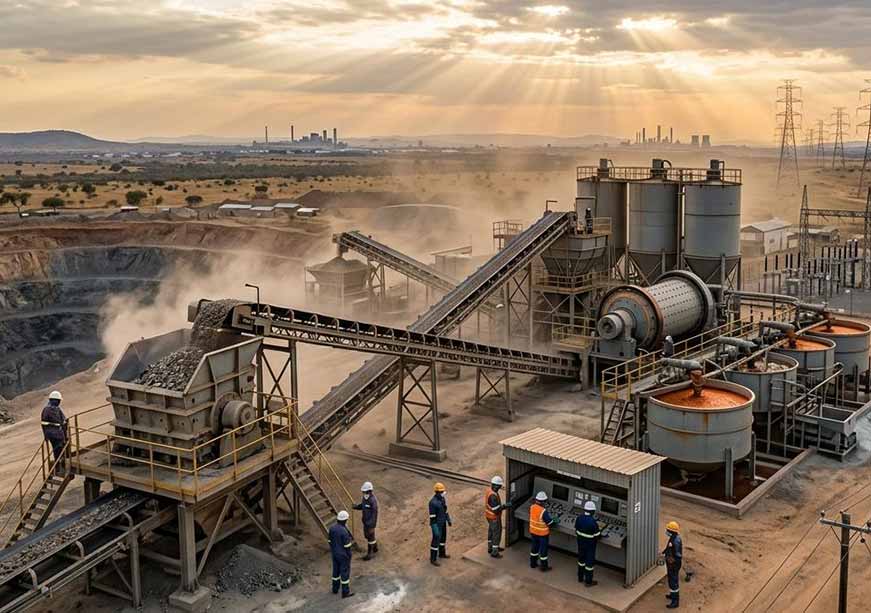

Image Source: ChatGPT
Negative headlines about economic downturns, debt, and domestic unrest have dogged African countries even more than usual lately. Yet the more important story is not simply that Africa is under pressure, but that its crisis is uneven. Several economies, such as Kenya, Mozambique, and Uganda, are being weakened by debt, volatility, and political uncertainty, while others are building the industrial capacity, infrastructure, and financial tools needed to withstand the next shock. For partners such as India, whose commercial and development ties with the continent continue to deepen, that distinction matters.
The pressures are real. In South Africa, anti-migrant protest violence has dented the country’s claim to continental leadership. At the same time, Senegal’s President Bassirou Diomaye Faye has split with Ousmane Sonko and the former ruling Pastef party, ending a broad coalition in one of Africa’s most politically stable countries. Ethiopia faced a debt restructuring crisis after Addis Ababa defaulted on its US$ 1 billion Eurobonds, reaching only a preliminary agreement with creditors in June 2026 after more than two years of stop-start talks and disputes with the International Monetary Fund (IMF). Foreign direct investment into Ethiopia has stagnated below pre-crisis levels, while official development assistance to the region is falling sharply as the United States and other donors cut back, hitting fragile states hardest. However, these pressure points do not define the whole continent.
Building Resilience Through Industrialisation
Yet some countries have shown that industrial ambition, infrastructure investment, and regional positioning can still reverse the trend. These are the countries that India and other external partners should not overlook.
For example, despite the difficulty in financing mega-projects, industrialisation has not stalled everywhere. Nigeria’s Dangote Group offers one such counter-example. Over three decades, Aliko Dangote has built a platform spanning cement, sugar, fertiliser, logistics, power, and petroleum refining, all aimed at replacing import dependence with domestic production.
The model challenges the assumption that African economies remain trapped as raw commodity exporters, exposed to geopolitical and price shocks.
The Dangote Refinery in Lekki is designed to end Nigeria’s paradox of exporting crude while importing the fuel it consumes. The model challenges the assumption that African economies remain trapped as raw commodity exporters, exposed to geopolitical and price shocks.
The regional spillover effect is just as important. Kenya has secured a proposed Dangote refinery at Lamu worth US$ 16 billion, drawing on the Lamu Port–South Sudan–Ethiopia Transport corridor and expected to supply fuel to Kenya and neighbouring markets. In parallel, Dangote’s talks with the Tanzanian government have encompassed port development, road access, a special trade zone, energy generation, fertiliser production, and transport infrastructure in the south.
Implications for India
For India, this shift towards domestic value addition creates an opportunity beyond conventional export markets. Indian companies can participate not merely by supplying African countries with finished goods, but by investing in producing those goods within Africa. Engineering, pharmaceuticals, fertilisers, agro-processing, renewable energy, logistics, and financial services are sectors where Indian capabilities can complement Africa’s industrial ambitions. Such partnerships would also align with the broader shift in India’s Africa policy from trade-led engagement towards investment, technology transfer, and local value creation.
For India, this shift towards domestic value addition creates an opportunity beyond conventional export markets.
These projects take root where governments have a long-term vision for change. In Tanzania, after finishing a digital connectivity project worth US$ 189 million in 2012, President Samia has committed an additional $48 million in 2026 to lay the national fibre optic network and is pushing to strengthen regional connections through roads, rail, and ports. Combined with a drive towards domestic refining and processing, this strategy gives countries a practical foundation for resilience and self-sufficiency. As global powers reassess their trading partners amid heightened geopolitical tensions, that capacity is becoming increasingly valuable.
The push towards local processing is particularly significant for India as it seeks to diversify its critical-mineral supply chains. Indian engagement in Africa’s mineral sector should therefore move beyond securing raw materials towards investment in processing and refining, allowing African producers and Indian manufacturers to participate in higher-value segments of the same supply chain.
Indian engagement in Africa’s mineral sector should therefore move beyond securing raw materials towards investment in processing and refining, allowing African producers and Indian manufacturers to participate in higher-value segments of the same supply chain.
The African Continental Free Trade Area (AfCFTA) further strengthens this proposition. For Indian investors, the attraction of African manufacturing is no longer limited to individual national markets. Companies that establish production bases in strategically located economies can leverage them as platforms to reach wider regional markets.
Financing the Next Phase of Growth
Financing remains the harder problem. Industrial ambition at scale still runs into a financing environment that is, at best, uneven. More than half of low-income countries in sub-Saharan Africa are already in debt distress or at high risk of it, and Ethiopia’s drawn-out restructuring is a stark reminder of how long a resolution can take once a country is in default.
Some governments are responding by diversifying financing rather than simply absorbing the shock. In July, Tanzania issued its first-ever offshore Tanzanian-shilling-denominated bond, listed in London and backed by the International Finance Corporation (IFC). The US$ 100 million issuance is being channelled through National Microfinance Bank (NMB) to expand lending to small and medium-sized enterprises. This creative model could be emulated elsewhere.
Africa’s economic crisis is neither universal nor permanent. Several economies are building the industrial and financial architecture needed to withstand future shocks.
External shocks like war in the Middle East continue to test economic resilience. Yet an important divide remains. This volatility is eroding some countries, while others are doubling down on domestic capacity. In a fragmented world, that capacity will prove a strength as external partners seek to diversify supply chains and reduce exposure to geopolitical shocks.
Africa’s economic crisis is neither universal nor permanent. Several economies are building the industrial and financial architecture needed to withstand future shocks. For India, the opportunity lies not in replicating any other model but in building partnerships that align with Africa’s own industrial ambitions.
Samir Bhattacharya is an Associate Fellow at the Observer Research Foundation.
The views expressed above belong to the author(s). ORF research and analyses now available on Telegram! Click here to access our curated content — blogs, longforms and interviews.