
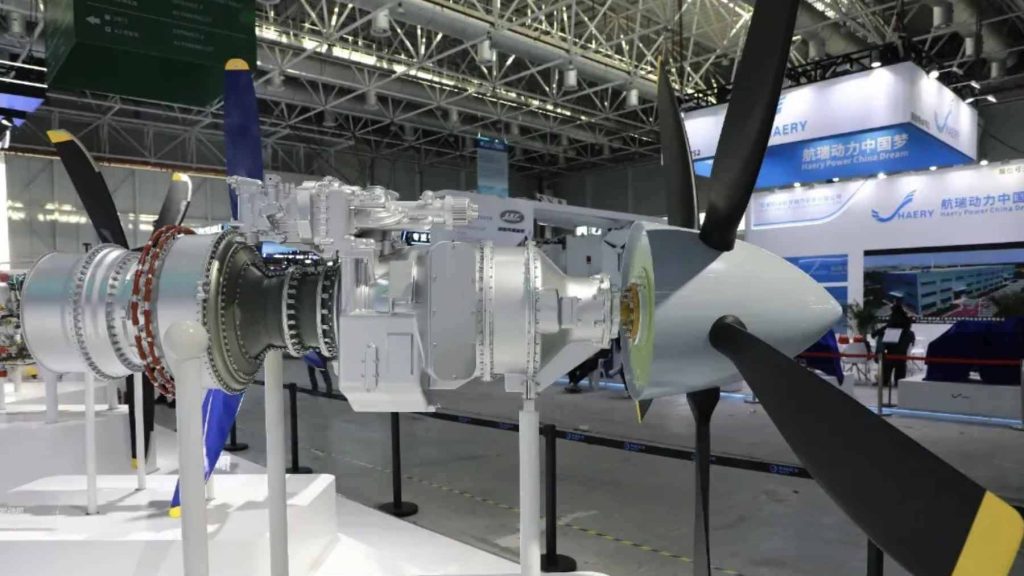
While much of the world is still wrestling with oil shocks, China has put a very different kind of aircraft into the sky. On April 4, 2026, a roughly 16,500-lb. unmanned cargo plane lifted off from Zhuzhou, in central China’s Hunan Province, using the AEP100, a megawatt-class hydrogen-fueled turboprop developed by the Aero Engine Corporation of China.
The flight was short, but not meaningless. The aircraft climbed to about 984 ft., covered 22.4 miles at roughly 137 mph, and landed safely 16 minutes later with the engine operating normally throughout the test.
That does not make hydrogen aviation ready for your next vacation flight, but it does move one big idea from the lab into the air.
Not powered by water
There is already a tempting phrase floating around this kind of story, the “water-powered plane.” It sounds great, and it is easy to remember. It is also not quite true.
The aircraft did not take water from a tank and magically turn it into flight. It used liquid hydrogen, a fuel that contains no carbon, so the engine does not release carbon dioxide from burning the fuel itself.
This was combustion, though, not a fuel cell, so experts still have to watch for nitrogen oxides that can form at high temperatures.
The cleanest version of this story depends on how the hydrogen is made. When hydrogen comes from renewable electricity and electrolysis, often called “green hydrogen,” the climate benefit is much stronger. When it comes from fossil fuels, the math gets messier very quickly.
Why the turboprop matters
The AEP100 is different from the hydrogen fuel-cell systems being tested for some electric aircraft concepts. It burns hydrogen directly inside a turbine cycle, then uses that power to spin a propeller.
In practical terms, that makes it interesting for cargo routes, island logistics, and regional service, where reliability and operating cost matter more than headline-grabbing speed. Think less sleek jetliner, more hard-working delivery truck in the sky.
The hard part is the fuel. Liquid hydrogen must be stored near -423°F, and that means insulated tanks, careful fuel flow, thermal control, and stable combustion.
A 16-minute flight proves something important, but it does not yet answer the daily questions airlines and freight operators care about, such as maintenance, durability, safety checks, and cost per trip.
Oil pressure in the background
The timing is hard to ignore. In March 2026, the International Energy Agency said its 32 member countries agreed to make 400 million barrels of emergency oil reserves available to the market because of disruptions linked to the Middle East conflict.
That kind of shock does not stay inside government reports. It can ripple into shipping rates, ticket prices, military logistics, and the everyday cost of moving goods around the world.
Aviation is especially difficult to clean up because batteries remain too heavy for many longer or heavier flights. The IEA says aviation accounted for 2.5% of global energy-related CO2 emissions in 2023, with emissions reaching about 1.05 billion tons of CO2.
China’s longer road map
China’s broader hydrogen aviation plan was laid out in a peer-reviewed paper by Jun Cao, Wei Li, and colleagues from AECC’s Hunan Aviation Powerplant Research Institute. The paper points to key technology validation by 2028, use in regional aircraft by 2035, and broader commercial aircraft use by 2050.
The authors do not present this as an easy switch. They list major barriers including aircraft-engine design, onboard liquid hydrogen storage, precise hydrogen control, thermal management, low-emission combustion, airport infrastructure, and standards regulators can trust.
Put simply, the engine is only one piece of the puzzle. A hydrogen aircraft also needs safe tanks, reliable refueling, trained maintenance crews, emergency procedures, and airports that can handle an extremely cold fuel without turning a normal turnaround into a science project.
Airbus is choosing another path
China’s test also highlights a split in hydrogen aviation strategy. Airbus says it selected hydrogen fuel-cell technology in 2025 for its future ZEROe aircraft concept, using fuel cells to make electricity for propellers instead of burning hydrogen in a turbine.
Airbus has already powered on a 1.2-megawatt fuel-cell demonstrator on the ground, and it says more than 220 airports have joined its Hydrogen Hubs at Airports effort. That program is studying how hydrogen could be produced, liquefied, stored, transported, and distributed for future flight.
So which approach wins? For now, the answer is still in the air (no pun intended). Fuel cells may offer cleaner operation at the point of use, while hydrogen combustion may fit more naturally with existing turbine know-how and higher-power aircraft needs.
Cargo may go first
Chinese experts cited by Xinhua pointed to early uses in the “low-altitude economy,” including unmanned air freight and island logistics, before any gradual move into regional and mainline aircraft, a plan that makes sense.
Passenger certification takes years, and no one wants experimental cryogenic fuel systems rushed into crowded airports full of travelers, luggage carts, tight schedules, and bad coffee. Cargo routes are simpler places to learn.
A freight corridor can be controlled more closely. Refueling can start at fewer locations, flight patterns can be repeated, and operators can collect data without immediately taking on the full complexity of passenger airline service.
A short flight with a long question
This test flight did something simple but important. A heavy unmanned aircraft took off, flew a planned route, and returned safely using hydrogen instead of conventional jet fuel.
Still, the future depends on what happens next. Green hydrogen has to get cheaper, cryogenic storage has to become practical, airports need new systems, and regulators will need proof that the technology is safe flight after flight.
That is the real test. Not one clean demonstration, but making hydrogen aviation boring enough to work every day.
The official report was published on Xinhua.