
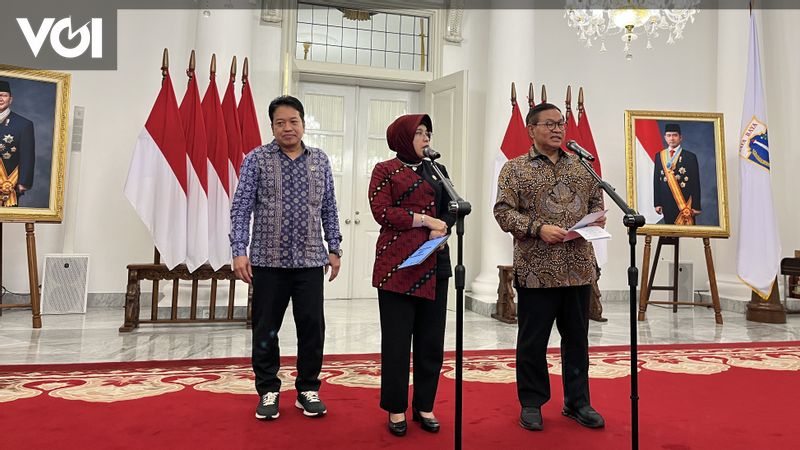
JAKARTA – The Central Statistics Agency (BPS) DKI Jakarta recorded that there were still 211 slum residents (RW) in the capital in 2026 out of a total of 2,759 RW. Although the number has decreased compared to several years ago, slum settlement points are still concentrated in densely populated areas.
DKI Jakarta Governor Pramono Anung said that the number had decreased significantly compared to 2017 which reached 445 RW. However, this shows that the problem of overcrowding in Jakarta has not been completely resolved.
“So, there is a decrease in slum RW from 445 in 2017 to 211 this year. The decrease is approximately 52.58 percent. So, if you want to see it simply like this, in one year of my administration and a little more, now it is 211 RW,” said Pramono at the DKI Jakarta City Hall, Wednesday, May 6.
Pramono considers the decline to be quite significant, even though it is not entirely claimed as the result of his government’s work. According to him, the challenges in the field are actually becoming more complex as the population grows.
“I don’t want to claim that it is all the result of what we have done, but if you look at the development of the population increasing, then the problems of the field are also getting more complex, there is a decrease of almost 52 percent more according to me it is a remarkable thing and I am grateful for it,” said Pramono.
The DKI Provincial Government is now prioritizing the handling of slum RW in high-density areas. West Jakarta and North Jakarta are the main focus because the number is the most.
“In the West there are the most and it is indeed in the field that almost all RW, almost all villages I have been around from 267, indeed some of them in the West, especially, for example, in Tambora and so on (slums) and we will go down for that,” he said.
Meanwhile, the head of BPS Amalia Adininggar Widyasanti explained that the method of data collection for slum RW has now been updated to be more accurate. In addition to direct surveys, BPS has begun to use satellite image technology.
“So the point is that we use two approaches, the approach of direct data collection in the field, plus calibration through satellite image methodology,” said Amalia.
In the future, BPS together with the DKI Provincial Government will continue to verify the other 1,904 RW with a similar method to update the settlement map in Jakarta.
The determination of the slum area itself is not only seen from the condition of the building, but also environmental and sanitation aspects. BPS uses 11 indicators, ranging from population density, building density, construction of residential buildings, ventilation and lighting conditions of residential buildings, latrines, waste disposal methods, waste transportation frequency, neighborhood road conditions, public street lighting, and building layout.
“So the essence is the squalor of an RT which we will later aggregate into a slum RW, not only from the shape of the building and the density of the building and the condition of the building’s eligibility, but also from the condition of the environmental and sanitation facilities,” he concluded.
The English, Chinese, Japanese, Arabic, and French versions are automatically generated by the AI. So there may still be inaccuracies in translating, please always see Indonesian as our main language.
(system supported by DigitalSiber.id)