

We’re genuinely delighted to be here and personally, I’m very happy that we’ve been able to see your ship in person. Seeing the vessel up close, and really feeling its scale, has been a wonderful experience. If we step back and look at travel in Japan broadly, Japan’s tourism industry was strongly affected by COVID-19. And yet, inbound travel has since surged to record levels. By the end of this year, Japan is expected to welcome roughly 40 million visitors. Japan is often described as one of the most popular destinations in the world. Do you believe Japan is, in fact, one of the most attractive destinations for travelers worldwide?
Yes, I do, and I believe there are three major reasons Japan is so attractive as a travel destination. First, Japan is safe and clean, and public transportation is extremely accurate and punctual. For travelers especially first-time visitors this creates a strong sense of reassurance. People can move around smoothly, with less anxiety, and simply enjoy the journey.
Second is diversity. The culture, food, and scenery vary significantly from region to region. Within one country, travelers can have completely different experiences so Japan can feel like many journeys even in a single trip. Third is Japan’s hospitality culture, which we call omotenashi. It is not necessarily “special service” in a luxurious sense. Rather, it is service provided with travelers in mind, so that visitors can travel with confidence and enjoy the experience comfortably, in a way that feels natural and thoughtful.
For a ferry company like ours, we also believe we can help convey Japan’s appeal by making the act of travel itself comfortable and memorable. In other words, not just getting people from one place to another, but making the travel itself part of the experience, something visitors will remember as a meaningful part of their trip in Japan.
When inbound travelers visit Japan, many people follow the same route, typically through major cities such as Tokyo, Kyoto, and Osaka. Japan, however, is exceptionally diverse, from the winter landscapes of Hokkaido in the north to the tropical climate of Okinawa in the south. Yet, many inbound travelers still visit the major cities, then return home. We believe your company is in a position to break that “standard route” and create new patterns that bring more visitors to regional areas. What is needed to attract more tourists to regional destinations, and what role do you think your company can play?
I believe each region already has its own charm. In fact, the appeal is already there. The issue is not that regional Japan lacks attractions; it is that those attractions are not being communicated widely or strongly enough, particularly to international audiences.
Regional areas have beautiful nature, historic townscapes, and distinctive local food cultures. I believe these are especially appealing to travelers from Europe and North America, who often place a high value on authenticity, heritage, and place-based experiences.
What we, as a hospitality company, can do is lower the “hurdle” of reaching those regions. A ferry is transportation, but it is also part of the trip. Because guests can enjoy the process of moving, watching the scenery change and spending time at sea, they can begin to feel the charm of regional Japan even before they arrive. The journey itself becomes a way of discovering Japan, not merely transportation.
You mentioned the Tokyo–Kyoto–Osaka route as the “Golden Route.” We refer to what we want to build as a “Western Japan Golden Route.” We would like to spread that concept more widely, positioning travel from Osaka to Kyushu as a compelling and recognizable domestic route.
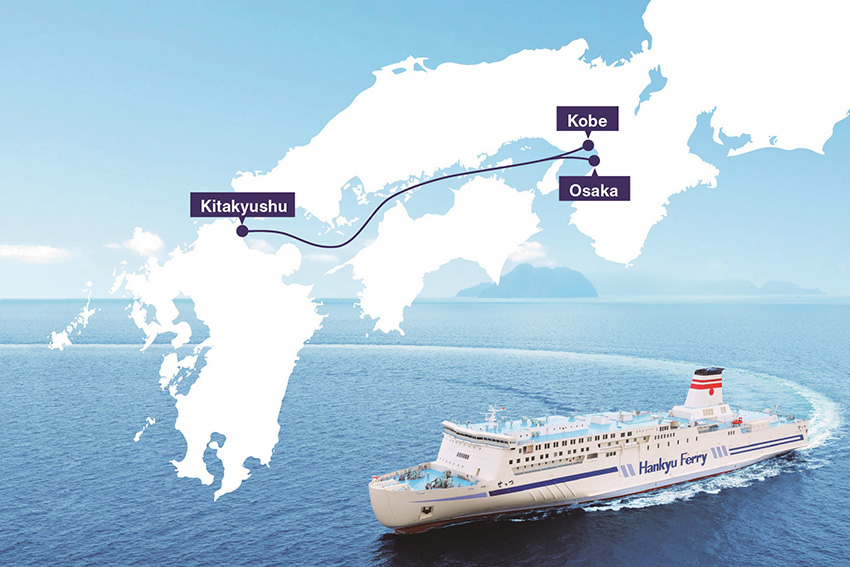
Navigation Route
Hankyu Ferry connects Kobe and Osaka in the Kansai region with Kitakyushu in northern Kyushu, Fukuoka Prefecture. Kitakyushu is known for its rich food culture and sightseeing destinations such as Mojiko and Kokura Castle. All ferries depart at night and arrive early the following morning after a 12-hour-and-30-minute voyage. Guests can enjoy the scenery of the Seto Inland Sea, dine onboard, relax in the bath facilities, and sleep comfortably in bed, making the journey feel as though it passes in no time before reaching their destination by morning.
Turning to services for inbound travelers: the people who use your services: are increasingly diverse. They may include families, travelers who need physical assistance, women traveling solo, and travelers with dietary or religious restrictions. For example, Muslim travelers may not be able to eat certain foods. Since inbound travel has increased considerably after COVID, we imagine more international visitors are using your services. In that environment, have you adapted your services since COVID to better serve a wider range of travelers?
Yes. First, in terms of inbound trends, we estimate what we call our inbound customer ratio. In fiscal year 2024, it was 4.2%, and in fiscal year 2025, it rose to 5.7%, so it is increasing steadily. We believe it will likely continue to rise. By country or region, our inbound customers are primarily from Australia, South Korea, Taiwan, and China.
As for supporting a wide range of travelers, one key area is reducing language barriers. On board, we are making efforts such as posting displays in multiple languages and using translation devices, so that guests can understand guidance and information more easily. The goal is to remove language barriers as much as possible and enable international visitors to feel comfortable and confident while using our services.
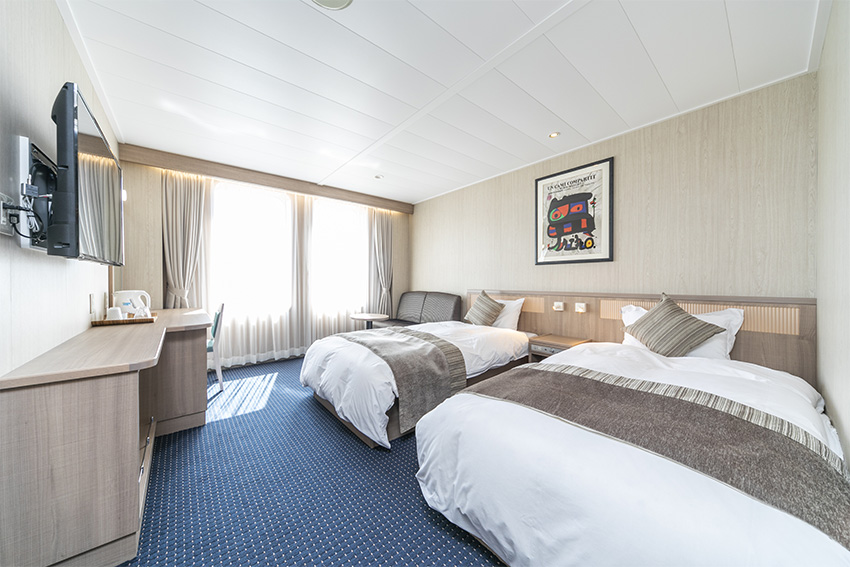
Guest Room Suite
We are also seeing a broader “slow travel” movement, where instead of simply taking the Shinkansen straight to a destination, travelers want to enjoy the journey itself and treat the route as part of the experience. Your company also communicates, including through catalogs, not only where people can go but what they can experience, what they can do, and what they can see once they come on board. For people planning to visit Japan and considering slow travel, what kinds of experiences can they enjoy on board a ferry? And what kinds of experiences might they miss if they travel only by Shinkansen?
If we focus on the on-board experience, I believe time spent at sea is, in itself, a special experience, something difficult to replace with any other form of travel. To help guests enjoy that, we open the deck so people can experience the sea directly. We also provide a viewing lounge beneath the bridge where guests can enjoy the voyage from a perspective close to the captain’s eye level. They can feel the motion of the ship, watch the route ahead, and enjoy the sense of traveling across the sea. The Seto Inland Sea is known for its calm waters and minimal waves, so there is little concern about seasickness, and at times guests may even forget they are traveling on a ship.
In addition, although it is not held regularly, we sometimes hold light music performances by amateur musicians. We also occasionally host small concert-style experiences on board, so that guests can enjoy music as part of their journey.
And what we are particularly confident in is our food. Many guests feel that dining on board is a meaningful experience, something they don’t often have the chance to enjoy in this way. We would truly like people to come aboard and experience it for themselves at least once.
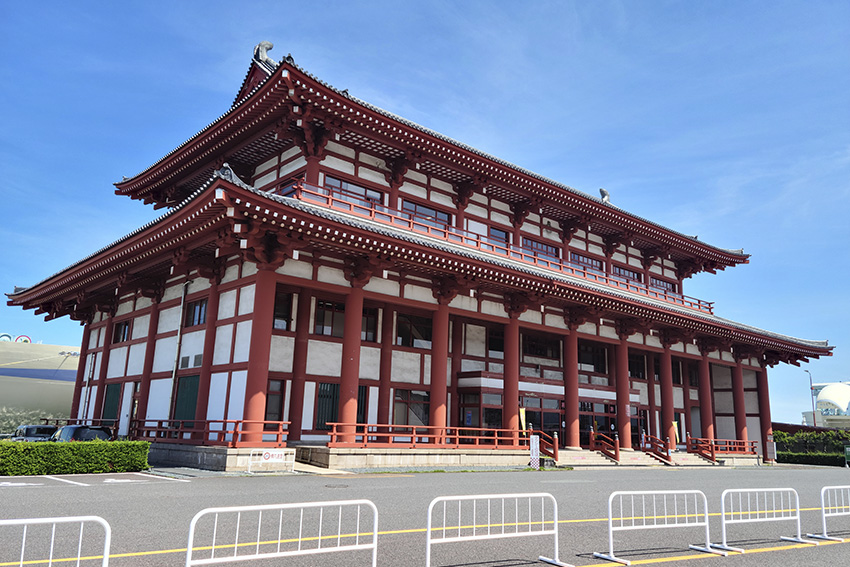
Hankyu Ferry Head Office
Are there any recommended meals you would suggest we should try?
We offer sashimi on board as a normal menu item. Guests can enjoy that without it being treated as something unusual.
Also, each vessel creates original products and menu items. We have four ships, and there is a healthy competition among them. Rather than naming one single best dish, the reality is that the focus changes by season. Each ship develops special seasonal menus, so the “highlight” evolves throughout the year, depending on timing and the specific vessel.
I’d like to ask about the bath experience as well. This seems to differ across the four ships, but guests can enjoy both indoor and outdoor bathing experiences. We find it particularly unique that you have not only a large communal bath, but also an open-air bath. Could you tell us how you think about the bathing experience, and what you are offering on board?
First, the large communal bath is designed as a panoramic bath with an outside view so you can bathe while looking out at the scenery.
We also have an open-air bath. To our knowledge, among Japanese ferry operators, this is an original feature unique to our group, the SHK Line Group. In addition to the Hankyu Ferry, it includes Shin Nihonkai Ferry and others, and we believe the open-air bath is a distinctive offering of our group.
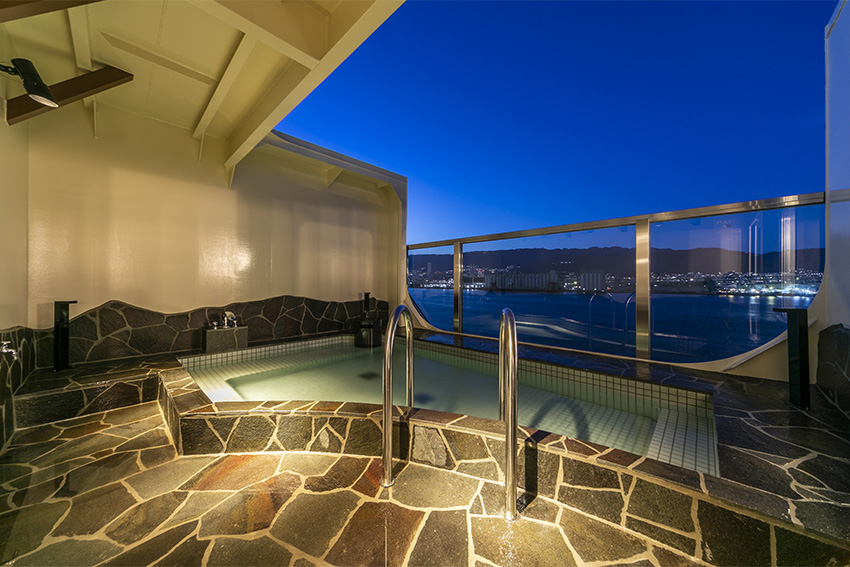
Open Air Baths
You mentioned earlier that inbound customers increased from 2024 to 2025 by 1.5 percentage points. The Japanese government has set a goal of welcoming 60 million inbound visitors, and there is also a national goal to increase inbound spending, positioning tourism as a major economic driver. In that context, as inbound travelers increase, does your company have a target inbound percentage? Or are you considering strategies to attract more inbound customers?
We do not have a specific numerical target defined as a company. However, I think it is possible that our inbound ratio could rise to around 10%.
We absolutely welcome international customers. However, there are cultural differences, and sometimes friction arises between foreign and Japanese customers regarding manners and behavior in shared spaces.
So along with welcoming more inbound travelers, we also want to work on improving their understanding of manners and encouraging good shared-space behavior, so that both Japanese customers and international customers can have a comfortable experience.
We have heard similar perspectives in other interviews. Shifting to another topic, through your partnership with Wärtsilä, you are implementing advanced maintenance support systems. How do you view this partnership and its contribution to vessel operations?
We have signed an OMA (Optimized Maintenance Agreement) with Wärtsilä for two vessels equipped with Wärtsilä engines: Settsu and Yamato. Through this partnership, operational data is monitored in real time to support safe and stable vessel operations. We believe this system enhances reliability and helps ensure a high level of safety for both our vessels and passengers.
Returning to booking, in the B2C world we see that the traditional approach to booking hotels and transport through agencies is declining. People increasingly search using AI tools, including GPT. In addition, major travel agencies and OTAs can charge high commissions. From your company’s perspective, do you plan to expand direct booking? And are you looking for new overseas partners through business alliances?
We are currently working on improving and rebuilding our website so that translation can be handled more effectively, potentially using tools such as GPT. If we can do that well, we will be able to exchange emails with customers more smoothly and in a more timely manner, accept reservations directly, and handle booking communications better. We are in the middle of those improvements now.
At the same time, we also recognize that OTAs remain important. We do not have enough overseas channels on our own, so we do want to expand by signing contracts and broadening distribution through those partners as well. In short, we want to strengthen direct booking capability while also expanding through oversea partnerships. We want to continue improving so we can create new partnerships.
I’m personally interested in vessel lifespan. You have relatively new ships, and you are introducing AI-based predictive maintenance, which might extend service life. How long can your current ships realistically remain in service?
There is a statutory service life for vessels, and that is 15 years. However, in practice, many ships operate beyond that. Using a vessel for more than 20 years has become common. I believe our current ships can likely operate for 20 years or more, and we are making efforts to ensure they can be used safely, reliably, and effectively for that duration.
Finally, on behalf of our readers: I’d like to ask a slightly different question a leadership question. You mentioned earlier that it has not been very long since you became president in this industry. During your time as president, what goals would you like to achieve? Before you pass the baton to the next generation what would you like to have accomplished before that day comes?
Life on board is comfortable, and I feel the appeal of ferry travel very strongly. At the same time, I don’t believe that this appeal has been communicated sufficiently to the broader public yet. When people ride a ferry even once, they often tell us, “It was wonderful,” or “It was better than expected.” That is exactly why I want to communicate the appeal properly and more widely and create more opportunities for people to actually come on board and experience it themselves.
As a concrete approach, for example, I want to increase opportunities for elementary and junior high school students to experience coming onto the ship, touring it, and learning through direct experience. I believe creating those opportunities can help broaden understanding of ferry travel and make it feel more familiar.
In addition, we are also pursuing sponsorship activities. We refer to it as “kenshō,” like the prize banners displayed in professional sumo. We are engaging in that type of sumo sponsorship as well. Through these efforts, we want people to feel that Hankyu Ferry is closer to them, more familiar, more approachable, and easier to choose.
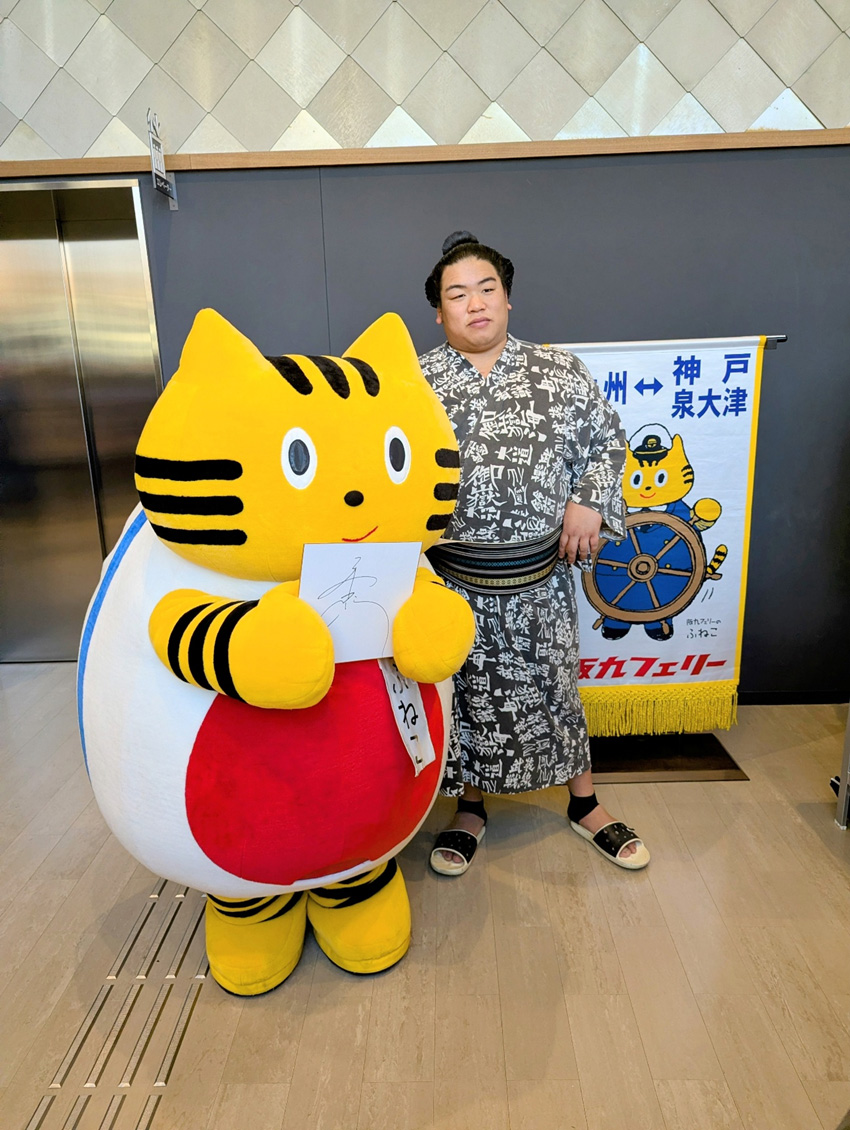
Hankyu Ferry’s mascot with a sumo wrestler
For more information, visit their website at: https://www.han9f.co.jp/en/