
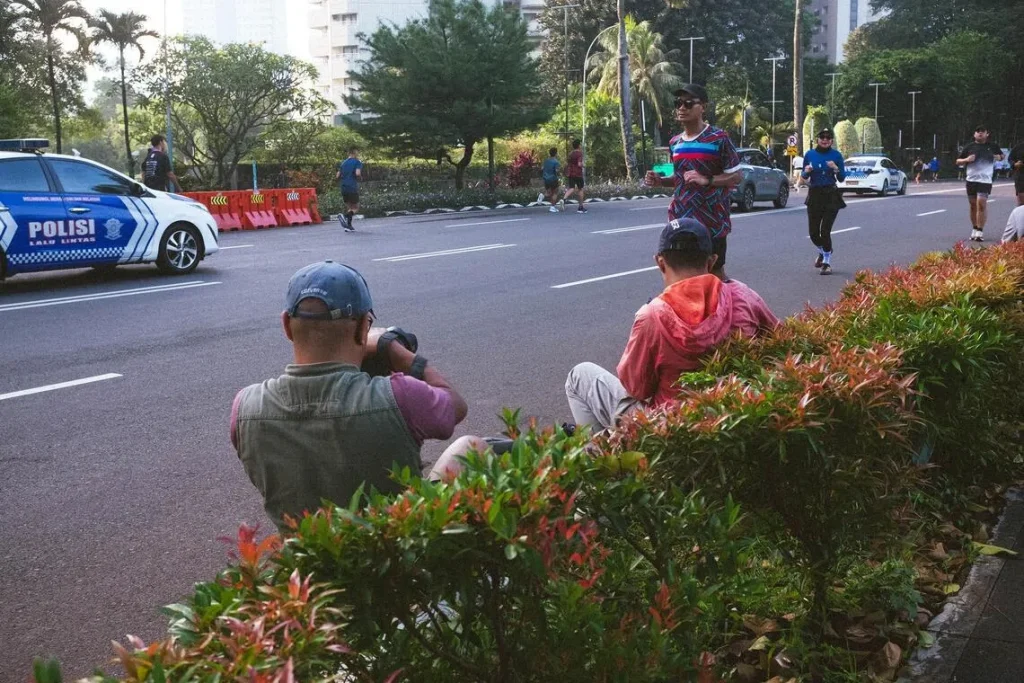
JAKARTA – In Jakarta, where well-maintained pavements are scarce, runners flock to a handful of pedestrian-friendly enclaves – from the Gelora Bung Karno multi-purpose complex in upscale Senayan to townships just outside the city, like Bintaro Jaya and Bumi Serpong Damai.
And where runners congregate, so do photographers.
Walking around Gelora Bung Karno on a weekend morning or a weekday evening, you’d be forgiven for thinking that a celebrity is expected to pass by, judging by the photographers flanking the pavements every few hundred metres or so.
But these are not paparazzi. The photographers line preferred running routes to capture ordinary joggers – then sell the images back to them for anywhere between 50,000 rupiah (S$3.80) and 100,000 rupiah apiece – fuelling a post-Covid-19 pandemic gig economy.
This type of photography has become so popular that in 2022, Indonesian AI start-up Supergiga launched Fotoyu, an app that uses face recognition to help users find and buy photos of themselves uploaded by street photographers. Individual photos typically cost 30,000 rupiah to 80,000 rupiah each, while full sets from a single photographer can go for 150,000 rupiah to 450,000 rupiah, depending on the location and the number of photos.

Street photographers taking photos of runners in Bintaro Jaya, a township just south of Jakarta that is a popular spot for runners.
ST PHOTO: KARINA TEHUSIJARANA
As I walked along the pavements outside the Gelora Bung Karno complex one Friday morning, I counted at least six photographers along a 1.5km stretch. Inside the complex, there were at least three times that number.
Their appearance and equipment varied. Some looked like seasoned professionals, wearing colourful vests displaying their Instagram handles and wielding expensive, long telephoto lenses. One had even set up a strobe light on a stand at a bus stop. Others seemed more like hobbyists, using smaller mirrorless cameras.
Sports medicine doctor Monica Rosandi, 34, who has been running since 2022, said the area gets even more crowded on Sundays. An avid runner in the neighbourhood, she is a familiar face to some of the photographers, who greet her by name as she jogs past.
“I haven’t installed Fotoyu because I’m afraid I’ll end up spending more money,” said Monica with a laugh. She has bought several sets of photos of herself, usually paying around 100,000 rupiah to 200,000 rupiah each time.
Around an hour after I left the area, I checked Fotoyu and found that dozens of photos of myself had already been uploaded. But I didn’t buy any because the “action” photos weren’t tempting enough.

A screenshot of the photography app Fotoyu, which uses face recognition technology to allow users to find and buy photos of themselves uploaded by street photographers.
ST PHOTO: KARINA TEHUSIJARANA
Photographers are a common sight at marathons around the world, where participants often pay for official race photos. But setting up along public running routes to shoot and sell images directly to joggers appears to be a largely Indonesian phenomenon – one that took off during the Covid-19 pandemic.
Mr Basuki, 39, who like many Indonesians goes by one name, had been a wedding and event photographer. When the pandemic hit, his gigs dried up. Living in Bintaro Jaya, he noticed quiet roads filling with runners and cyclists.
“So I started going out to take photos,” he said. Today, it is his full-time job.
“I’ve already forgotten how to pose people for photos,” he said. “This is easier because you don’t have to direct people.”
Mr Hadi Pranoto, 35, has a similar story. Before the pandemic, he worked mainly as an event photographer, covering corporate functions and the occasional wedding. Nowadays, he heads to Gelora Bung Karno as often as five days a week.
“Most of my other gigs are referrals from people I photograph on the street,” he said.

Street photographers line the area around the Gelora Bung Karno sports complex in the Senayan area of Central Jakarta.
ST PHOTO: KARINA TEHUSIJARANA
At first, photographers like Mr Basuki and Mr Hadi would advertise their work by posting photos on Instagram, with a link to a Google Drive where runners could look through and find their photos. No doubt the advent of Fotoyu has made it easier for him to reach new customers – the trade-off being that the app takes a 15 per cent cut of the earnings.
“I charge 50,000 rupiah per photo if customers buy from me directly, 60,000 rupiah per photo on Fotoyu,” he noted.
The popularity of “running photography” stems from Indonesians’ inherent friendliness and love of being photographed, according to Dr Monica.
“We like taking pictures. We like our pictures being taken. I think we’re just generally friendlier,” she said.
But not all Indonesians are on board with this type of unsolicited photography. In October 2025, an X post documenting this phenomenon by Mr Ismail Fahmi, founder of social media monitor Drone Emprit, went viral, drawing support in favour of privacy concerns and starting a discussion on the matter.
“Photographed without permission, being used for face recognition without permission, it’s the perfect privacy violation combo,” one X commenter opined.
The post and ensuing debate led Fotoyu to introduce a feature allowing users to request their photos be deleted without the photographer’s approval.
Ms Tina, 41, a private sector employee who asked to be identified only by her nickname due to privacy concerns, is one runner who does not want to be photographed.
“I don’t really post a lot about my private life and I don’t like (having) my photo taken,” she said. “So when I pass by photographers, I usually cover my face or ask them not to photograph me.”
Still, she said she is not overly bothered by the photographers along her usual running route in Gelora Bung Karno.
“They understand when people don’t want to be photographed,” she said.
Mr Sakti Pujo Asmoro, 48, the head of a street photography community in Bintaro Jaya called BinLoop Graphers, described the online reaction as a bit of a storm in a teacup.
“Of course, some people don’t want to be photographed, but in my experience it’s maybe only 1 per cent of all passers-by,” he said.
My own experience bears this out. During the three hours I spent walking along one of the frequented thoroughfares in Bintaro on a Saturday morning, none of the passers-by seemed put out by the presence of photographers. Many posed gamely for the cameras, with peace signs and wide smiles.
Mr Sakti attributed some of the concerns over privacy to the deluge of new photographers on the scene, including some who are not professional photographers with the proper ethics, such as respecting personal space.
Echoing the sentiment, Mr Hadi explained that experienced photographers can usually tell when people don’t want to be photographed or approached, even without them saying so directly.
“Social media content about how you can make money from this kind of photography has drawn a lot of new people,” he said.
“Some of them are just trying (this) out and don’t really understand the ethics of photography, and just upload things willy-nilly.”
The influx of street photographers has increased competition and eroded individual sales, despite the sport’s rapid growth.
Mr Hadi said that when he started photographing runners in 2021, there would be 20 to 30 photographers around Gelora Bung Karno on weekends, and at most 60 along the Sudirman-Thamrin thoroughfare on car-free Sundays.
Post-pandemic, the number of street photographers in these favoured areas has increased fivefold, he noted.
The number of running events in Indonesia has surged in the past few years, from 88 in 2021 to 603 in 2025, according to GoodStats.id. Data from Garmin shows a similar trend, with active users on its Garmin Connect app rising from 35,000 in 2023 to 242,000 in 2025.
All four photographers who spoke to The Straits Times say their earnings have notably declined in recent years.

Members of the BinLoop Graphers photography community in Bintaro Jaya, a planned township just south of Jakarta that is a popular spot for runners.
ST PHOTO: KARINA TEHUSIJARANA
In 2021 and 2022, Mr Sakti said he could make up to 12 million rupiah a day selling photos of runners and cyclists.
“Sales started going down a lot in 2024, and even more in 2025,” he said. Now, he’s lucky if he takes home two million rupiah at the end of the day.
There are many more photographers jostling for sales these days, he said. And “regular runners are also getting a bit bored of buying photos”.
Dr Monica’s experience confirms this. She said that at first, she would feel bad if she didn’t buy any photos, and ended spending up to 400,000 rupiah a week sometimes.
“I wanted to appreciate the photographers’ effort. But after a while, I felt like I don’t need to buy every time.”
Despite the downturn, Mr Sakti said he still enjoys taking to the streets to get photos, even though it’s more of a side hustle for him as he runs his own advertising production agency.
“It’s nice to see the regulars, and watch them as they become more fit,” he said.
“When I started out, I met some people who would just run when they’re being photographed, and stop running after they get past the camera. Over time, those same people have turned into serious runners. So we’re like witnesses of their journey, in a way.”