
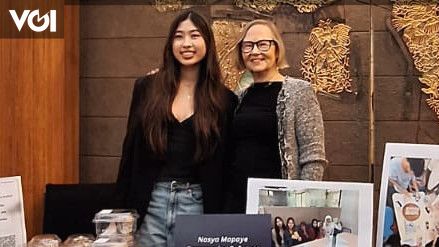
JAKARTA – Among the nine student projects presented at Jakarta Scholars Symposium (JSS) Volume V – Catalysts for Change, the booth marked “The Business Blueprint” drew some of the longest audience engagement at Soehanna Hall, Energy Building, SCBD. Behind it stood Nasya Mapaye, a student at Jakarta Intercultural School (JIS), who designed and facilitated a week-long entrepreneurship workshop specifically for refugee teenagers in Jakarta.
The initiative grew from Nasya’s awareness of a stark reality: approximately 9,000 refugee families in Indonesia spend years — sometimes decades — without legal access to employment or formal education. Rather than treating this as an impasse, she turned it into a starting point.
From the Classroom to a Real Business
The Business Blueprint was designed as an intensive one-week workshop, with curriculum deliberately tailored to participants’ legal constraints. The program goes beyond theory — it pushes participants to apply business concepts directly within the realities of their daily lives.
Core modules included:
• Shark Tank-style pitch analysis — training participants to present ideas concisely and persuasively
• Customer problem identification and basic cost and pricing calculations
• Building a simple brand identity: logo, slogan, and early packaging
• Accessible and practical marketing strategies
• Business communication in English to build participants’ confidence
By the end of the week, each team had produced a micro-business concept, a draft branding kit, and a short pitch presented to peers and mentors. Facilitators noted marked improvements in collaboration, self-confidence, and clarity of ideas among participants.
On the JSS Stage: From Talk to Mini Clinic
In her talk before the JSS audience, Nasya emphasized that dignity does not stem from rights alone — it also grows from agency. And agency, she argued, can begin with a small, safe, home-based business that operates within existing rules. The message resonated strongly with both participants and general visitors at an event often described as “like TED, but more impactful.”

After her session, The Business Blueprint booth transformed into an interactive mini clinic. Visitors sampled prototype products made by participants, scanned a QR code to access the full curriculum, and asked directly how to become a volunteer or sponsor. Photo documentation at the booth — from project boards and pricing exercises to early packaging designs — provided authentic visual proof of the learning journey that moved many in attendance.
Why This Matters Now
While Indonesia’s employment regulations for refugees have yet to see significant change, the entrepreneurial skills taught through The Business Blueprint can open small income pathways capable of stabilizing families. Beyond that, the training equips refugee youth with transferable soft skills — planning, teamwork, and pitching — that will remain relevant when opportunities for education or resettlement eventually open up.
“Dignity grows alongside agency — and agency can begin with a small, safe, home-based business that works within the rules.”
— Nasya Mapaye, Founder, The Business Blueprint
Next Steps: Scaling the Impact
Nasya has outlined a roadmap to grow The Business Blueprint into a more systematic and sustainable program:
• Expanding cohorts: partnering with community learning centers to run regular cycles themed around food, crafts, and digital services
• Micro-grants: providing small seed funding for the most business-ready ideas, supported by step-by-step mentoring
• Mentor network: recruiting Indonesian entrepreneurs and university clubs to coach branding, bookkeeping, and sales
• Open toolkit: publishing bilingual (Indonesian–English) worksheets so communities can run the program independently
How to Get Involved

Partners from the private sector, educational institutions, or individuals can contribute in three ways: host one workshop cycle, mentor one participant team, or fund a micro-grant. Each of these represents a concrete path to turning a student-led initiative into a lasting pipeline for refugee youth in Jakarta.
The English, Chinese, Japanese, Arabic, and French versions are automatically generated by the AI. So there may still be inaccuracies in translating, please always see Indonesian as our main language.
(system supported by DigitalSiber.id)