
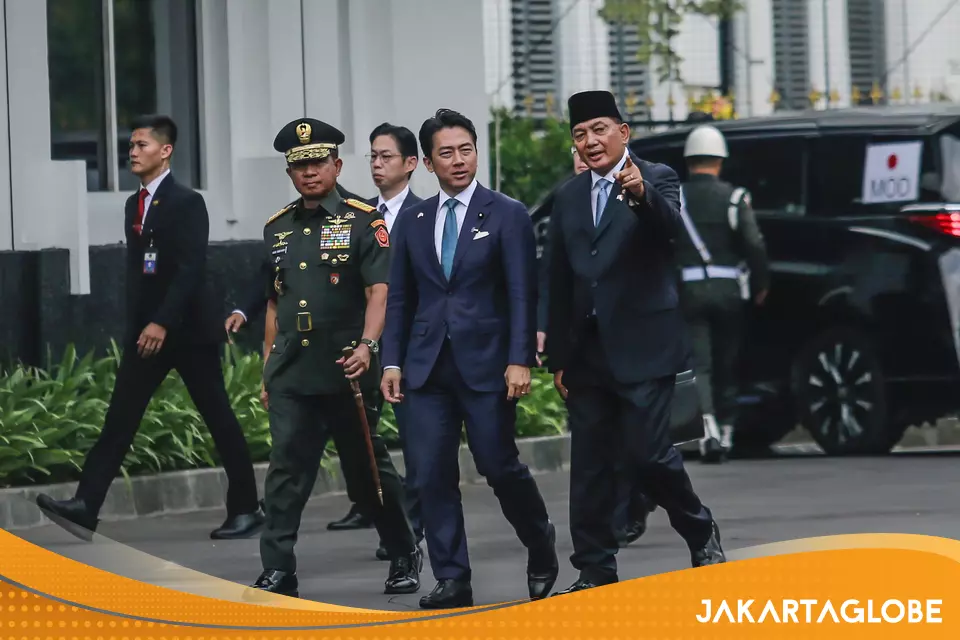
Japan’s Defence Minister Shinjirō Koizumi and his Indonesian counterpart Sjafrie Sjamsoeddin signed a Defence Cooperation Agreement (DCA) during the former’s visit to Jakarta in early May. Koizumi called it a ‘crucial milestone’ and a ‘compass’ for relations between the two countries.
It is hard to argue with that assessment. The DCA marks a quietly consequential moment for Indo-Pacific security and one that speaks directly to Indonesia’s wider strategic dilemma.
Reports of a recent proposal to grant US military aircraft blanket overflight rights over Indonesian airspace have fuelled mounting criticism that President Prabowo is trading Jakarta’s ‘free and active’ non-alignment in favour of closer ties with Washington.
While the government insists that no deal has been reached, Jakarta’s tilt toward Tokyo could be the more telling.
The Indo-Pacific region is becoming increasingly unstable. Chinese incursions in the South China Sea are increasing in both frequency and severity. North Korea continues to launch ballistic missiles into international waters at an alarming rate. Their coordination with Russia, meanwhile, is becoming ever more entrenched.
ADVERTISEMENT
Closer to home, Chinese vessels have repeatedly encroached on Indonesia’s exclusive economic zone in the North Natuna Sea. To some, Prabowo’s pivot toward Washington looks less like an abandonment of Indonesia’s principles and more like a pragmatic response to a deteriorating security environment.
Indonesia’s archipelagic geography demands a strong defensive posture. The country straddles the Strait of Malacca, the Indo-Pacific’s most critical chokepoint, through which 44.8% of energy imports pass annually. For Jakarta, securing these corridors is a matter of economic survival.
That, inevitably, requires capable partners.
However, deeper security cooperation with Washington does not, as recent events in the Gulf have acutely demonstrated, guarantee security. American commitments have proved to be subject to shifting priorities and, increasingly, to the temperament of President Donald Trump.
What Indonesia needs is a stable, capable partner. One that can take a more active role in regional defence without the political baggage that American alignment can carry.
Increasingly, that partner is Japan.
Under Prime Minister Sanae Takaichi, Tokyo is transforming its defence policy in ways that would have been unthinkable a decade ago. Japan is seeking to play a more proactive role in upholding the vision of a Free and Open Indo-Pacific (FOIP), a framework first articulated by the late Prime Minister Shinzo Abe.
Marking the tenth anniversary of FOIP this May, Takaichi emphasized that Japan would take on a more active role than ever before, supporting an international order based on ‘freedom’ and the ‘rule of law’. An order essential to protecting the region’s economic and energy security.
Japan recently deployed its largest-ever contingent to the multinational military exercise Balikatan 2026, alongside the US, Australia, the Philippines, and others. Particularly notable was Japan’s deployment of anti-ship missile capabilities – a pointed signal as China continues to intensify pressure across the South China Sea.
In April, Tokyo announced a historic reform to its defence export regulations. For most of the post-war era, Japan’s constitution ruled out the export of lethal weapons. Now, for the first time, Japan can export fighter jets, missiles, and warships to approved strategic partners.
Under Defence Minister Shinjirō Koizumi’s policy of ‘arms sale diplomacy’, technology and materiel will flow only to like-minded partners, with the explicit aim of strengthening the capacity of the region’s democracies to defend the Indo-Pacific against hostile encroachment.
Critically for Indonesia, deeper alignment with Japan offers a clearer path to immediate security gains at little diplomatic cost. Jakarta already holds a technology transfer agreement with Tokyo and is in talks for the joint development of Mogami-class frigates, with four vessels to be built in Indonesian ports. Japan has already signed contracts with Australia for these frigates in a $6.5 billion deal for eleven vessels, the largest defence export contract in post-war Japanese history.
Japan has also offered Jakarta Oyashio-class submarines, an offer confirmed by Indonesian Navy Chief of Staff Admiral Muhammad Ali in April and currently under review by the Ministry of Defence.
At their meeting in Jakarta, Koizumi and Sjafrie agreed to advance cooperation in defence equipment and technology with the explicit aim of enhancing maritime deterrence – a commitment now formalised in the DCA.
Cooperation with Tokyo would grant Indonesia, and most likely by extension ASEAN, access to one of Asia’s most sophisticated defence industries. Crucially, it would do so without the obligations of a formal alliance structure or the political exposure that comes with aligning with Washington.
Japan’s Free and Open Indo-Pacific vision operates as a flexible collective security architecture, one that accommodates the individual diplomatic circumstances of its partners rather than subordinating them to a single strategic agenda.
This flexible approach is particularly vital given Jakarta’s deeply entrenched institutional aversion to formal military alliances. However, navigating this ‘third way’ will not be without domestic friction. Critics in Jakarta will closely scrutinise whether deeper reliance on Tokyo’s military hardware inadvertently binds Indonesia to Japan’s own strategic anxieties regarding China.
To maintain its central position within ASEAN, Indonesia must ensure that this bilateral synergy complements, rather than undermines, regional mini-lateral frameworks. Jakarta must clearly signal to its Southeast Asian neighbours that embracing Japan’s arms sales diplomacy is a calculated move to bolster regional resilience, rather than an uncritical alignment with Tokyo’s broader geopolitical ambitions.
For President Prabowo, the benefits are becoming harder to ignore. Indonesia evidently seeks partners who can deliver capabilities without demanding diplomatic compliance.
Engagement with Japan could be the answer to this problem. A stronger partnership with Tokyo advances Indonesia’s strategic objectives while preserving its non-alignment credentials. It could secure the country without the political cost of being seen to have abandoned the principles that have defined Jakarta’s foreign policy since Sukarno.
—
Virdika Rizky Utama serves as Executive Director of the PARA Syndicate and is currently pursuing a doctoral degree in Political Science at the School of Social Sciences, Nanyang Technological University, Singapore.
The views expressed in this article are solely those of the author and do not necessarily reflect the positions of affiliated institutions.
Tags:
Keywords: