
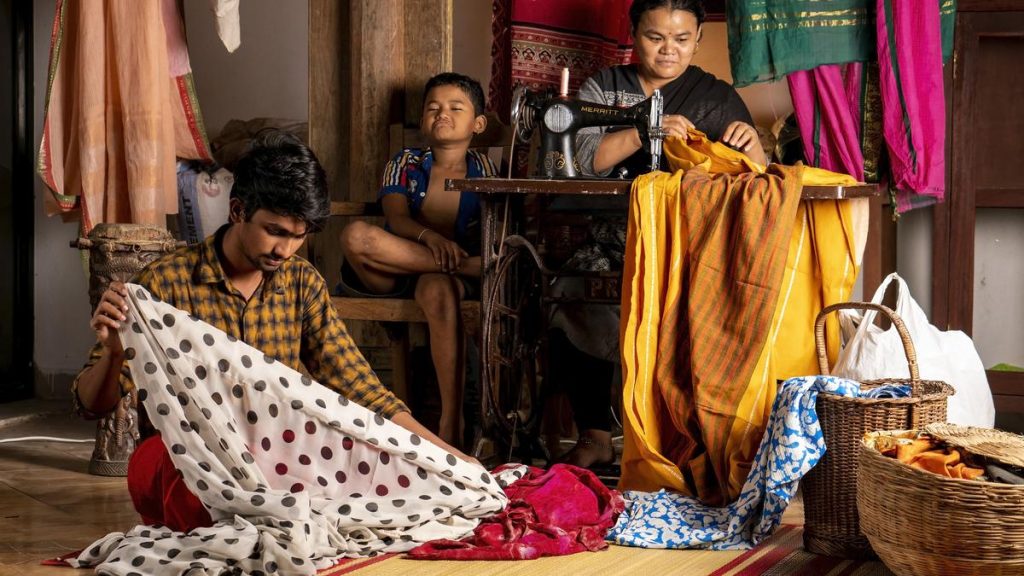
In today’s world fuelled by mass consumption, the art of upcycling is an important skill we must possess in order to create a circular and sustainable society. Bringing this vision to life are over 100 practitioners in the textile space at the upcoming Weave The Future, a national platform initiated by the Development Commissioner for Handlooms, Ministry of Textiles, in 2025.
Read more | An IT professional turned upcycling artist in Kerala is teaching India to rethink waste
The fourth edition of the event, themed on upcycling, aims at exploring and advance sustainable, circular, and craft-led approaches to everyday living. Shubhi Sachan, curator, Weave The Future, explains how visitors will experience repair, visible and invisible mending, thrift, upcycling, recycling, regenerative materials, community-led textile recovery, material innovations, and circular design practices. “The event also expands the conversation beyond garments to include footwear, accessories, buttons, trims, production waste, and other overlooked material streams,” says Shubhi, who is also the founder of Noida-based think tank Material Library of India (MLI). Through installations, workshops, exhibitions, and public engagement, the team hopes to shift the perception of textile waste from something to be discarded to something that still holds value and possibility.
Read more | An upcycling enterprise with an all-women workforce thinks out of the ‘bag’

A snapshot from an earlier edition of Weave The Future
| Photo Credit:
Special Arrangement
One of the event’s highlights is the Repair Fest (July 12-17) which will bring together some of India’s most skilled repair artisans and master darners who will demonstrate and undertake repairs of garments and other textile items brought in by visitors. “This is our largest edition so far and the first to occupy the entire Dilli Haat, INA. Since launching in 2025 under the guidance of the Development Commissioner for Handlooms, Ministry of Textiles, Weave The Future has evolved from a platform showcasing upcycling into a much broader public movement around material literacy, repair, circularity, regeneration, and responsible consumption,” says Shubhi, who says planning for the event has been underway for several months.

Products at an earlier edition of Weave The Future
| Photo Credit:
Special Arrangement
To encourage people to recognise the challenge textile waste poses, the team has developed Re-Stitch India, an initiative that brings together individuals, communities, artisans, designers, students, and organisations to express their solutions. “Every day, across homes, workshops, institutions, factories, and communities, textile waste is generated and forgotten. What if, instead of throwing it away, we stitched it back into something meaningful?” asks Shubhi. The team invited interested candidates across India to create a 1 metre x 1 metre textile panel using discarded garments, fabric scraps, surplus materials, production waste, or reclaimed textiles. “So far, we have received approximately 35 entries. Each panel will become part of a larger installation at Weave The Future, demonstrating how materials, stories, skills, ideas, and communities can be brought together through the simple act of stitching,” she says.

A snapshot from an earlier edition of Weave The Future
| Photo Credit:
Special Arrangement
Also part of the event is a series of workshops and installations. The former includes Mann ki Marammat (July 13 and 17), a hands-on workshop in collaboration with New Delhi’s Rafooghar that will use fabric as a medium to explore ideas of ‘rupture, repair, and resilience’; Fibre to Paper (July 15) with the Elephant Poo team, wherein participants will create tree-free paper from discarded textile fibres, among others. Installations include Seen Unseen that invites ‘visitors to interact with a series of mirrors overlaid with imagery and data representing the growing volumes of textile waste generated through contemporary consumption patterns’; Infinity, a piece created from recovered and discarded textiles that highlights a material’s lifecycle; and Re Button India, which spotlights a garment’s hidden components such as zippers and buckles.

A visitor at an earlier edition of Weave The Future
| Photo Credit:
Special Arrangement
The team is also introducing a Silent Auction that aims to ‘celebrate the value already present in the garments and objects we own’. The auction will feature garments contributed by four to five prominent personalities, each carrying its own story and encouraging visitors to rethink the value of clothing beyond its first life. “The idea is not simply to auction garments, but to generate conversations around extending the life of textiles while encouraging public participation. We hope to demonstrate that garments can continue to hold emotional, cultural, and material value long after their first use, while drawing greater attention to the role of thrift and reuse in building a more circular textile ecosystem.”
The vision for Weave The Future is simple, says Shubhi. “Sustainability should not remain a niche. It should be visible, accessible, aspirational, and embedded in everyday life. We are a ground- up, zero-waste platform that demonstrates the alternative systems that already exist and can be desirable, practical, and scalable,” she concludes.
July 12-17 at Dilli Haat, INA, New Delhi
Published – July 07, 2026 09:12 am IST