
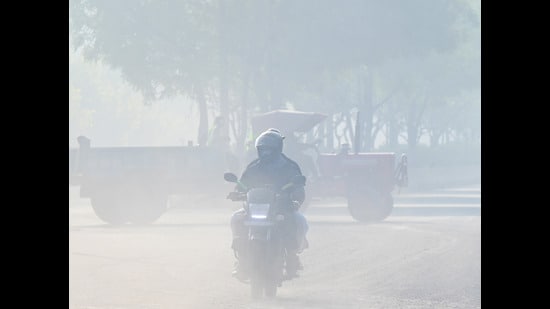
Months before Delhi enters its annual pollution season, the city government on Friday unveiled a winter air quality framework that could bring back a host of familiar restrictions – from doubled parking charges, and a ban on fuel sales to vehicles without valid pollution certificates, to curbs on out-of-state commercial vehicles, and staggered office timings and attendance — if pollution levels deteriorate later this year, the government announced on Friday.

The “Proactive Winter Air Quality Management Framework”, notified by the Delhi government, laid out measures that may be activated between November and February when air quality worsens and higher stages of the Graded Response Action Plan (GRAP) come into force.
Chief minister Rekha Gupta said the move is aimed at giving residents, businesses and government agencies advance notice of potential restrictions instead of announcing them only after pollution levels spike. The notified guidelines are expected to remain in force every year from November 1 to February 28 and will function as a supplementary framework to Grap.
“For the first time, months before winter, the government is clearly outlining what measures may be taken if pollution levels rise, what arrangements could be implemented and what different stakeholders will be expected to do,” Gupta said. “This will give citizens, resident welfare associations (RWAs), industries, commercial establishments, construction agencies and government departments adequate time to prepare.”
Every year, Delhi is engulfed in an annual spectre of pollution between November and February, with AQI levels often reaching “very poor” and “severe”.
Gupta said the government’s approach this year focuses on advance preparedness, timely interventions and better coordination rather than relying solely on emergency responses.
The framework, issued under the Environment (Protection) Act, 1986, will operate alongside the revised Grap notified by the Commission for Air Quality Management (CAQM).
Among the key measures that may be enforced is a restriction on fuel sales. Under the framework, petrol pumps in Delhi will supply fuel only to vehicles carrying a valid Pollution Under Control Certificate (PUCC).
Authorities also plan to bar the entry of non-BS-VI commercial vehicles registered outside Delhi between November 1 and January 31. Electric vehicles, CNG vehicles, emergency service vehicles and vehicles engaged in government work will be exempt.
To discourage excessive use of private vehicles, parking charges at authorised parking facilities will be doubled from November 1 to February 28.
The government also plans to introduce staggered office timings, under which government and private offices may be required to operate with only 50% physical attendance, while the remaining employees work from home. Essential and emergency services will remain exempt.
The framework places significant emphasis on controlling dust pollution, one of Delhi’s major pollution sources. Construction agencies and project operators have been advised to plan activities in advance to minimise dust generation during periods of poor air quality.
All construction and demolition activities between November 1 and January 31 will be required to comply with prescribed environmental and dust-control norms. Additional restrictions may be imposed between December 10 and January 20, a period the government expects to witness the most severe pollution levels, according to officials.
The government has also directed agencies to discourage the common practice of security guards and outdoor workers lighting fires for warmth during winter. Gupta said employers should instead make alternative heating arrangements available.
Environmental experts welcomed the advance planning but stressed that implementation would be critical. Sunil Dahiya, founder and lead analyst at Envirocatalysts, said the framework provides greater clarity on restrictions that may accompany various GRAP stages.
“Outlining measures nearly four months in advance is a welcome step because it gives stakeholders time to plan… However, previous years have shown that implementation and enforcement remain weak. The government must ensure that these measures are effectively enforced if they are to make a meaningful difference,” he said.